

Does your business need GEO now?
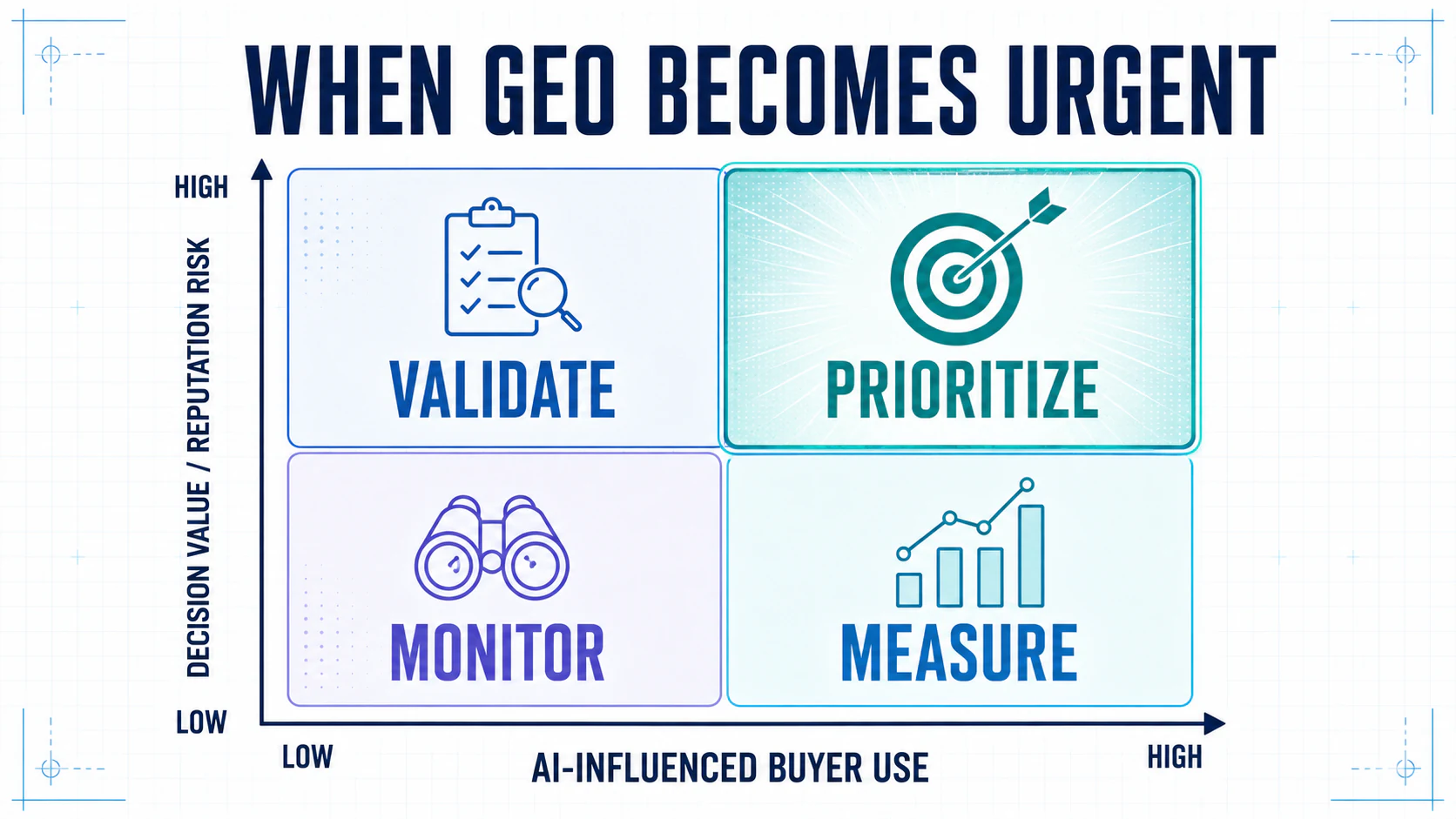
Your business needs a Generative Engine Optimization program now if buyers use generated search to understand your category, compare vendors, validate claims, or shortlist solutions—and you cannot currently measure how your brand appears in those answers.
That does not mean every company needs a large standalone GEO budget. For many teams, the right first step is a focused extension of existing SEO: establish a prompt baseline, fix access and factual inconsistencies, improve the most important source pages, and connect citations and referrals to analytics.
GEO is most urgent when a wrong or missing answer can change a high-value decision. It is less urgent when the audience rarely uses research-led search, the site is not yet technically sound, or the business lacks the source material needed to support its claims. Google's AI search guidance keeps the work grounded in core SEO, while OpenAI's publisher FAQ documents search discovery and ChatGPT referral tracking.
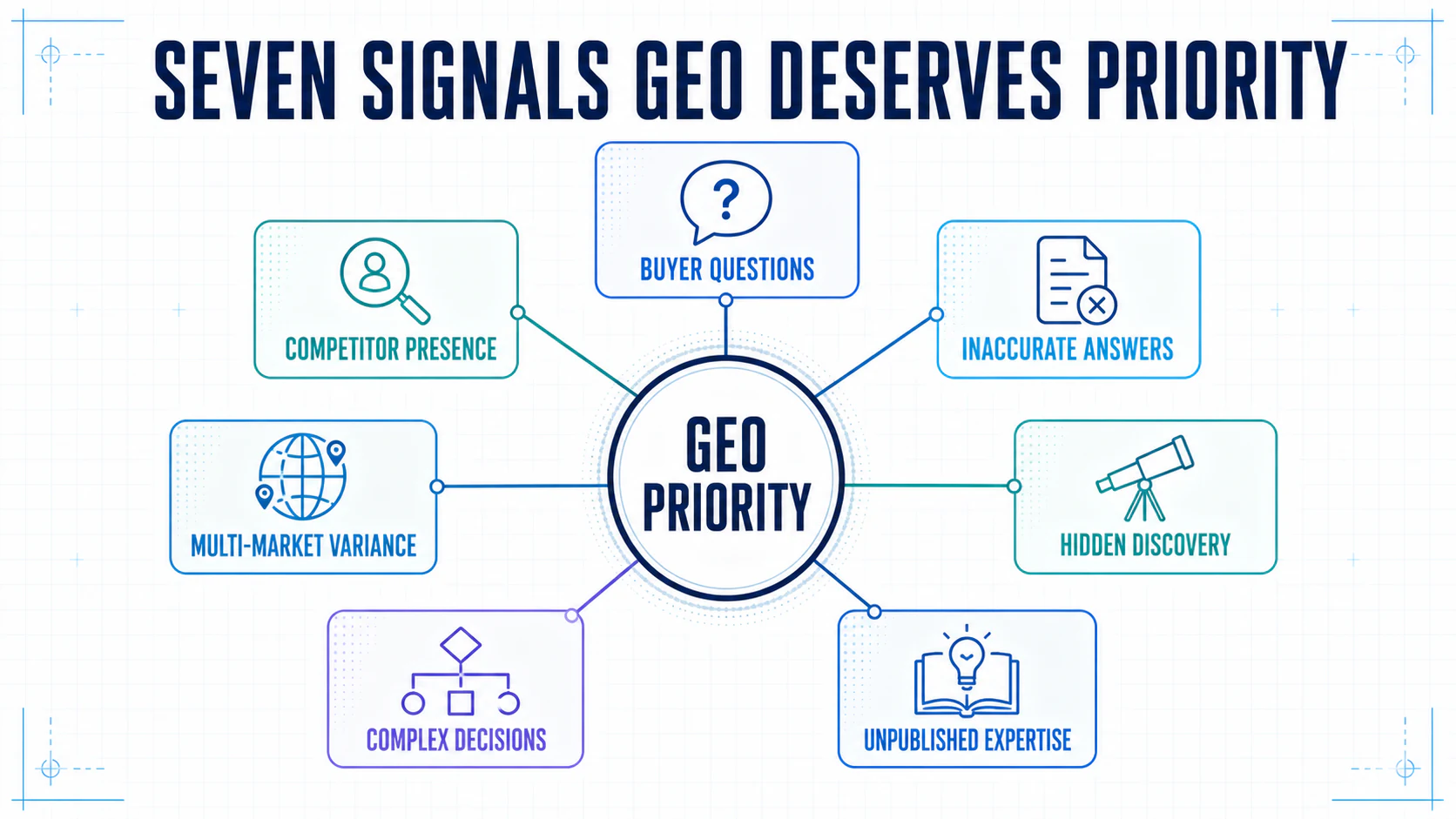
Seven signals that GEO deserves priority
1. Buyers ask AI systems category and vendor questions
Interview sales and support teams. Review customer calls, site search, community questions, and traditional search queries. If prospects ask “what is,” “which is best,” “X vs Y,” “how do I choose,” or “recommend a provider,” generated answers are likely part of the research surface.
Do not assume adoption from general market headlines. Test the actual questions and markets relevant to the business.
2. Competitors appear while your brand is absent
A repeated sample shows a strategic gap when competitors are consistently mentioned or cited for relevant decision prompts and your brand is not. The next question is diagnostic: do they have better source pages, clearer positioning, stronger third-party corroboration, better crawl access, or simply greater category relevance?
One screenshot is not enough. Use a fixed prompt cohort and repeat observations.
3. AI answers describe the business inaccurately
Wrong markets, outdated capabilities, old pricing, missing products, or confused brand relationships create a reputation and conversion risk. GEO includes correcting owned source facts, aligning credible external profiles, and publishing a canonical explanation that can be retrieved.
No outside consultant can force a model to update. The controllable work is to improve the evidence environment and measure whether answer accuracy changes.
4. Organic traffic no longer tells the full discovery story
A user can learn about a brand without clicking. Another may visit later through a direct or branded query. If reporting covers only last-click organic sessions, it misses mention and citation exposure as well as assisted journeys.
Google's dedicated Generative AI performance report in Search Console now provides Google-specific impressions and clicks for AI search experiences. It does not replace cross-platform monitoring: teams still need sampled answer visibility, AI referrals, landing pages, assisted conversions, and sales feedback to understand ChatGPT, Perplexity, and the wider journey.
5. The business has expertise that is not published
Sales engineers, consultants, support teams, and product leaders often answer valuable questions privately while the public site contains generic summaries. Turning that knowledge into cited definitions, implementation guides, benchmarks, and decision tools creates source value for people and retrieval systems.
6. The category is complex or high-consideration
B2B technology, professional services, enterprise software, industrial products, healthcare, finance, and cross-border purchases often require education and validation. Generated research can influence a shortlist long before a form submission.
The higher the decision value and the greater the information asymmetry, the more important factual accuracy and source presence become.
7. The business operates across languages or markets
AI visibility does not transfer automatically between English, German, Russian, or regional variants. Each market has different terminology, sources, competitors, and buyer concerns. A global brand needs native-language measurement and localized source content, not a global average.
What business risk does GEO address?
| Risk | GEO response | Evidence of progress |
|---|---|---|
| Brand absent from category answers | Improve source coverage and independent corroboration | Repeated mention and citation sample |
| Wrong brand facts | Align canonical facts and update sources | Accuracy audit over time |
| Competitors define the comparison | Publish an honest decision framework | Source and prompt coverage |
| Important pages cannot be retrieved | Fix crawling, rendering, indexing, and bot policy | Logs, index coverage, rendered tests |
| AI exposure is fragmented across reporting | Combine Google's generative AI report with prompt cohorts and referral classification | Stable cross-platform dashboard and methodology |
| Content repeats commodity summaries | Publish original evidence and expertise | New source assets and earned references |
| Markets receive inconsistent answers | Localize facts and measurement | Market-language cohorts |
GEO does not eliminate these risks. It creates a process to identify, reduce, and measure them.
What a credible GEO program includes
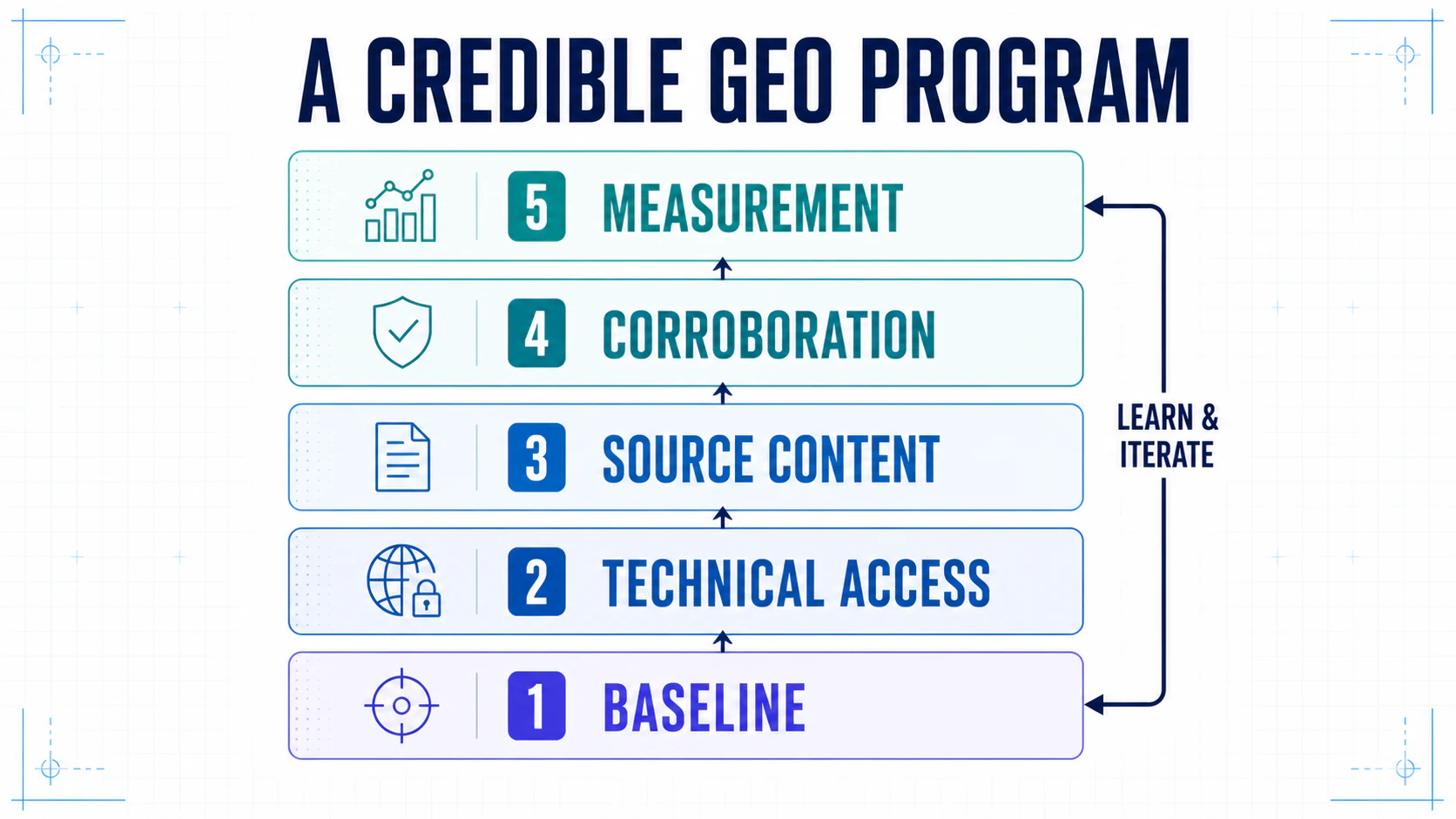
Baseline
- priority topics, prompts, markets, and competitors;
- repeated observations across relevant platforms;
- mentions, citations, prominence, accuracy, and sentiment classification;
- Google generative AI impression and click baseline where available;
- cross-platform prompt observations, AI referrals, and conversion baseline;
- documented measurement limitations.
Technical access
- crawl, render, index, canonical, and sitemap review;
- separate policy decisions for search crawlers, user-triggered fetchers, and training crawlers;
- CDN and WAF validation;
- server log and analytics checks;
- structured data that matches visible content.
Source content
- strong category hub and distinct supporting articles;
- direct definitions and decision criteria;
- first-party evidence with disclosed methods;
- current product, service, author, policy, and market facts;
- contextual primary-source citations;
- localization for priority markets.
Corroboration
- accurate company and professional profiles;
- expert contributions to relevant publications and communities;
- real customer proof and partner references;
- removal of contradictory or obsolete public information.
Measurement and experimentation
- frozen prompt cohorts and repetition rules;
- controlled release log;
- separate reporting for mentions, citations, referrals, conversions, and revenue;
- monthly or quarterly decision cadence;
- transparent reporting of uncertainty.
For a page-level starting point, use the GEO audit checklist.
What GEO should not include
Be cautious if a proposal centers on:
- guaranteed citations or “rank number one in ChatGPT”;
- bulk AI-generated pages with little original value;
- fake reviews, mentions, or forum participation;
- a special schema type that supposedly forces AI inclusion;
llms.txtpresented as a universal ranking factor;- proprietary scores without disclosed prompts or methodology;
- success measured only by screenshots;
- a fixed uplift claim with no baseline or market definition.
Google explicitly says its AI search features require no special schema or AI text files. OpenAI and Perplexity document crawler access, but access creates eligibility, not a guaranteed citation.
How to build the business case
1. Define the decision surface
Estimate which products, services, markets, and buyer questions matter most. GEO is not valuable merely because AI search exists; it is valuable where generated discovery overlaps with commercial decisions or reputation.
2. Quantify the current gap
Use a controlled cohort to measure:
- valid answers;
- brand and competitor mentions;
- owned and third-party citations;
- factual errors;
- AI referral sessions;
- related qualified conversions.
The baseline can justify a small pilot without pretending to know the total market volume.
3. Price the controllable work
Scope technical fixes, source assets, localization, authority work, monitoring, and analytics. Do not price an external platform outcome as if it were deliverable.
4. Define leading and lagging indicators
Leading indicators:
- crawl access and index eligibility;
- source content published;
- factual consistency;
- prompt coverage;
- mentions and citations in the sample.
Lagging indicators:
- qualified AI referrals;
- branded demand;
- assisted opportunities;
- pipeline and revenue under a stated attribution model.
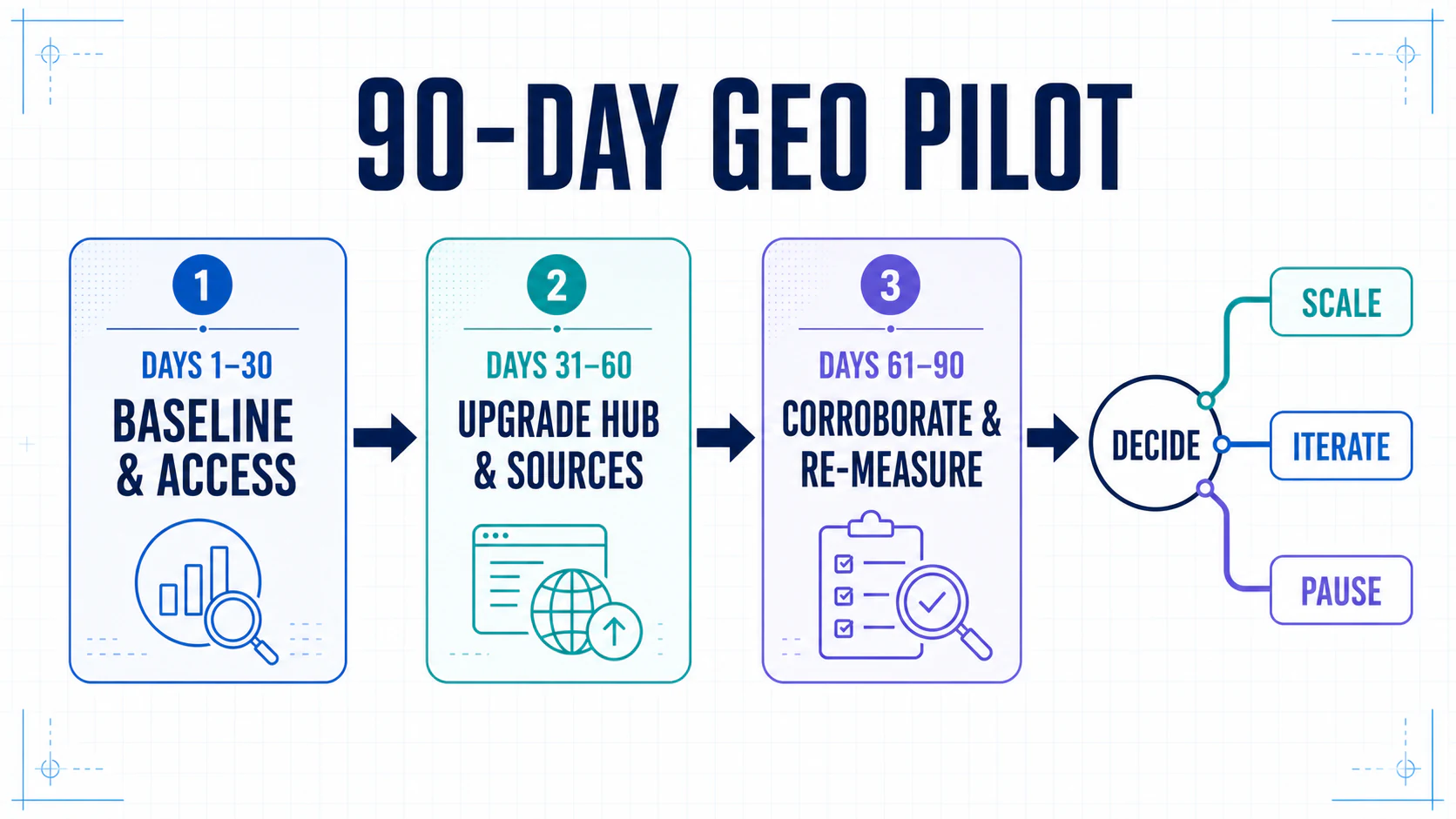
5. Run a 90-day pilot
Choose one category and market. Establish a baseline, repair technical access, upgrade one hub, publish two or three source assets, earn relevant corroboration, and repeat the measurement after crawl and index processing.
The pilot should answer whether the organization can improve evidence and observe meaningful change—not promise final market dominance in three months.
A simple GEO investment score
Rate each factor from 0 to 2:
| Factor | 0 | 1 | 2 |
|---|---|---|---|
| Buyer use | Rare or irrelevant | Plausible | Observed in research or sales |
| Decision value | Low | Moderate | High-value or high-risk |
| Current gap | Brand already accurate and present | Mixed | Consistently absent or wrong |
| Source advantage | Little unique evidence | Some expertise | Strong original data or authority |
| Technical readiness | Major SEO blockers | Partial | Crawlable, indexable, measurable |
| Measurement readiness | No analytics | Basic | Prompt, referral, and CRM capability |
A high score supports an immediate pilot. A low technical-readiness score suggests fixing SEO foundations first. A low source-advantage score suggests customer research and expert-content development before tool spending.
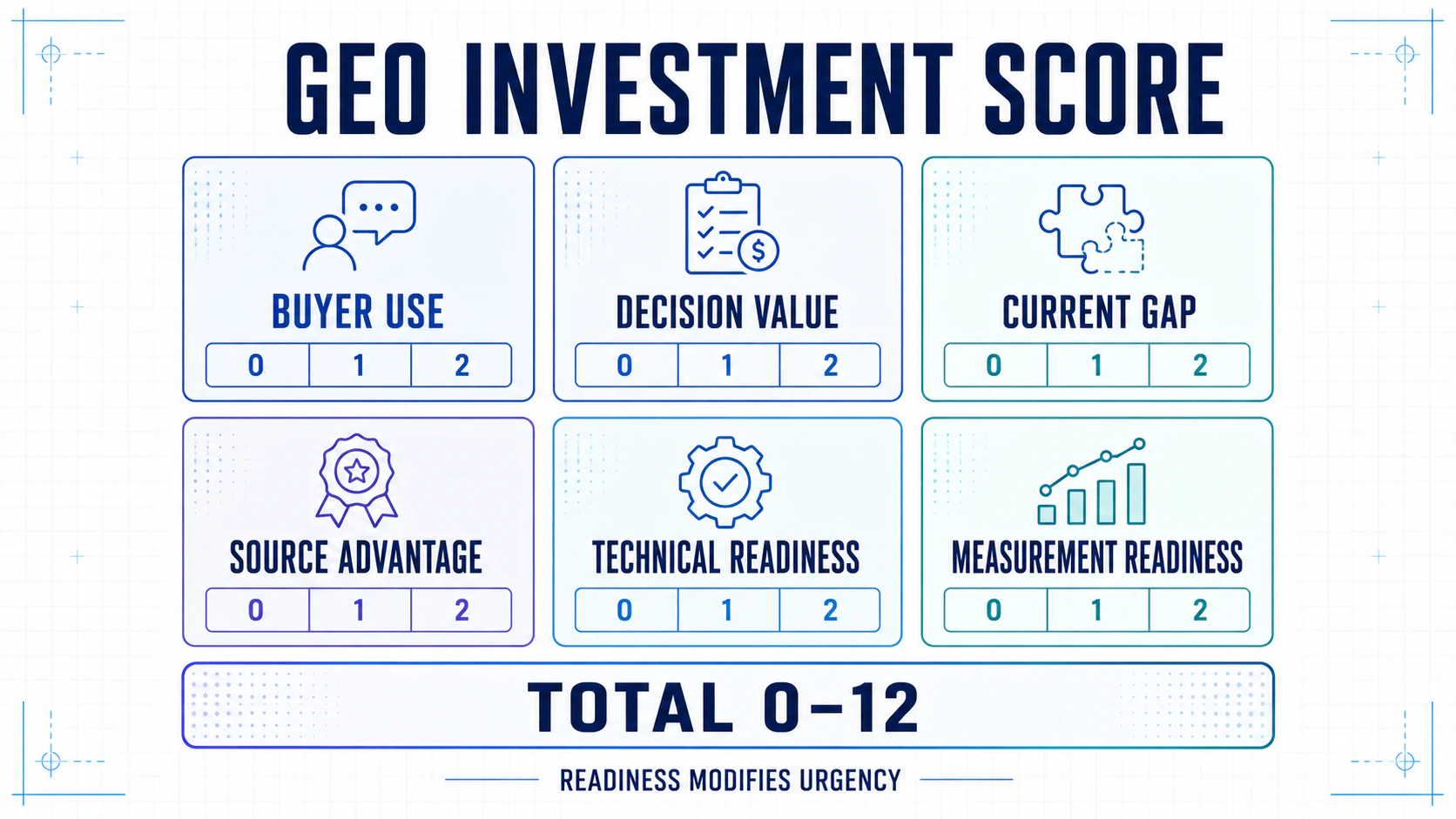
Decision artifact: Download the GEO investment scorecard (CSV). Score each factor from 0 to 2, record the evidence behind the score, and assign the next action before discussing budget.
When to delay a GEO program
Delay a standalone program when:
- the core site is blocked, unstable, or not indexable;
- positioning and product facts are still unresolved;
- there is no owner for content accuracy;
- the team cannot measure even basic traffic and conversion;
- the audience's use of generated search is untested;
- the proposal would divert resources from a higher-confidence customer problem.
“Delay” does not mean ignore. Capture a small baseline and revisit it after the foundation improves.
The practical reason to start now
The strongest reason to begin GEO is not fear of losing all search traffic. It is the opportunity to understand a discovery surface already influencing some buyers, correct inaccurate narratives, publish expertise that was previously hidden, and connect answer visibility to real outcomes.
Start small and measurable. Extend the SEO program, publish source-worthy material, observe how systems use it, and invest further only when the evidence supports it. The future of search guide explains the broader transition; our GEO service scopes the technical, editorial, and measurement work as one program.