

What is the difference between SEO, AEO, GEO, and LLMO?
SEO improves qualified visibility in search systems. AEO makes an answer easy to locate, understand, and reuse. GEO studies and improves how a brand or source appears in generated responses. LLMO is the least standardized label: it can mean public LLM discovery, model/data work, or optimization of an owned retrieval system.
They are not four independent acquisition channels. In most organizations, they are four lenses on the same content, technical platform, reputation, and measurement system.
Google now makes this especially plain. Its 2026 guidance for generative AI features defines AEO and GEO as market terms, then says that from the perspective of Google Search, the work is still SEO. AI Overviews and AI Mode use Search infrastructure, ranking systems, quality systems, and indexed pages. That does not make cross-platform observation irrelevant; it means the foundation did not disappear when the interface changed.
The practical conclusion is simple:
Keep one shared search program. Use the acronyms to name a target and a missing capability—not to fund four disconnected backlogs.
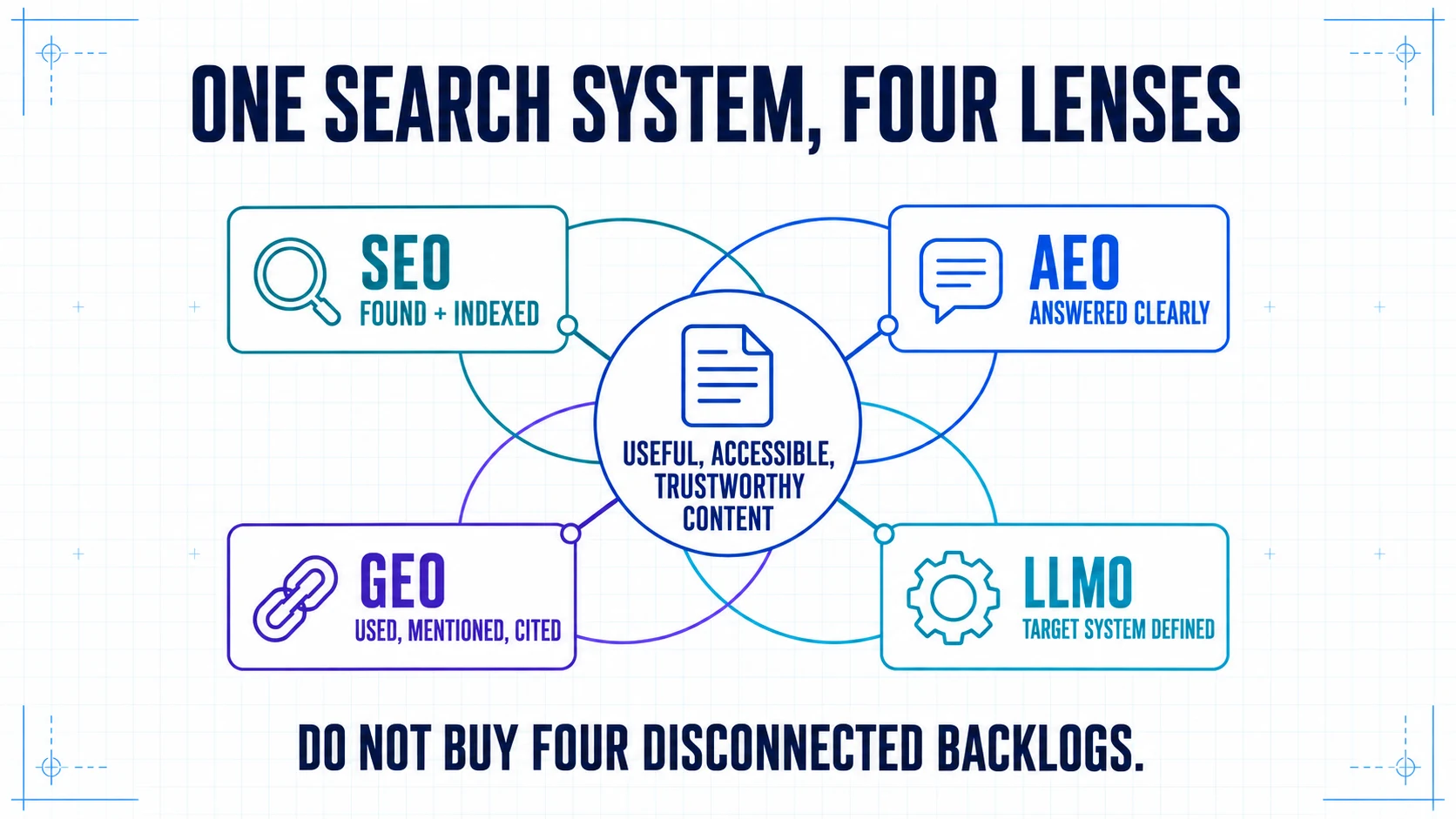
The 2026 comparison at a glance
The definitions below are operational definitions, not universal standards. That caveat matters because the current search results contain mutually incompatible glossaries: some sources treat AEO, GEO, and LLMO as synonyms; others draw rigid boundaries that the platforms themselves do not use.
| Lens | Primary target | Main intervention | Observable evidence | Business outcome |
|---|---|---|---|---|
| SEO | Search results and the systems that produce them | Crawlability, indexation, relevance, page experience, content, links, reputation | Eligible/indexed pages, impressions, rankings, clicks | Qualified organic visits, leads, sales, reduced acquisition cost |
| AEO | Direct-answer experiences, including snippets, help systems, voice, and generated answers | Clear definitions, scoped claims, steps, tables, concise answer blocks, supporting detail | An answer is extracted, displayed, or successfully resolves the task | Faster evaluation, self-service success, assisted conversion |
| GEO | Generated responses and their supporting sources | Prompt research, source-led publishing, entity accuracy, access review, citation and mention monitoring | Brand mention, linked citation, source coverage, answer accuracy | Influence during discovery, qualified referrals, pipeline assistance |
| LLMO | A named LLM-based system—public or owned | Depends on the system: GEO/AEO, feeds, retrieval, data quality, evaluation, fine-tuning, or RAG engineering | Platform-specific retrieval, answer quality, task success, or visibility | Discovery, internal productivity, support quality, product adoption, or another declared result |
No row provides a guaranteed placement. Eligibility is not retrieval; retrieval is not a mention; a mention is not necessarily a citation; a citation is not a visit; and a visit is not revenue.
Use an acronym decoder before approving a scope
When someone proposes “GEO,” “AEO,” or “LLMO,” translate the proposal into four fields:
- Target surface: Where must the change appear—Google Search, Google AI Mode, ChatGPT Search, Perplexity, an internal assistant, or an agentic product flow?
- Intervention: What will the team actually change—content, templates, crawler controls, structured data, third-party corroboration, a feed, retrieval configuration, or model evaluation?
- Observable: What can be measured directly—indexation, generated impressions, a sampled mention, a linked citation, a referral, task accuracy, or retrieval success?
- Business outcome: What decision should improve—qualified discovery, conversion, support resolution, sales-cycle velocity, or internal productivity?
For example, “improve our GEO” is not a scope. “Increase accurate source visibility for 40 European procurement questions in Google AI Mode and ChatGPT Search, while measuring linked citations, qualified referrals, and assisted opportunities” is closer. It names surfaces, a question set, evidence, and a commercial destination without guaranteeing selection.
Use our downloadable GEO–AEO–LLMO–SEO operating brief to document these fields, crawler decisions, metrics, owners, and a 90-day backlog.
What is SEO in 2026?
Search Engine Optimization remains the work of making useful resources accessible, understandable, competitive, and measurable in search. It includes technical SEO, information architecture, content, internal linking, reputation, supported structured data, page experience, and conversion measurement.
That definition already covers much of the work now sold under newer acronyms. Google says a page must be indexed and eligible to appear with a snippet before it can appear as a supporting link in AI Overviews or AI Mode. Its generative features can use query fan-out—running multiple related searches across subtopics and data sources—then assemble a response with supporting links. Search eligibility and content quality remain upstream of that experience.
SEO should be the first workstream when:
- important pages are not crawled, rendered, indexed, or canonicalized correctly;
- architecture and internal links hide useful resources;
- content misses established demand or repeats commodity summaries;
- reputation and independent corroboration are weak;
- analytics cannot connect organic discovery to qualified outcomes.
SEO is broader than “ten blue links,” but it is not a guarantee of inclusion in every answer interface.
What is AEO?
Answer Engine Optimization is an editorial and information-design lens. It asks whether a person—or a system assisting that person—can locate a correct, bounded answer quickly and still inspect the evidence and context behind it.
Good AEO usually looks unglamorous:
- answer the main question before the long history lesson;
- define important terms without circular language;
- use a sequence for a process and a table for a genuine comparison;
- put conditions, exceptions, units, markets, and dates beside the claim they qualify;
- cite the primary source rather than a chain of summaries;
- keep enough context that an extracted passage does not become misleading;
- give the reader a useful next step after the short answer.
AEO is not a mandate to turn every heading into a question, force every answer into 40 words, or publish hundreds of near-duplicate FAQ pages. Google explicitly says there is no need to create AI-specific text fragments, rewrite content solely for generative systems, or add special AI schema. Clear writing helps because ambiguity falls—not because a secret format has been satisfied.
Prioritize AEO when the correct information exists but is buried, vague, unscoped, inconsistent, or difficult to compare.
What is GEO?
Generative Engine Optimization focuses on how organizations, claims, and sources appear inside generated responses. The 2024 GEO research paper helped formalize the term and proposed ways to measure source visibility. It is useful research context, not a universal list of ranking factors for every commercial engine.
Operational GEO adds capabilities that conventional rank tracking does not fully provide:
- question-journey research: stable cohorts of discovery, comparison, constraint, and decision questions;
- answer observation: repeated, timestamped samples by platform, market, language, account state, and device where relevant;
- source analysis: which pages and domains support an answer, and which information need each source satisfies;
- entity accuracy: whether names, capabilities, locations, prices, policies, and relationships are represented correctly;
- source-led publishing: original evidence, named expertise, methods, comparisons, implementation detail, and current facts;
- business linkage: citations and mentions connected cautiously to referrals, assisted journeys, qualified pipeline, and revenue.
GEO does not override the platform's decision to retrieve, synthesize, cite, or recommend. It creates a disciplined way to improve source quality and observe outcomes without pretending the answer is controllable.
Our evidence-based GEO strategy guide explains the publishing and experimentation layer; the GEO audit checklist turns it into a repeatable assessment.
What is LLMO?
Large Language Model Optimization is the broadest and least stable term in the group. In one proposal it may mean GEO for public assistants. In another it may cover training-data permissions, product feeds, retrieval configuration, evaluations, fine-tuning, knowledge graphs, or an enterprise RAG system.
These are not interchangeable projects:
- Public LLM discovery concerns external interfaces such as ChatGPT Search and usually overlaps with GEO, AEO, SEO, digital PR, and brand monitoring.
- Owned RAG optimization concerns document ingestion, chunking, metadata, permissions, retrieval, reranking, grounding, and answer evaluation inside a system the organization controls.
- Model optimization may concern training, fine-tuning, prompts, tools, safety, latency, or cost. Search visibility might not be an objective at all.
- Agent readiness may concern authenticated APIs, product data, policies, actions, and reliable machine-readable state—not merely public webpages.
Before purchasing LLMO, require the provider to name the system, data boundary, controllable intervention, evaluation set, metric, and accountable owner. “Make every model recommend us” is not an executable scope.
What actually changes in 2026?
The foundation—technical accessibility, useful information, reputation, and measurement—stays. Five operating assumptions do change.
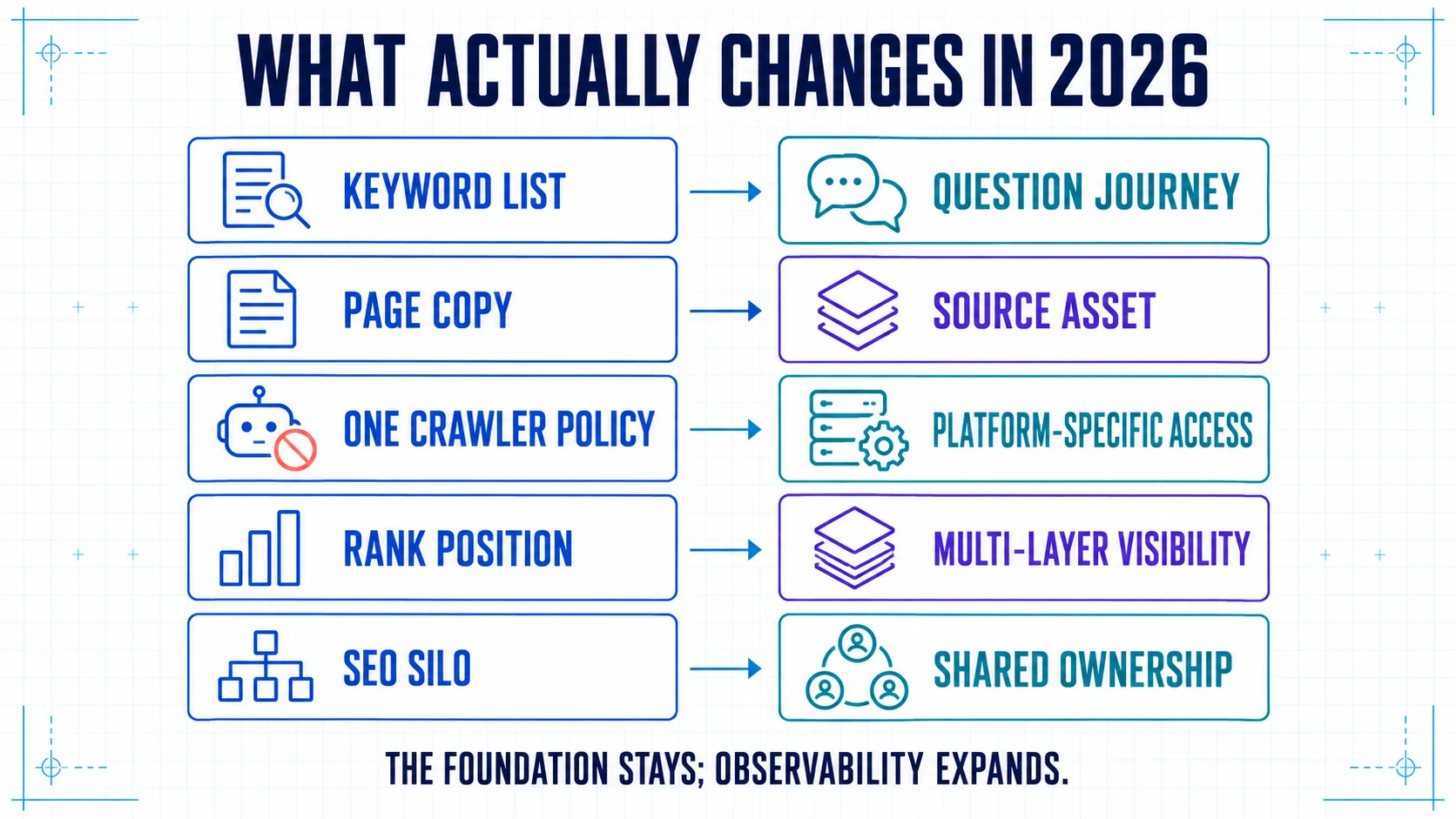
1. Keyword lists become question journeys
A buyer rarely asks only one isolated question. They move from definition to comparison, constraints, evidence, implementation, risk, and next step. Google documents query fan-out for its generative features: a single query can trigger multiple related searches to develop a response.
That makes topic coverage more strategic than manufacturing a page for every phrase. Map the journey, decide which information needs deserve their own durable resource, and connect them through useful internal links.
A useful 2026 fact: one visible prompt can produce several hidden searches. The user sees one question; the retrieval system may explore evidence, alternatives, constraints, and next actions before composing the response.
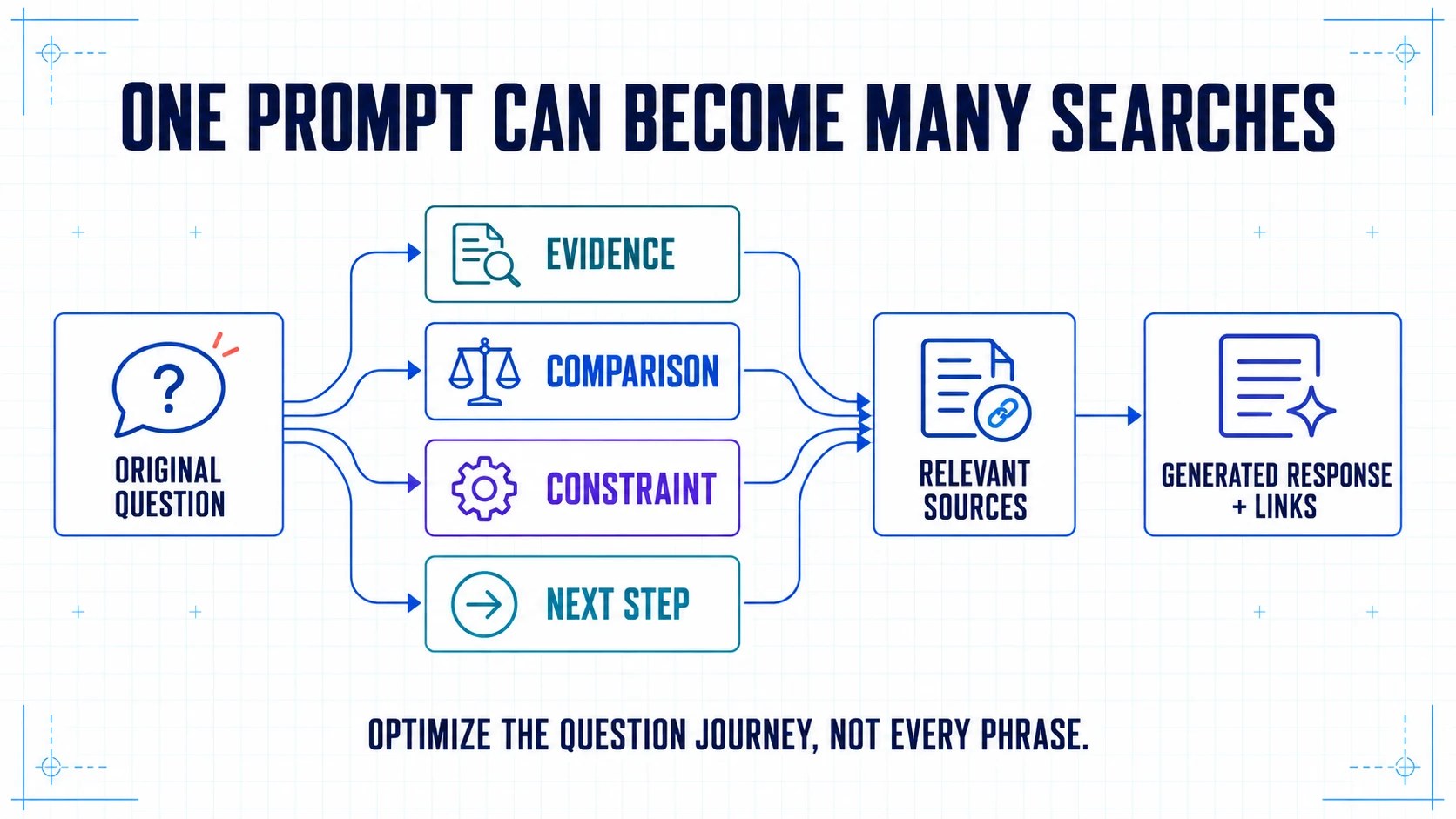
This does not justify guessing thousands of hidden queries. It justifies stronger information architecture and source assets that resolve adjacent decisions.
2. Page copy becomes a source asset
A page can rank and still be a weak source. Generated responses increase the value of material that can be checked and attributed:
- original research with sample, date, method, and limitations;
- product or service facts with clear market and version scope;
- named expert analysis and implementation lessons;
- comparison criteria that explain why a choice changes;
- examples, calculations, diagrams, and reproducible procedures;
- maintained reference pages with visible update history.
The goal is not “citation bait.” It is to publish the best inspectable evidence for a real decision. Our guide to source-led publishing and AI citations covers the editorial workflow in depth.
3. One crawler assumption becomes platform-specific access
Crawler names describe different purposes. Do not collapse search surfacing, potential training, and user-initiated fetching into one “AI bot” switch.
| Operator | Documented token | Documented role | What the control does not prove |
|---|---|---|---|
Googlebot and ordinary Search controls | Discovery and indexation for Search; indexed, snippet-eligible pages can support generative features | Inclusion in an AI Overview or AI Mode response | |
| OpenAI | OAI-SearchBot | Surfacing sites in ChatGPT search results | Training permission or guaranteed citation |
| OpenAI | GPTBot | Potential use in foundation-model training | ChatGPT Search eligibility |
| OpenAI | ChatGPT-User | User-initiated visits/actions; not an automatic crawler | A general Search opt-out mechanism |
| Perplexity | PerplexityBot | Surfacing and linking sites in Perplexity search results; not foundation-model training | Selection or recommendation |
| Perplexity | Perplexity-User | User-requested page fetching; not automatic crawling | Continuous discovery or training use |
Review robots.txt, meta robots, X-Robots-Tag, authentication, CDN/WAF behavior, rendering, and server logs according to the named platform and business policy. Access creates a precondition, not an outcome. The AI crawler access guide provides a fuller audit method.
4. Rank and traffic become a measurement ladder
AI visibility has several layers. Each answers a different question and needs different evidence.
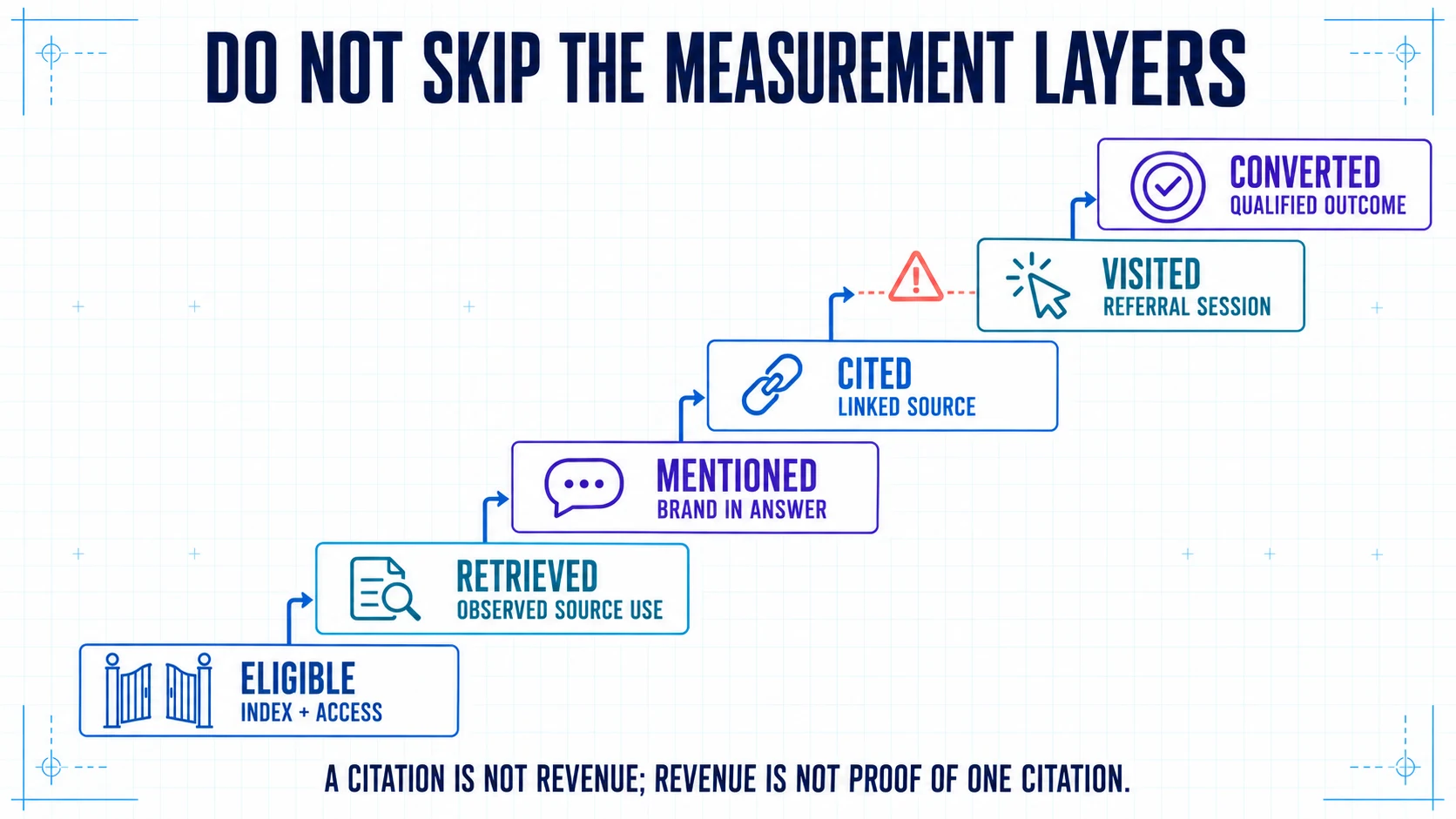
| Layer | Question | Example evidence |
|---|---|---|
| Eligible | Could the system access and consider the page? | Index coverage, robots test, logs, snippet eligibility |
| Retrieved | Was the source observed in the answer workflow? | Linked source, platform report, reproducible observation |
| Mentioned | Did the response name the brand, product, expert, or concept? | Timestamped prompt sample with answer capture |
| Cited | Did it provide a navigable source reference? | Cited URL, citation position, source coverage |
| Visited | Did a person arrive from the experience? | Referral/session evidence with landing page and quality signals |
| Converted | Did the journey produce a qualified business event? | Lead, sale, opportunity, revenue, or assisted-conversion record |
On August 31, 2026, Google rolled out a dedicated Generative AI performance report in Search Console. It reports impressions from AI Overviews and AI Mode and can be broken down by pages, countries, dates, and devices. This is a meaningful observability improvement, but it is not a complete cross-platform citation or revenue report. The data also remains included in the broader Web totals, so teams should avoid double-counting.
For a full measurement design, use our guide to mentions, citations, share of voice, and revenue.
5. The SEO silo becomes shared ownership
An integrated program usually crosses:
- SEO and engineering for crawling, rendering, indexation, templates, logs, and performance;
- editorial and subject-matter experts for evidence, accuracy, methods, and maintenance;
- PR and brand teams for credible third-party corroboration and entity consistency;
- analytics and revenue operations for referrals, assisted journeys, pipeline, and attribution limits;
- legal, security, and data owners for crawler, training, licensing, and privacy decisions;
- product/data teams when feeds, APIs, agents, or owned RAG systems are in scope.
The answer is not a committee for every heading. It is one accountable owner, named contributors, a shared evidence model, and explicit decision rights.
What work is shared, and what is genuinely distinct?
The shared backlog
Most value sits in work that benefits several surfaces at once:
- resolve crawling, rendering, canonical, and indexation defects;
- clarify information architecture and internal links;
- publish accurate, differentiated, expert-led resources;
- keep visible facts and supported structured data consistent;
- maintain authorship, dates, methods, and primary-source references;
- earn relevant independent coverage rather than manufactured mentions;
- connect visibility observation to analytics and commercial outcomes.
Distinct AEO work
AEO adds answer-quality reviews: directness, extraction safety, structure, definitions, comparison logic, exception handling, and useful next steps.
Distinct GEO work
GEO adds sampled prompt cohorts, platform-by-platform answer capture, source and entity analysis, citation monitoring, competitive source gaps, and re-testing after meaningful changes.
Distinct LLMO work
LLMO becomes distinct when the scope includes an owned system or data relationship: ingestion, permissions, retrieval, reranking, evaluation sets, tools, feeds, fine-tuning, or agent actions. Those deliverables belong to product and engineering as much as marketing.
Which workstream should come first?
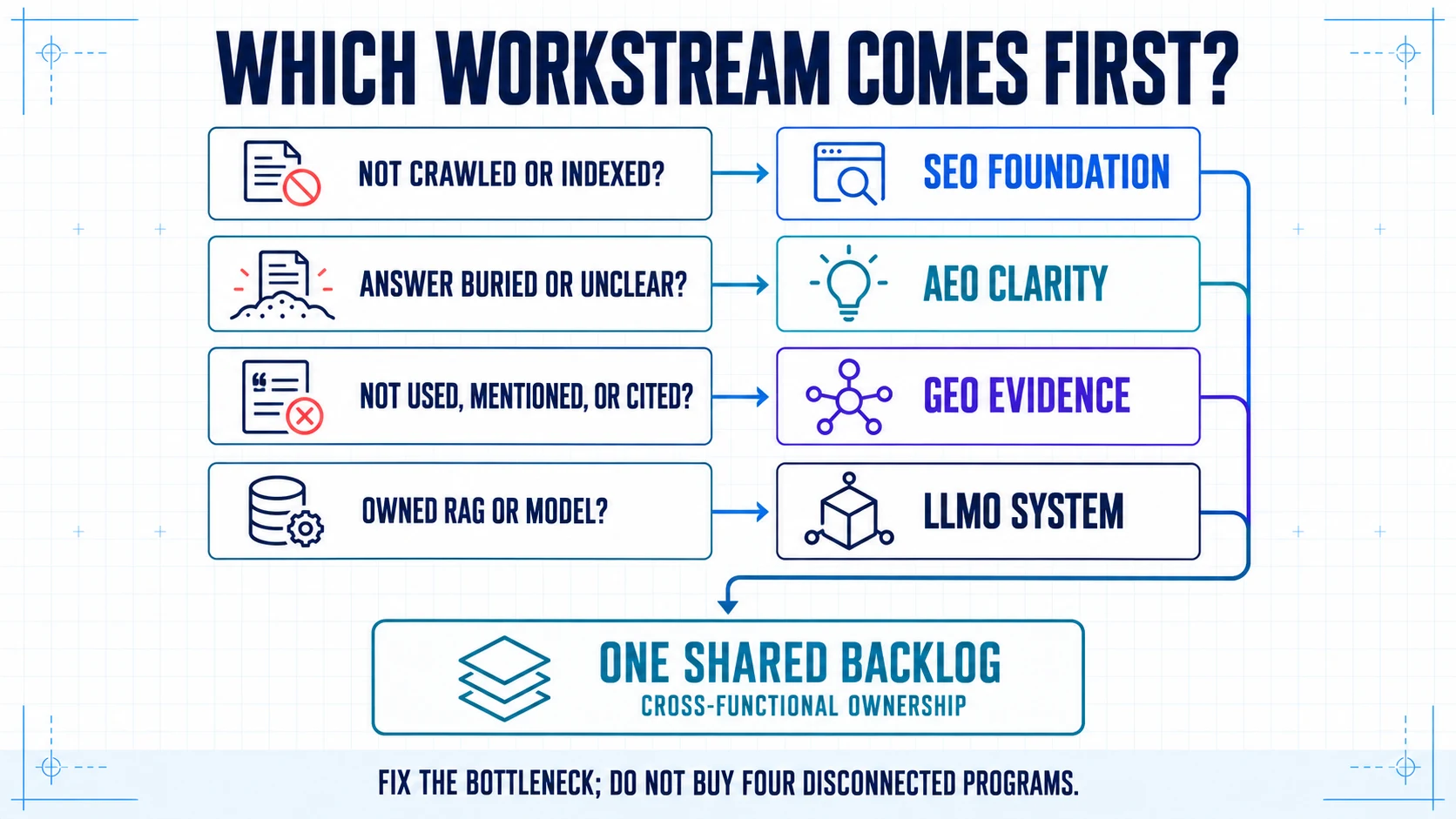
Use the first proven bottleneck:
- Not crawled or indexed? Start with the SEO foundation. Prompt monitoring cannot compensate for an unavailable source.
- Correct answer exists but is buried or unclear? Add AEO editing and information design.
- Eligible sources are not used, mentioned, or cited for commercially important questions? Add GEO observation, source-gap analysis, and evidence-led publishing.
- The target is an owned RAG system, model, feed, or agent? Define an LLMO product/engineering scope and evaluation set.
Several tracks can run together, but priority should still follow evidence. Fixing a proven indexation fault is usually more defensible than generating another 500 speculative “AI-optimized” articles.
A practical 90-day operating model
Days 1–30: define and baseline
- Name the platforms, markets, languages, audience, and business decisions in scope.
- Build a balanced cohort of discovery, comparison, constraint, and decision questions.
- Audit search eligibility, relevant crawler controls, rendering, indexation, analytics, and server evidence.
- Capture a timestamped baseline of answers, brands, sources, citations, landing pages, and factual errors.
- Identify the pages and third-party sources that already influence those answers.
Days 31–60: fix and publish
- Repair access, indexing, template, structured-data, and measurement defects.
- Improve answer clarity on high-value existing pages before creating net-new URLs.
- Publish one or two differentiated source assets with named expertise, method, scope, and limitations.
- Correct inconsistent entity and product facts across owned surfaces.
- Coordinate relevant outreach when independent expert coverage would help the audience verify a claim.
Days 61–90: re-test and decide
- Repeat the same prompt cohort under documented conditions.
- Separate answer volatility from consistent directional change.
- Inspect citations and landing-page quality, not just brand mentions.
- Connect referral and assisted-conversion evidence without claiming deterministic attribution.
- Keep, revise, or stop each intervention based on evidence and cost.
- Turn recurring findings into editorial, engineering, and governance standards.
Common mistakes and sales red flags
- Guaranteed citations or a “number-one ChatGPT ranking.” Generated answers vary and platforms control selection.
- A proprietary visibility score presented as platform truth. Require the prompts, sampling design, calculation, markets, and limitations.
- Fixed uplift claims without a baseline. A percentage without sample, denominator, time window, and method is decoration.
llms.txtsold as a Google AI ranking factor. Google states that it ignores the file for Search.GPTBotdescribed as the ChatGPT Search crawler. OpenAI documentsOAI-SearchBotfor search andGPTBotfor potential training; their controls are independent.- Special “AI schema.” Google says no special structured data is required for its generative features. Use supported Schema.org vocabulary that matches visible content.
- Mass-produced pages for every prompt variation. Google warns against scaled, low-value production; query fan-out also makes literal phrase coverage a poor operating model.
- A mention counted as a citation, or a citation counted as revenue. Preserve the measurement layers.
- LLMO with no named system. If the provider cannot identify the model/interface, data boundary, intervention, and evaluation, the scope cannot be governed.
- Four vendors editing the same pages to four different playbooks. Consolidate shared work and make platform-specific experiments explicit.
Frequently asked questions
Is GEO replacing SEO?
No. GEO adds generated-answer observation, source analysis, and cross-platform measurement to work that still depends heavily on search accessibility, content quality, authority, and technical foundations. Google explicitly treats AEO and GEO work for its Search features as SEO.
Are AEO and GEO the same?
They overlap. AEO focuses on answer clarity and task resolution. GEO focuses on presence, source use, citations, and accuracy inside generated responses. One strong explanatory page can support both, but the audits and measurements differ.
Is LLMO a better term than GEO?
Only when it clarifies a broader system. LLMO is useful for a scope involving owned retrieval, model evaluation, data, feeds, or agents. For public generated-answer visibility, GEO is usually the clearer label.
Do we need special schema for AI search?
No special AI schema is documented by Google. Use supported structured data when it accurately represents visible content and qualifies for a relevant search feature. Schema is a clarification mechanism, not a citation switch.
Does allowing an AI crawler guarantee a citation?
No. Access can support eligibility. Retrieval, synthesis, citation, and ranking remain separate platform decisions.
Can AI visibility be measured reliably?
It can be measured responsibly, not perfectly. Use stable prompt cohorts, repeated observations, declared environments, page-level source evidence, platform reports where available, analytics, and qualified business outcomes. Report uncertainty and avoid treating one generated answer as a rank position.
Bottom line
SEO is the foundation and the broadest public-search discipline. AEO is the clarity and answer-design lens. GEO adds generated-response research, source visibility, accuracy, and measurement. LLMO is useful only when it names a wider, specific LLM system and its controllable inputs.
What actually changes in 2026 is not the need for excellent SEO. Teams now need to map question journeys, publish inspectable source assets, govern crawler purposes separately, measure several visibility layers, and share ownership across search, editorial, engineering, analytics, PR, product, and data.
Start with the bottleneck you can prove. Keep one backlog. Measure the layer you claim to improve.
Research method and primary sources
We reviewed the leading non-social Google results for the comparison intent on September 8, 2026, then checked terminology and technical claims against current platform documentation and primary research. Search results are a time- and location-sensitive snapshot; market definitions are not standards. The operational framework above is ours, designed to make scopes and measurements testable.
- Google: Optimizing for generative AI features
- Google: AI features and your website
- Google Search Console: Generative AI performance report
- Google: Guidance on third-party SEO tools and advice
- OpenAI: Overview of OpenAI crawlers
- Perplexity: Crawler documentation
- GEO: Generative Engine Optimization research paper
- Schema.org: How the vocabulary is versioned