

What does it mean to integrate AI citations into content?
Integrating citations means connecting a factual claim to a source a reader can inspect, while clearly separating sourced facts, your analysis, and your original evidence. In AI-search work, this has two benefits: it makes the page more trustworthy for people and gives retrieval systems a cleaner evidence trail to evaluate.
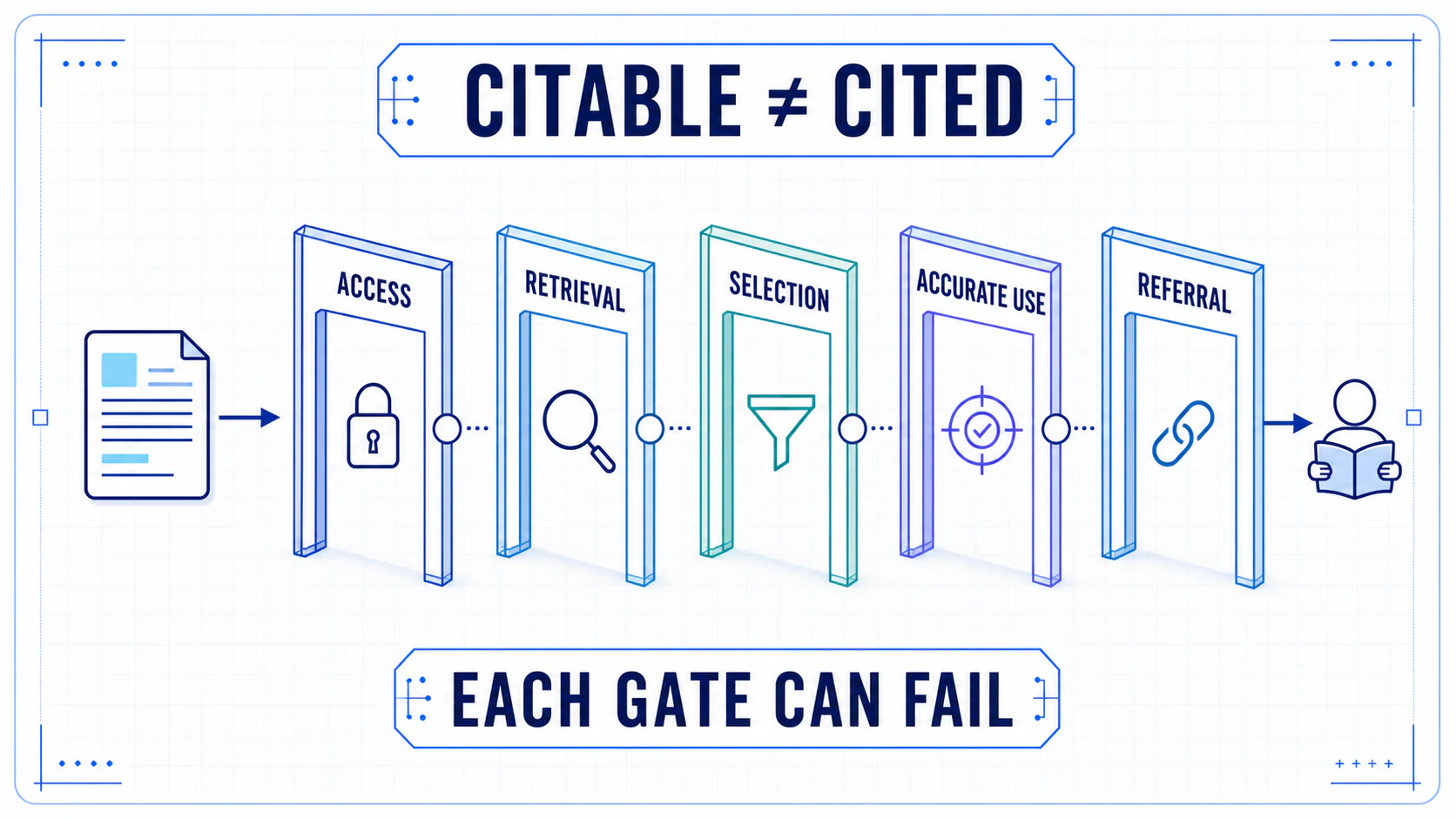
It does not guarantee that ChatGPT, Google, Perplexity, or another system will cite the page. Citation selection depends on the query, crawl and index access, retrieval, platform design, competition, freshness, and the specific answer run. The goal is verifiability and source value—not a mechanical “citation score.”
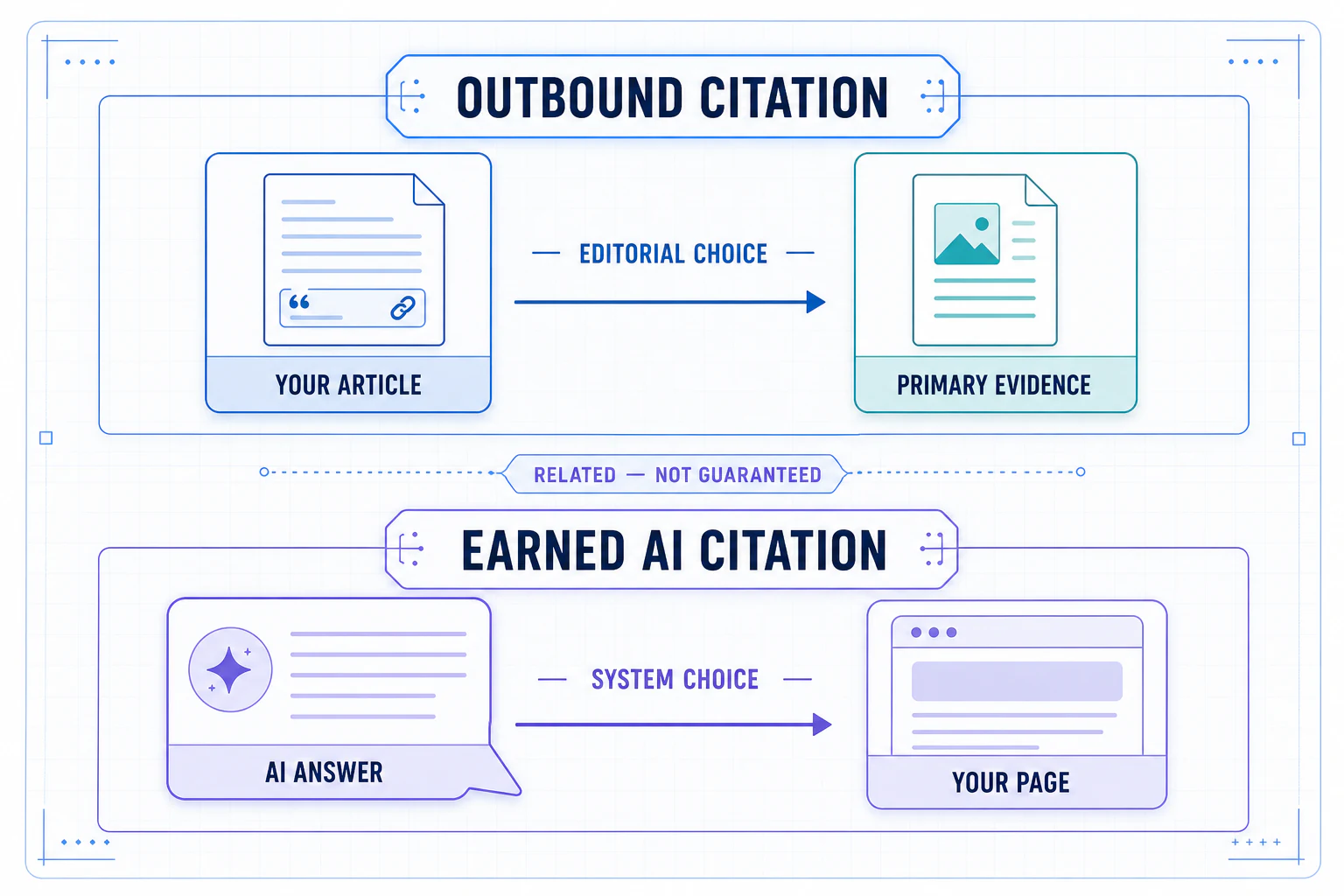
Two types of citation matter
Teams often mix two distinct activities:
- Outbound citation practice: your article links to the primary evidence behind a claim.
- Earned AI citation: an AI-search experience selects your page as a source for its generated answer.
Strong outbound sourcing can improve editorial trust and help readers validate a statement. It does not automatically produce an earned citation. Your page also needs something worth sourcing: a clear explanation, original finding, comparison, method, dataset, or accurate synthesis that answers the query better than alternatives.
Google's people-first content guidance asks whether content offers original reporting or analysis, provides clear sourcing, and shows who created it. That is a useful editorial standard even beyond Google.
10 best practices for citation-led content
1. Cite the claim, not the paragraph topic
Place the link immediately after the sentence or table cell it supports. A source link at the end of a long section leaves the reader guessing which statements it proves.
Weak:
Structured data guarantees AI visibility and increases CTR. Read Google's documentation.
Better:
Google says valid structured data can make a page eligible for supported search features, but it does not guarantee that a rich result will appear. Google structured-data guidelines
The second version narrows the claim to what the source actually establishes.
2. Prefer the closest primary source
Use the organization responsible for a platform, standard, law, product, dataset, or study whenever it publishes the relevant information.
| Claim | Preferred source |
|---|---|
| Google crawler or structured-data behavior | Google Search Central documentation |
| ChatGPT Search discovery controls | OpenAI publisher or crawler documentation |
| Core Web Vitals definitions | Chrome or Google Search documentation |
| A regulation | Official legal text or regulator |
| Software behavior | Maintainer documentation or repository |
| Research finding | Original paper and, when available, dataset |
A secondary explainer can add interpretation, but it should not replace an accessible primary source for a precise or changing fact.
3. Match the strength of the language to the evidence
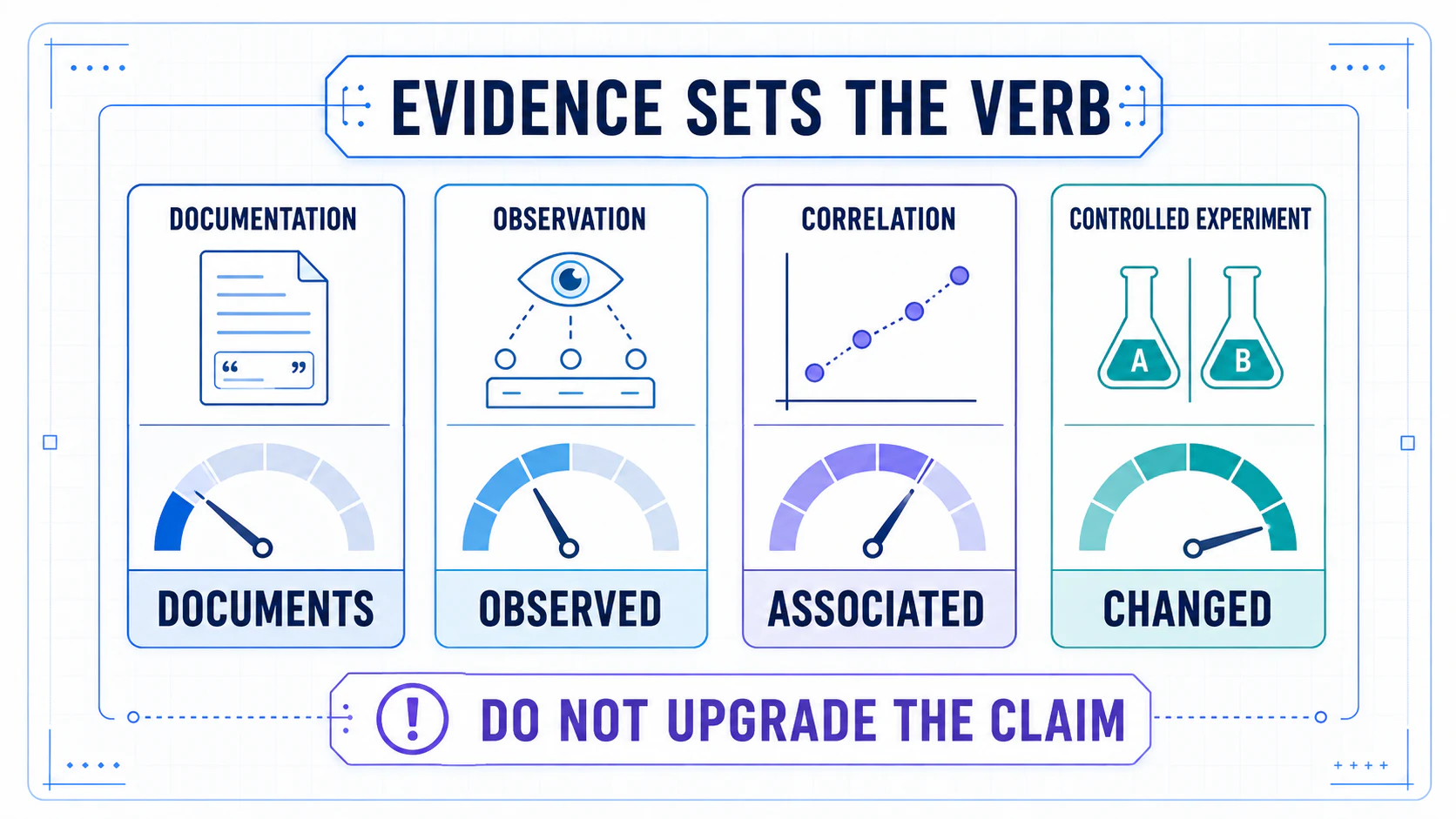
Use “documents,” “reports,” or “observed in this sample” when that is what the source supports. Reserve causal language for designs that can establish causality.
Examples:
- Documentation: “OpenAI documents
OAI-SearchBotas a control for ChatGPT Search discovery.” - Observation: “In our fixed prompt cohort, citation coverage increased from X to Y after the release.”
- Correlation: “Pages with this characteristic were associated with higher citation frequency in the study sample.”
- Experiment: “In the experiment's controlled setting, the treatment changed the measured outcome.”
Do not transform “eligible” into “will appear,” “correlated” into “caused,” or “up to” into a normal expected result.
4. Publish the method beside original numbers
An original metric is useful only if someone can understand how it was produced. For surveys, benchmarks, tests, and case studies, disclose:
- dates and markets;
- sample or prompt cohort;
- tools, platform modes, and versions where visible;
- inclusion and exclusion rules;
- repetitions and aggregation method;
- metric definition and denominator;
- known limitations;
- whether the data is observed, modeled, or estimated.
For example, “42% AI visibility” is ambiguous. “The brand appeared in 42 of 100 valid responses across a frozen set of 50 prompts, tested twice in US English during August 2026” is auditable.
This is especially important because generated answers vary across runs. Our AI visibility measurement framework separates mentions, owned citations, referrals, and business outcomes rather than compressing them into one score.
5. Create citation-worthy source assets
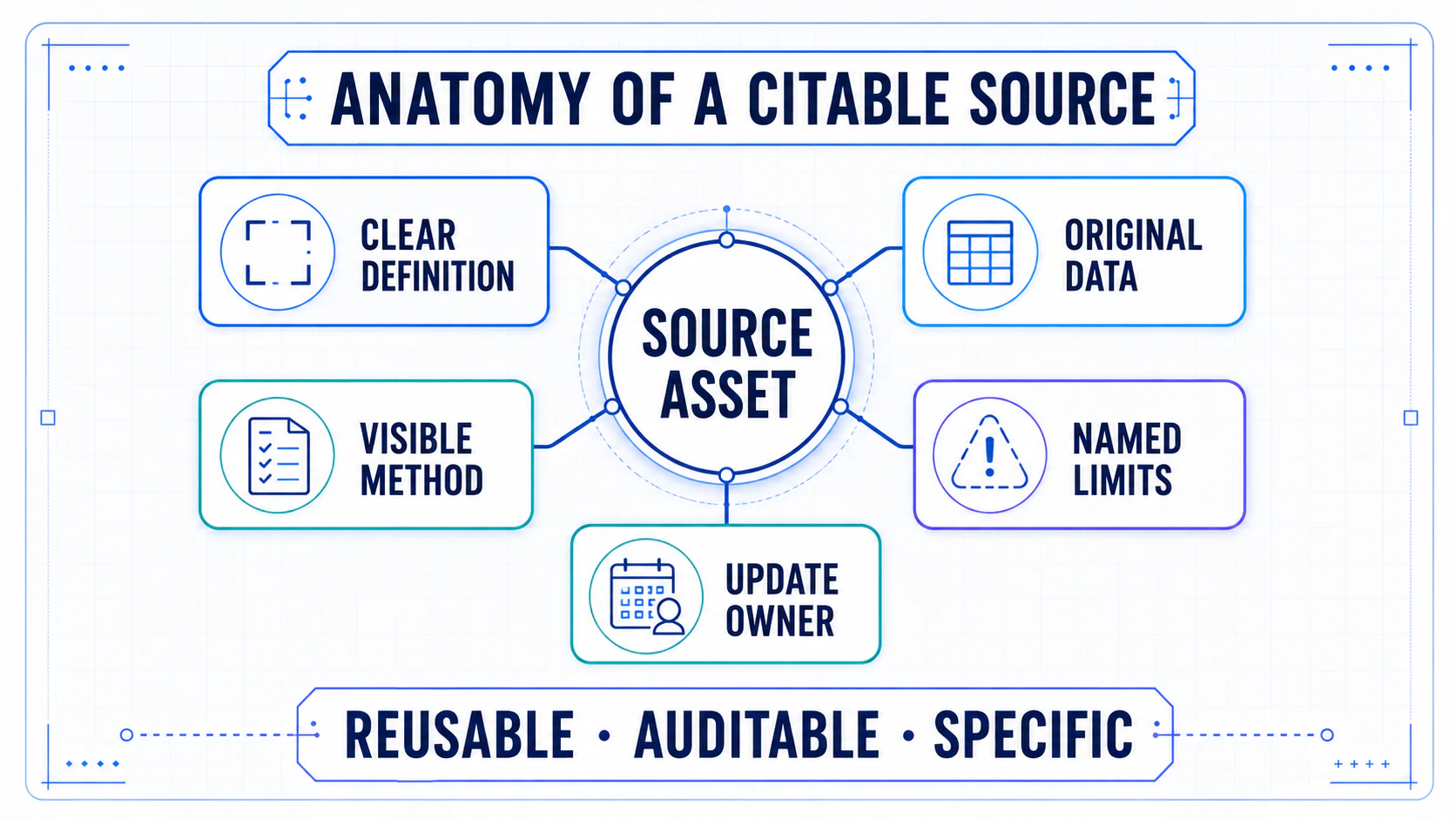
Adding external links makes an article sourced; publishing reusable evidence can make it a source.
High-value source assets include:
- a named definition with clear boundaries;
- a transparent benchmark and methodology;
- an original dataset or downloadable table;
- a decision matrix based on documented criteria;
- a reproducible test;
- a diagram that explains a system;
- a case study with baseline, intervention, and measured result;
- a maintained reference table for a changing topic.
Do not manufacture arbitrary statistics to look quotable. If the most useful contribution is a precise synthesis of primary documentation, say so.
6. Make evidence easy to extract without removing context
Use descriptive headings, direct answer paragraphs, tables, steps, definitions, and concise summaries. Keep the qualification near the fact.
Bad extraction unit:
It improves performance by 40%.
Useful extraction unit:
In the foundational GEO paper's benchmark, the best reported visibility lift was up to 40% in its experimental setting; the result does not establish a guaranteed organic traffic gain across live platforms. GEO paper
The limitation is part of the fact. Moving it three screens lower invites both human and machine misquotation.
7. Keep source links crawlable and stable
A citation is less useful when the source is behind an unnecessary redirect, script-only click handler, expired signed URL, or broken fragment.
Editorial and technical checks should confirm:
- normal HTML links with descriptive anchor text;
- direct HTTPS destination where possible;
- no accidental
nofollowpolicy on ordinary editorial sources; - no link shorteners for permanent references;
- access without a private session when a public source exists;
- a replacement or archive note when a source disappears;
- no broken references after localization or migration.
Do not copy long passages merely to protect against link rot. Summarize the evidence in your own words and comply with source licenses and quotation limits.
8. Show authorship, review, and update responsibility
A page should make clear who wrote or reviewed it, why they are qualified, when the page was materially updated, and who owns future corrections.
Use a real update date only after a substantive review. Changing a date without changing the article does not create freshness. Google explicitly lists cosmetic date changes as a warning sign in its people-first guidance.
For regulated, medical, legal, or financial topics, define an appropriate subject-matter review process and link to the governing primary material. An author biography is not a substitute for correct evidence.
9. Maintain one factual layer across languages and formats
Translations may adapt terminology and examples, but numbers, product capabilities, dates, entity names, and limitations should remain consistent. Store critical facts in structured editorial fields or a claims register rather than manually retyping them across every version.
A claims register can contain:
| Field | Purpose |
|---|---|
| Claim ID | Stable internal reference |
| Approved wording | Maximum defensible statement |
| Primary source URL | Evidence owner |
| Source date checked | Freshness control |
| Pages and languages | Impact map |
| Reviewer | Accountability |
| Recheck trigger | Date, release, law, or product change |
This makes updates safer when platform documentation changes.
Field artifact: Download the AI citation claims register (CSV). It includes the fields above plus a verified example row you can replace or duplicate.
10. Measure earned citations as a sample, not a permanent rank
Track AI citations with a fixed cohort of commercially relevant prompts and repeated observations. Record platform, market, language, date, mode, exact prompt, cited URLs, prominence, and whether the answer actually uses the cited evidence accurately.
Useful metrics include:
- response validity rate;
- brand mention rate;
- owned citation rate;
- source coverage by prompt family;
- citation prominence;
- factual absorption or support quality;
- qualified referral sessions;
- assisted conversions and pipeline where attributable.
OpenAI states that ChatGPT Search answers may include inline citations and that publisher referrals can carry utm_source=chatgpt.com; its publisher FAQ explains both discovery and referral tracking. A referral is stronger downstream evidence than a screenshot, but it still captures only users who clicked.
A citation workflow for editorial teams
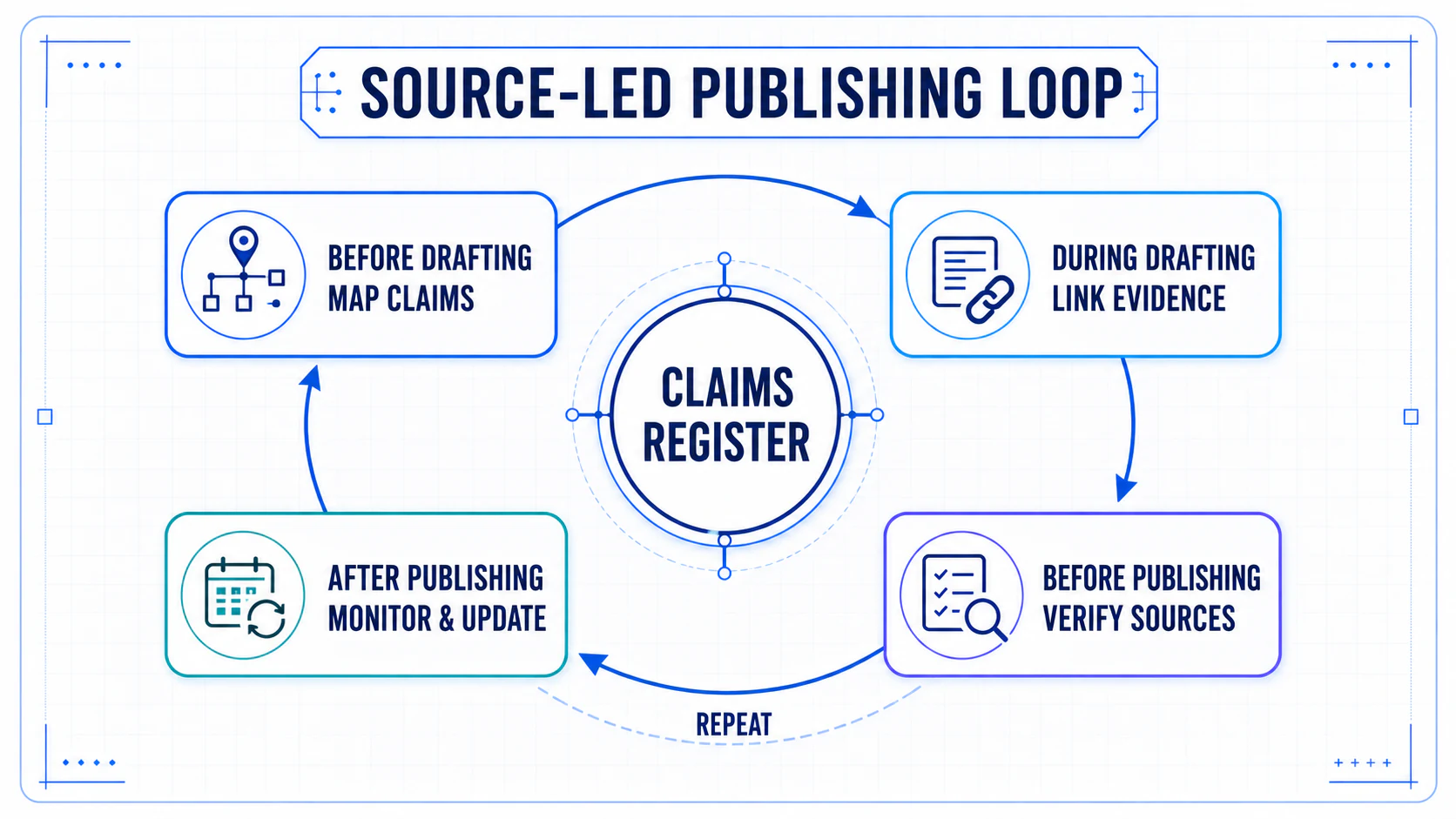
Before drafting
- Define the reader's decision or task.
- List the factual claims the article needs.
- Identify the primary source for each volatile or consequential claim.
- Mark where original experience, data, or analysis will add value.
- Reject claims that cannot be responsibly supported.
During drafting
- Lead with a direct answer.
- Attach each source to the narrow claim it proves.
- Label estimates, observations, and interpretations.
- Put limitations beside results.
- Link to a methodology for original datasets or benchmarks.
- Add contextual internal links where the reader needs a deeper explanation.
Before publication
- Open every source and verify the exact claim.
- Prefer current first-party documentation for volatile platform behavior.
- Check names, dates, units, denominators, and sample sizes.
- Confirm quotations are necessary, accurate, and short.
- Review visible author and update information.
- Test server-rendered links and crawl access.
After publication
- Monitor broken and redirected sources.
- Recheck documentation after platform releases.
- Update the claims register and all affected language versions together.
- Track search coverage, sampled AI citations, referrals, and business results separately.
- Correct errors visibly when they affect the reader's decision.
Citation mistakes to avoid
- Linking to a search-results page instead of the actual evidence.
- Citing a source that discusses the topic but does not support the claim.
- Stacking many links after one sentence without mapping each source.
- Using vendor marketing copy as independent proof of the vendor's superiority.
- Citing an AI-generated answer as the sole authority for a factual claim.
- Inventing references, study titles, authors, or statistics.
- Removing limitations from a research result.
- Copying a source's wording instead of adding original value.
- Treating an outbound citation count as an AI-search ranking factor.
- Reporting a single AI response as stable platform visibility.
Does adding citations improve GEO?
Accurate citations improve the page's auditability and can strengthen the reader's trust. Research on GEO has tested citation- and evidence-related content changes, but the findings are conditional on experimental design, topic, retrieval set, and platform. They should not be converted into a universal promise.
The safest conclusion is practical: make the page accessible, answer the query precisely, show original value, connect important claims to primary evidence, and measure whether the page is discovered, cited, used accurately, and visited. These are separate stages.
For a technical and editorial baseline, use the GEO audit checklist. For implementation and monitoring across ChatGPT and Perplexity, see our AI search citations service.