

What is Generative Engine Optimization?
Generative Engine Optimization (GEO) is the practice of improving how a brand and its information are discovered, interpreted, and referenced by search experiences that generate answers. It combines technical SEO, useful source content, entity consistency, digital PR, and repeatable visibility measurement. GEO can improve eligibility and relevance; it cannot guarantee a mention, citation, recommendation, or ranking.
That distinction matters. AI answers change with the query, market, language, model, retrieval system, and date. A credible GEO program therefore treats visibility as an observable outcome to measure, not a position an agency can permanently secure.
The term GEO was formalized in the 2024 research paper GEO: Generative Engine Optimization. The study introduced GEO-bench and reported visibility gains of up to 40% in its experiments, with results varying by domain. That is evidence that content interventions can affect measured visibility inside a research benchmark—not a promise that any tactic will reproduce the same lift in a live product.
The market now also uses AEO and LLMO. These labels overlap, and none of them replaces the need for a crawlable, useful, trustworthy website.
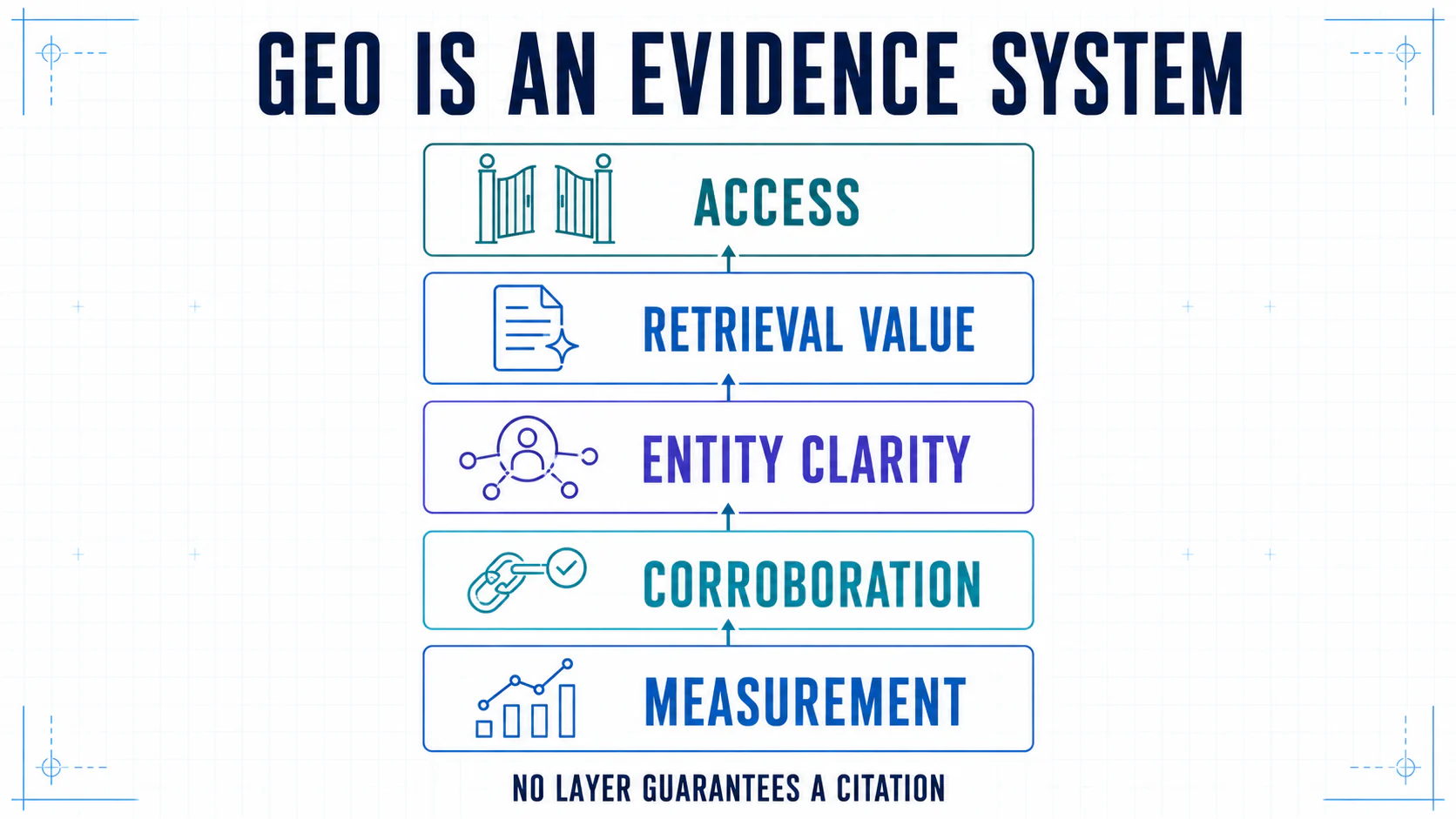
What makes these strategies evidence-based?
This guide uses three evidence levels and does not treat them as equivalent:
- Documented platform controls: first-party instructions about crawling, indexing, eligibility, reporting, or structured data.
- Published research: findings with a stated benchmark and scope, such as the 2024 GEO paper.
- Operational hypotheses: publishing and measurement practices that are plausible, useful, and testable but not documented as ranking factors.
The ten strategies combine all three. Technical access is a documented prerequisite. Clear source material and corroboration are quality practices to test, not secret signals. Prompt cohorts and outcome tracking are measurement methods, not ranking factors. This evidence contract was reviewed against the primary sources listed below on September 5, 2026.
Does GEO replace SEO?
No. SEO remains the retrieval foundation for Google Search and an important discovery layer elsewhere.
Google's current guidance for generative AI features is explicit: its AI experiences use core Search ranking and quality systems. The same page advises site owners to create valuable, non-commodity content, maintain a clear technical structure, and avoid supposed GEO shortcuts.
The practical model is:
| Discipline | Primary job | Typical output | Core measurement |
|---|---|---|---|
| SEO | Make pages crawlable, indexable, relevant, and useful in search | Technical fixes, content, internal links, authority building | Impressions, clicks, rankings, conversions |
| AEO | Make a direct answer easy for people and answer interfaces to understand | Concise definitions, steps, tables, FAQs | Answer visibility and assisted engagement |
| GEO | Improve presence inside generated answers and their cited sources | Source content, entity consistency, prompt cohort, citation monitoring | Mentions, citations, source coverage, qualified referrals |
| LLMO | Broad industry label for visibility across LLM-based discovery | Often overlaps with AEO and GEO | Platform-specific visibility and business outcomes |
For a fuller decision framework, read GEO vs AEO vs LLMO vs SEO.
How AI search discovers sources
There is no universal AI-search index. Each platform documents different controls, and those controls can change.
Google AI Overviews and AI Mode
Google retrieves information from its Search index. A page must be crawlable, indexed, and eligible to appear with a snippet. Google says there is no special AI markup, required word count, or required content chunk size. Structured data can still support ordinary Search features when it accurately represents visible content, but it is not a special GEO switch.
Google says its dedicated Generative AI performance report in Search Console completed worldwide rollout on August 31, 2026. It reports impressions by page, country, device, and date for AI Overviews and AI Mode. A property may still show no report when it has insufficient impressions or the feature has not appeared for that account.
ChatGPT Search
OpenAI documents OAI-SearchBot as the crawler used to surface websites in ChatGPT Search. GPTBot is a separate control for potential model training, and ChatGPT-User supports some user-initiated visits. OpenAI says ChatGPT-User is not used to determine Search inclusion and that robots.txt rules may not apply to these user-initiated actions. These names should not be treated as interchangeable.
OpenAI's crawler documentation recommends allowing OAI-SearchBot when a publisher wants content eligible for ChatGPT Search. Its publisher FAQ also explains that referral URLs include utm_source=chatgpt.com, which makes downstream traffic measurable in analytics.
Perplexity
Perplexity identifies PerplexityBot as the crawler intended to surface and link websites in its search results. It separately documents Perplexity-User for user-requested page visits and says that agent generally ignores robots.txt. Its crawler documentation recommends checking both the declared user agent and published IP ranges when configuring a WAF.
Crawler access creates eligibility, not a citation guarantee. A platform can crawl a page and still decide that another source better answers a specific query.
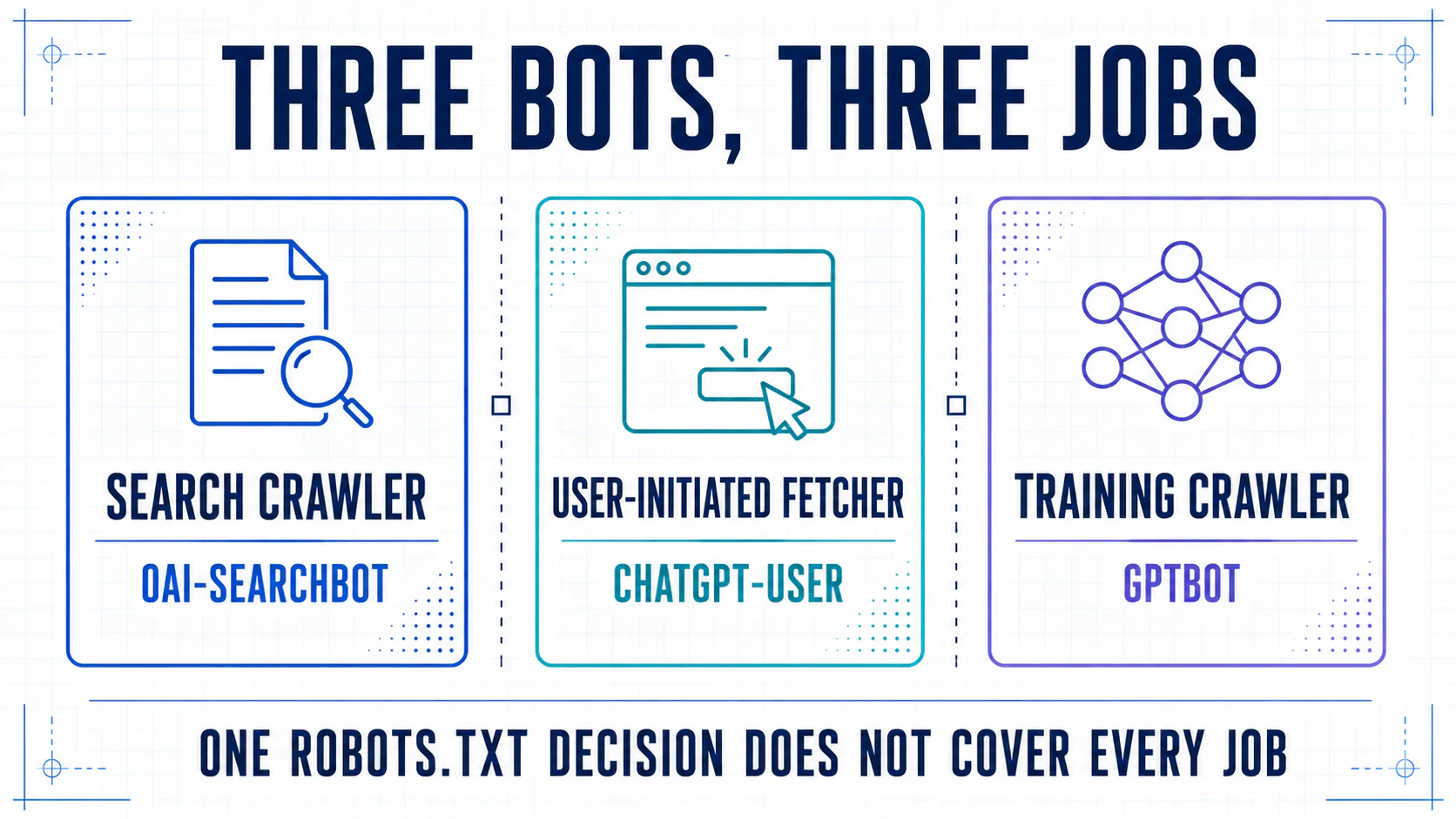
A useful crawler-policy fact: search crawling, user-requested fetching, and model-training crawling can be separate jobs. Record each decision by user agent, then verify that CDN and WAF behavior matches the policy.
Top 10 GEO strategies for 2026
The most defensible GEO strategy is a connected system, not a collection of AI-search tricks. These ten practices cover measurement, technical access, source content, entity clarity, authority, internal discovery, page experience, localization, and experimentation.
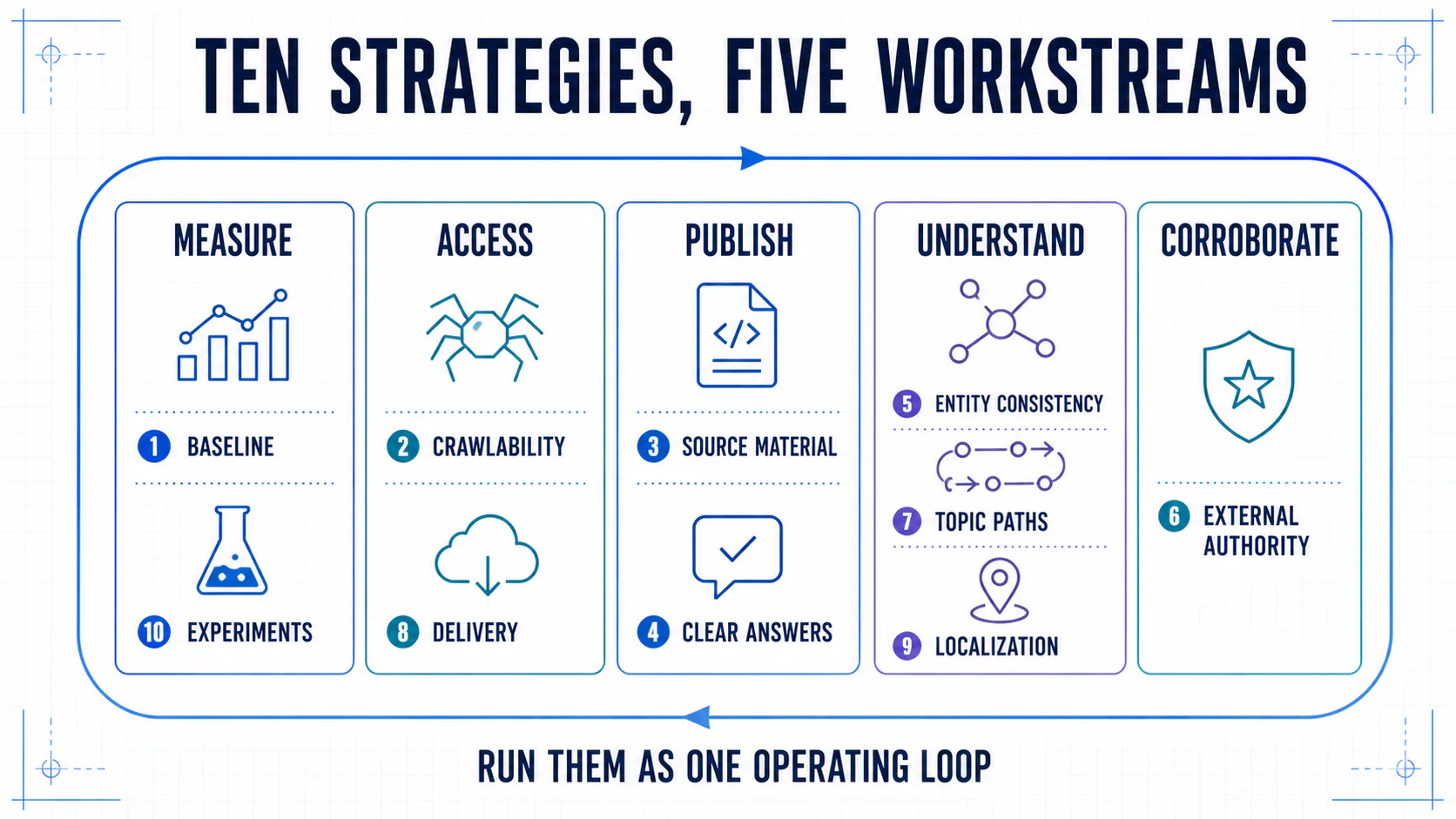
| Workstream | Strategies | Strongest evidence basis | What to verify |
|---|---|---|---|
| Measure | 1 and 10 | Repeatable experiment design and platform reporting | Whether change persists across a fixed cohort and improves a defined outcome |
| Access | 2 and 8 | Google, OpenAI, and Perplexity documentation | Whether the intended crawler can fetch the canonical page and its primary content |
| Publish | 3 and 4 | Google quality guidance, scoped GEO research, and reader usability | Whether the page adds source value and is quoted accurately |
| Understand | 5, 7, and 9 | Structured-data and localization guidance plus testable retrieval hypotheses | Whether facts stay consistent and market-specific answers improve |
| Corroborate | 6 | Source-led publishing and platform guidance against inauthentic mentions | Whether credible independent sources confirm the claim |
1. Establish a repeatable baseline
Start with a fixed set of commercially relevant prompts rather than a handful of screenshots. Include category questions, comparisons, problem-led queries, implementation questions, and branded accuracy checks.
For every observation, record:
- exact prompt and language;
- platform, model or search mode where visible;
- country or location context;
- date and session state;
- whether the brand was mentioned;
- whether an owned page was linked;
- competing sources and factual errors.
Run the same cohort again after a defined change window. AI outputs are variable, so a single answer is an example—not a trend.
Use the AI visibility measurement framework to define citation rate, mention rate, source coverage, share of voice, and referral conversions.
2. Fix crawlability and indexability
A page cannot become a reliable live source if the relevant search system cannot access it.
Check:
- HTTP status, canonical, robots directives, and sitemap inclusion.
- Whether the primary content is present in rendered HTML.
- Google indexing and snippet eligibility.
OAI-SearchBotandPerplexityBotpolicy decisions inrobots.txt.- CDN, WAF, or bot-management rules that may contradict
robots.txt. - Page performance and mobile usability for human visitors.
Bot policy is a business decision. Search crawling, user-initiated fetching, and model training can use different user agents. Document the decision instead of copying a generic allowlist.
3. Publish source material worth retrieving
Generated answers do not need another summary of what every competitor already says. They need sources that resolve uncertainty.
Strong source material includes:
- a first-party benchmark with a disclosed method;
- a decision matrix that explains trade-offs;
- a documented implementation or migration;
- an expert explanation with verifiable credentials;
- current product, pricing, service, or policy facts;
- a template, calculator, dataset, or checklist;
- a correction to a widely repeated but unsupported claim.
Every important claim should answer three questions: Who says this? What evidence supports it? Under what conditions does it hold?
4. Make answers clear without writing “for the machine”
Use descriptive headings, direct opening sentences, short paragraphs, lists where order matters, and tables where comparison matters. This improves comprehension for readers and makes individual passages easier to quote accurately.
Do not force every paragraph into a fixed token window. Google specifically says there is no required “chunking” pattern for its generative AI features. Structure information around reader tasks, not an invented crawler specification.
5. Keep entities and facts consistent
Use the same factual company name, service descriptions, markets, people, prices, and policies across the website and credible external profiles. Contradictory facts create ambiguity for people and retrieval systems.
Schema.org markup can clarify visible entities and relationships, but only when it matches the page. Use standard non-versioned URLs such as https://schema.org/Organization. Schema.org's current public release is version 30.0; “Schema 3.0” is not the name of a special AI-search markup layer.
Validation does not guarantee a rich result or an AI citation. Google's structured data guidelines state that even valid markup does not guarantee display.
6. Earn corroboration outside the owned site
AI answers may cite publishers, review platforms, professional directories, documentation, forums, or other third-party sources. The right response is not manufactured mentions. Build references through actual expertise:
- contribute original data to industry publications;
- keep reputable company and professional profiles accurate;
- publish named expert commentary;
- answer relevant community questions without hiding affiliation;
- earn reviews and case coverage from real customers and partners.
The goal is independent corroboration, not a volume of low-quality placements.
7. Build topic clusters and explicit internal paths
A single page cannot answer every question in a buying journey well. Create a clear hub for the broad topic and focused supporting pages for measurement, comparisons, implementation, risks, and decisions. Link them with descriptive anchors so readers and crawlers can move between the general concept and the precise evidence.
Consolidate pages that compete for the same intent. Ten thin variations of “what is GEO?” fragment maintenance and authority; one strong guide with distinct supporting articles gives each URL a clearer job.
8. Protect rendering, performance, and page experience
Technical eligibility is not the end of the journey. Deliver the primary answer, links, and metadata in reliable server-rendered or prerendered HTML where practical. Keep mobile interaction responsive, avoid intrusive overlays, and test important routes under real network conditions.
Core Web Vitals are not a special AI-citation signal, but performance affects whether people can use the source and whether complex JavaScript reliably exposes the content. Treat page experience as part of source quality, not an AI-search hack.
9. Localize evidence for each market and language
Translate meaning, not only words. Research native-language questions, use local terminology and units, adapt examples and commercial proof, and keep entity facts consistent across versions. Every locale needs a stable URL, correct canonical, reciprocal hreflang where applicable, and direct crawl access.
Measure native-language prompt cohorts separately. Visibility observed in US English does not establish visibility in German-speaking Austria or Russian-language discovery.
10. Run controlled experiments tied to business outcomes
Change one meaningful content or technical variable at a time where possible. Record the baseline, affected URLs, release date, crawl and index status, prompt cohort, repeated observations, referrals, and conversions. Compare platform-specific results instead of averaging incompatible signals.
The outcome hierarchy should remain explicit: discovery, mention, citation, accurate use, referral, qualified conversion, and revenue are different stages. A citation lift is useful evidence, but not proof of sales impact without downstream data.
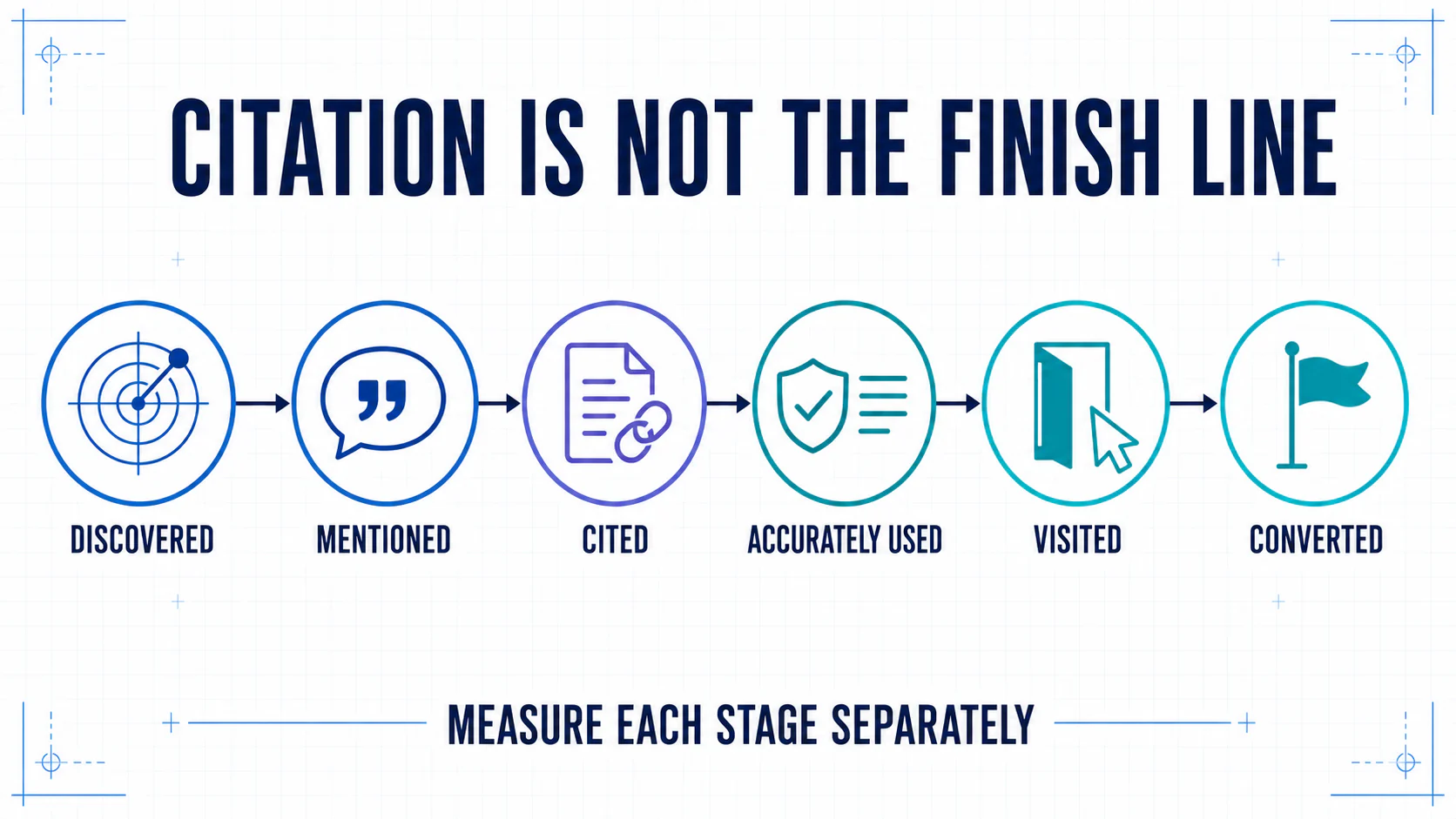
Implementation artifact: Download the GEO Evidence & Experiment Register (Markdown) to record crawler policy, prompt cohorts, source claims, experiments, and downstream outcomes without collapsing them into one vanity metric.
What about llms.txt?
llms.txt is a public proposal for giving agents a curated Markdown map of a website. It can be useful for documentation workflows or agents that deliberately request it. It is not a universal ranking protocol.
Google says it ignores llms.txt for Google Search, including its generative AI features. OpenAI and Perplexity document their search crawlers but do not state that an llms.txt file increases citation probability. Therefore:
- maintain the file if it helps supported agent or documentation use cases;
- keep it accurate and link only to canonical public content;
- do not sell it as a ranking factor;
- do not report its deployment as an AI visibility result.
The source specification itself describes llms.txt as a proposal, which is the correct level of certainty.
What GEO cannot honestly guarantee
No provider controls a third-party model's retrieval, synthesis, or citations. Be cautious with promises of:
- guaranteed indexing or citations;
- a permanent “number one” position in ChatGPT or Perplexity;
- a fixed percentage lift without a disclosed baseline and experiment;
- “zero hallucinations” across external AI systems;
- special schema or files that force AI recommendations;
- identical outcomes across models, languages, users, and dates.
A defensible engagement guarantees the work: audit scope, implementation, measurement protocol, reporting cadence, and transparent evidence. It does not guarantee an external platform's answer.
A practical 90-day GEO program
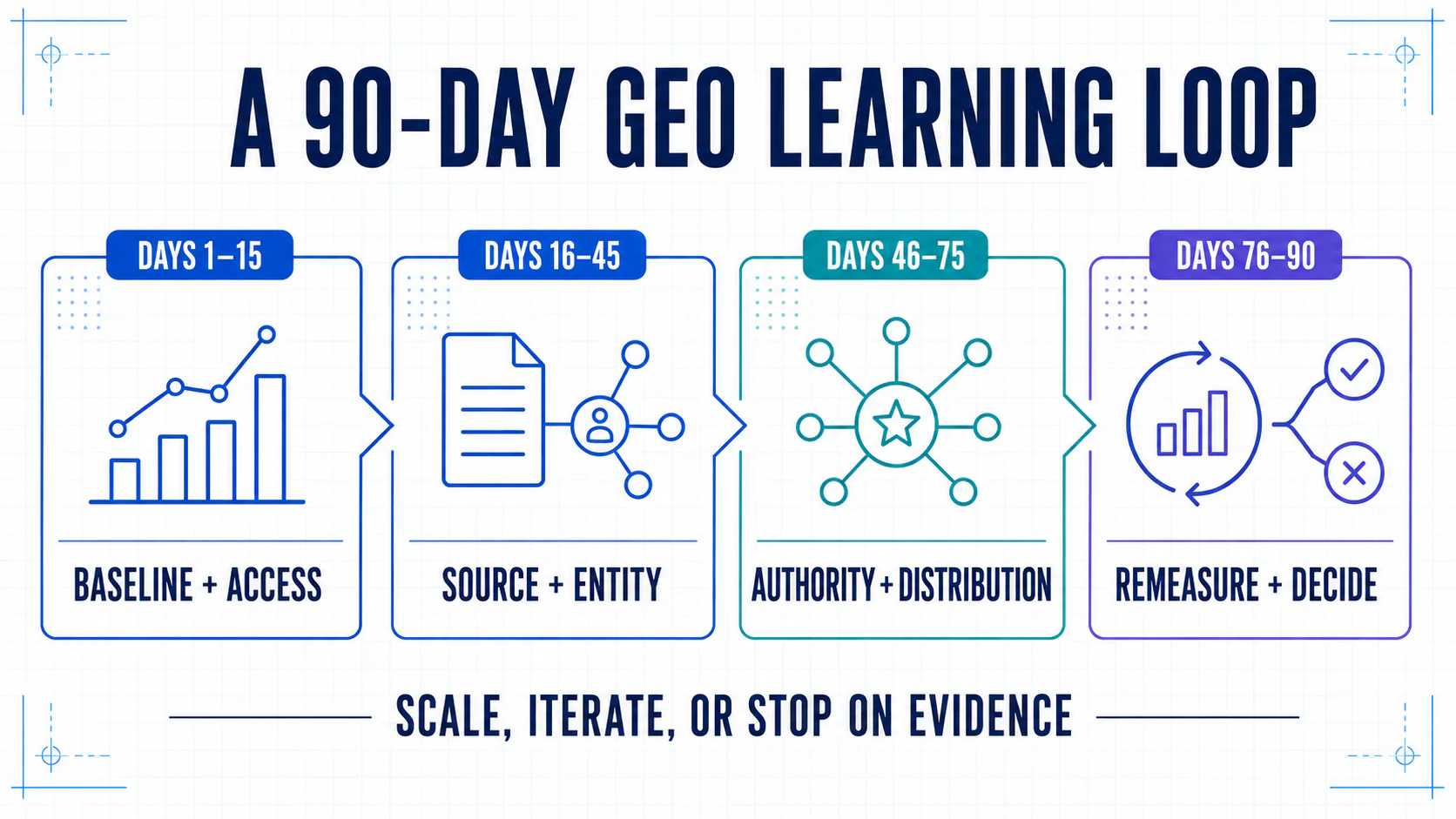
Days 1–15: Baseline and technical access
- define the prompt cohort and competitors;
- capture mention, citation, and accuracy baselines;
- verify crawling, indexing, rendering, canonicals, and bot policy;
- inventory unsupported claims and inconsistent entity facts;
- connect Search Console and analytics reporting.
Days 16–45: Source content and entity repair
- improve the most commercially relevant hub page;
- publish comparison, audit, and measurement resources;
- add source links and remove claims that cannot be substantiated;
- align organization, service, author, and contact information;
- implement only the structured data supported by visible content.
Days 46–75: Authority and distribution
- publish one piece of first-party evidence;
- place expert commentary in relevant external publications;
- update profiles and partner references;
- create internal links from supporting articles to the hub and service pages.
Days 76–90: Re-measure and decide
- rerun the same prompt cohort under the same protocol;
- export Google generative AI impressions when the property has enough data to show the report;
- review ChatGPT and other AI referral sessions and conversions;
- separate observed change from assumptions;
- prioritize the next experiment based on business value.
GEO readiness checklist
- [ ] Priority pages are crawlable, indexable, and useful without login.
- [ ] Search crawler policies reflect a documented business decision.
- [ ] The site contains original evidence or expert experience.
- [ ] Key claims have a source, date, and scope.
- [ ] Brand and service facts are consistent across owned pages.
- [ ] Structured data matches visible content and validates.
- [ ] A fixed prompt cohort and competitor set exist.
- [ ] Mentions, citations, referrals, and conversions are measured separately.
- [ ] No external-platform outcomes are presented as guaranteed.
- [ ] Every experiment has an owner, release date, stop rule, and downstream metric.
For a page-by-page review, use the GEO audit checklist.
The bottom line
GEO is most useful as a measurement and publishing discipline layered on top of strong SEO. The durable work is familiar: make content accessible, publish information worth citing, identify the source, keep facts consistent, earn independent authority, and measure real outcomes. The new part is the cross-platform prompt and citation layer—not a shortcut around search quality.
If you need an evidence-led baseline, AppWebSeo can review the crawl path, priority prompt cohort, current citations, entity consistency, and measurement setup before recommending implementation work.
Primary sources
- Google: Optimizing your website for generative AI features
- Google Search Console: Generative AI performance report
- OpenAI: Overview of OpenAI crawlers
- OpenAI: Publishers and Developers FAQ
- Perplexity: Crawler documentation
- Schema.org: Release history
- Google: General structured data guidelines
- The `llms.txt` proposal
- GEO research paper