

What a GEO audit should answer
A GEO audit should show whether priority content can be accessed, whether it is useful and verifiable enough to serve as a source, how the brand currently appears in generated answers, and whether that visibility produces qualified business activity. It should not promise future citations or compress every finding into a mysterious “AI ranking score.” No auditor has access to the internal ranking or retrieval systems of Google, OpenAI, or Perplexity.
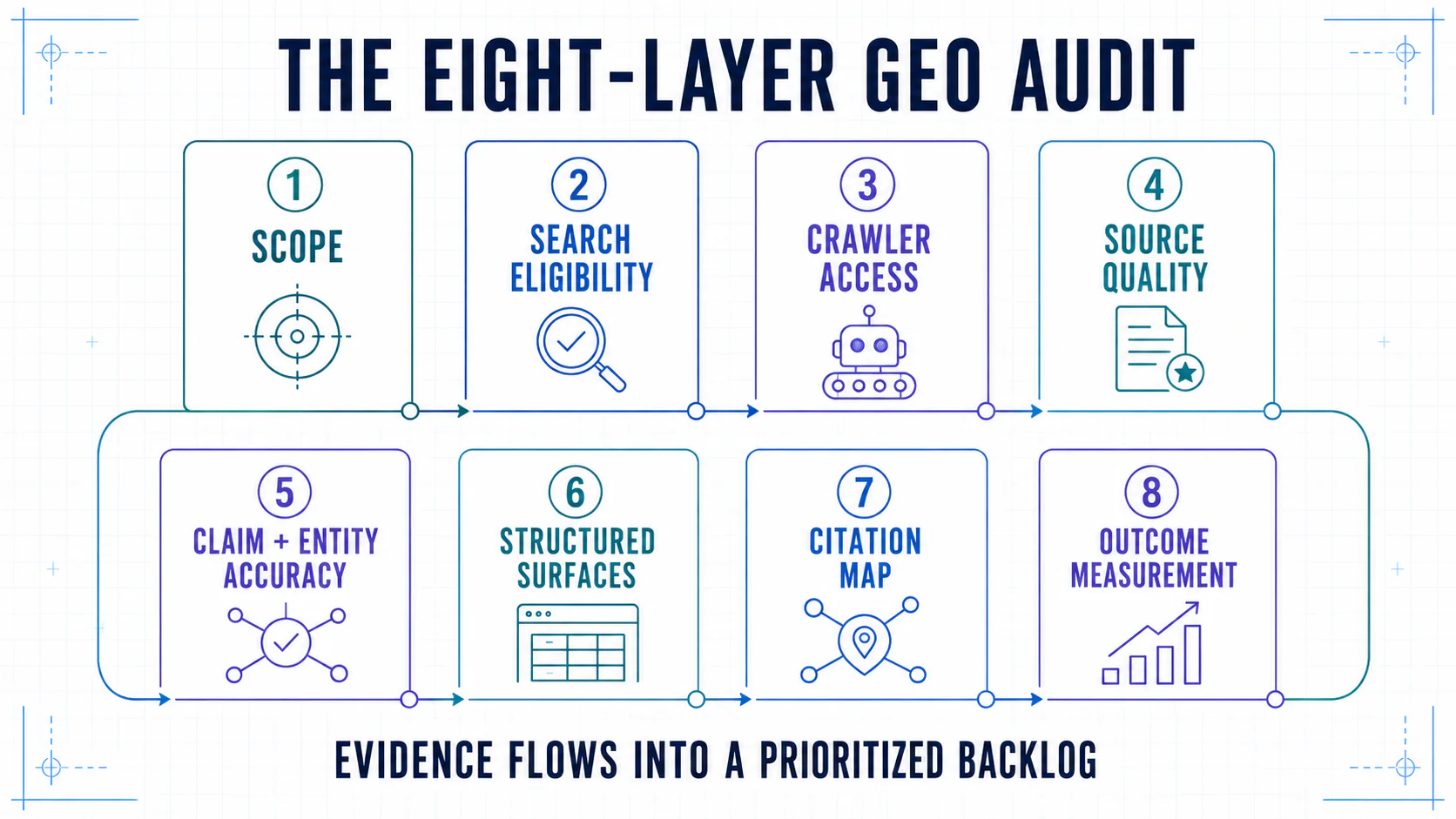
The audit has eight parts:
- Scope and prompt baseline.
- Google Search eligibility.
- AI search crawler access.
- Content usefulness and extractability.
- Evidence, authorship, and entity accuracy.
- Structured data and machine-readable surfaces.
- Citation and competitor patterns.
- Measurement, conversion, and experiment design.
Use this checklist for Google AI Overviews and AI Mode, ChatGPT Search, and Perplexity. Record platform-specific evidence rather than assuming one engine's behavior applies to the others.
The minimum standard for an audit finding
A useful finding contains six fields: observation, captured evidence, business consequence, recommended action, owner, and retest. “Add schema” is a task. “The visible author and Article.author disagree on three priority URLs, creating an entity conflict; align them and revalidate by September 30” is an auditable finding.
Part 1: Scope and prompt baseline
Do not begin by scanning every page. Begin with the decisions the content is expected to influence.
- [ ] Identify 3–5 business-critical services, products, or categories.
- [ ] Define the countries and languages that matter.
- [ ] Select 3–5 direct competitors for each category.
- [ ] Identify the primary conversion: audit request, demo, qualified lead, purchase, or another event.
- [ ] Choose the owned pages that should support each category.
- [ ] Agree on a review window and who will validate technical, editorial, and business findings.
Build a comparable prompt cohort
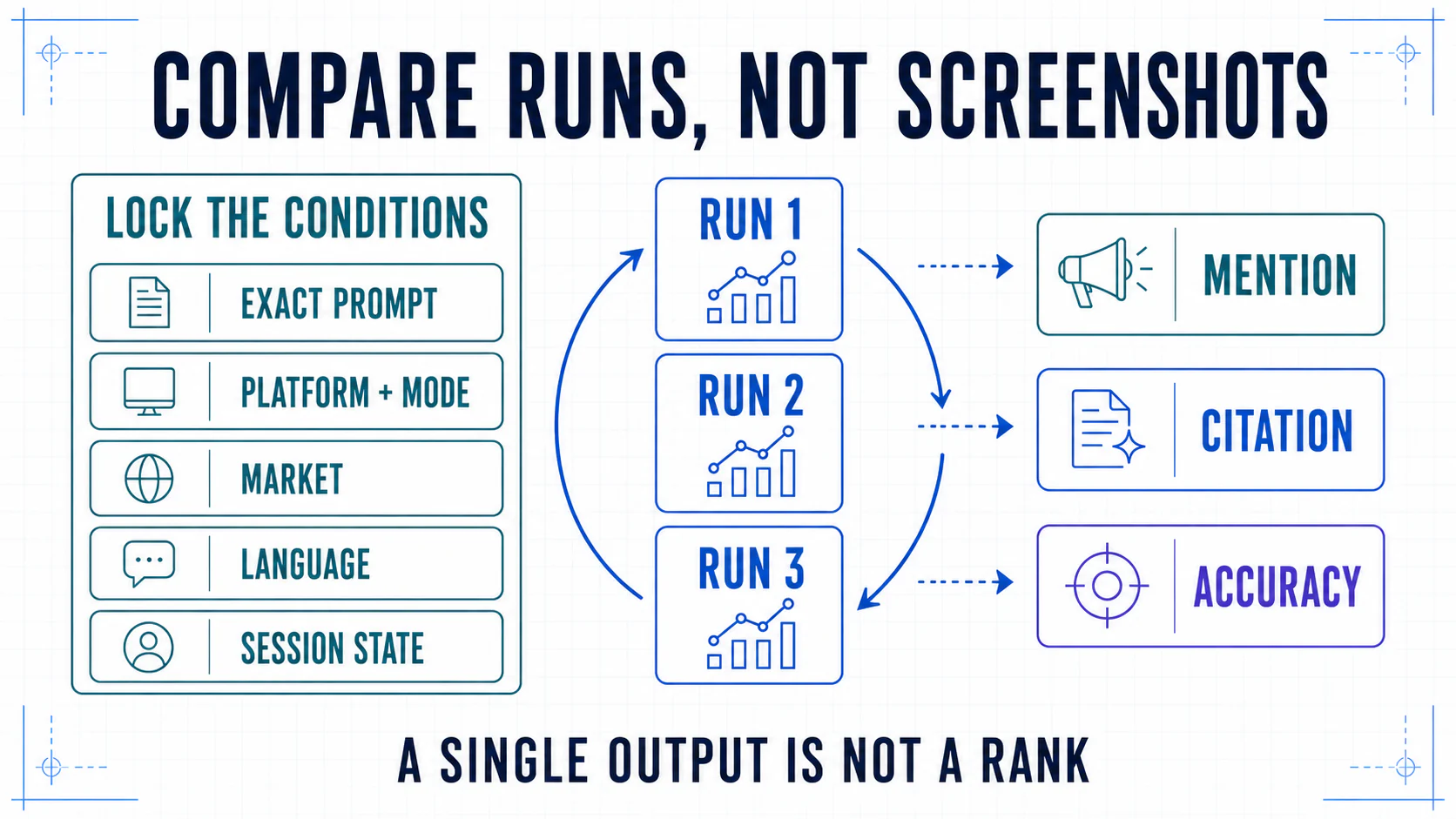
Build a prompt cohort large enough to cover the important research intents. For many focused audits, 20–50 prompts is a workable starting range, not a platform requirement. Freeze the wording and conditions before collecting the baseline.
| Prompt type | Example | What it tests |
|---|---|---|
| Category | “What is generative engine optimization?” | Definition and topical authority |
| Problem | “How can a B2B brand measure visibility in ChatGPT?” | Problem-solution relevance |
| Comparison | “GEO vs SEO for an international SaaS company” | Decision support |
| Recommendation | “Which GEO agencies work with DACH enterprise companies?” | Brand consideration |
| Implementation | “How should OAI-SearchBot be configured?” | Technical expertise |
| Branded accuracy | “What services does AppWebSeo provide?” | Entity and factual consistency |
For each observation, record platform, model or mode where available, language, location context, date, session state, answer, linked sources, brand mention, competitors, and factual errors.
A single output is not a rank. Generated answers can vary between runs. Use repeated observations and report the sample size.
Part 2: Google Search eligibility
Google states that its generative AI features use the core Search index and quality systems. Start with ordinary Search requirements.
- [ ] Priority URLs return
200and are not blocked byrobots.txt. - [ ] Pages are not marked
noindexand are eligible to show a snippet. - [ ] Canonicals point to the intended indexable URL.
- [ ] Pages appear in the XML sitemap with accurate modification dates.
- [ ] Main content is visible in rendered HTML.
- [ ] Internal links connect hubs, supporting articles, and commercial pages.
- [ ] Google Search Console shows the expected indexed canonical.
- [ ] The Search generative AI control is set to include—or inherits an include setting—when visibility is desired.
- [ ] Parent and child property inheritance is checked before the control is reported as configured.
- [ ] The dedicated Generative AI performance report is exported when it contains data.
- [ ] If the report is absent, low impressions, exclusion, and account access are recorded as possible explanations rather than reported as zero visibility.
Google's AI optimization guide says there is no special AI markup, required text length, or chunking formula. Google announced worldwide rollout of both the Search generative AI control and the Generative AI performance report on August 31, 2026. The report currently measures impressions for AI Overviews and AI Mode; it is not a cross-platform citation report.
Part 3: AI search crawler access
Crawler names have different purposes. Audit the actual documented search crawler rather than allowing every bot under an “AI” heading.
ChatGPT Search
- [ ]
OAI-SearchBotis not blocked when ChatGPT Search inclusion is desired. - [ ] WAF, CDN, and bot management rules allow OpenAI's published searchbot IP ranges.
- [ ] The policy for
GPTBotis documented separately because it relates to potential model training. - [ ] The team understands that
ChatGPT-Usermay be used for user-initiated visits and is not the automatic Search crawler. - [ ] The audit allows for OpenAI's stated adjustment period of approximately 24 hours after a
robots.txtchange before retesting.
Source: OpenAI crawler documentation.
Perplexity
- [ ]
PerplexityBotis not blocked when Perplexity search inclusion is desired. - [ ]
Perplexity-Useris recorded separately as a user-requested fetcher that Perplexity says generally ignoresrobots.txt. - [ ] Published Perplexity IP ranges are not rejected by infrastructure.
- [ ] Server logs are checked for successful crawler responses and unexpected
403,429, or5xxpatterns.
Source: Perplexity crawler documentation.
Policy check
- [ ] Search inclusion, model training, and user-initiated fetching are treated as separate decisions.
- [ ] Legal, privacy, and content teams approve the policy.
- [ ]
robots.txtand edge security implement the same decision. - [ ] Changes are dated and documented.
Crawler access supports discovery. It does not guarantee selection or citation.
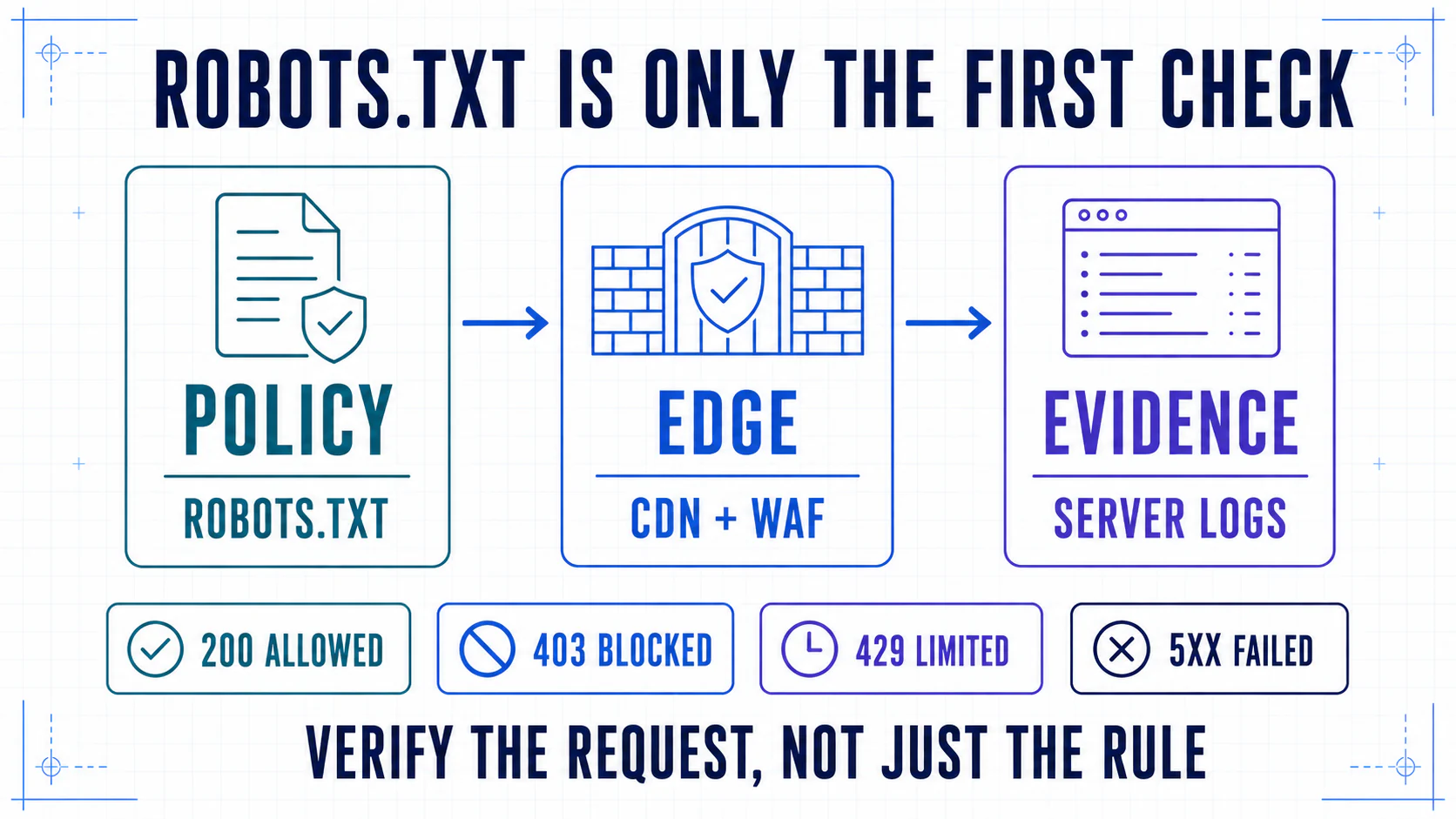
A surprisingly common audit trap: an allow rule in robots.txt can coexist with a 403 or 429 at the CDN or WAF. The policy says what should happen; the request and server log show what actually happened.
Part 4: Content usefulness and extractability
Review the priority pages as a skeptical buyer and as an editor.
- [ ] The page directly answers its primary question near the beginning.
- [ ] The content adds first-hand experience, original data, a method, a template, or a decision framework.
- [ ] Important terms are defined in plain language.
- [ ] Headings reflect reader tasks rather than keyword variations.
- [ ] Tables are used for genuine comparisons.
- [ ] Processes use ordered steps.
- [ ] Each key paragraph can be understood without an unexplained pronoun or missing qualifier.
- [ ] The page covers limitations and cases where the recommendation does not apply.
- [ ] The content has a visible publication or update date in metadata.
- [ ] The next step is appropriate for the reader's buying stage.
Do not optimize for an invented token window. Google explicitly says it can understand multiple topics on a page and does not require publishers to divide content into tiny AI-oriented chunks.
Part 5: Evidence, authorship, and entity accuracy
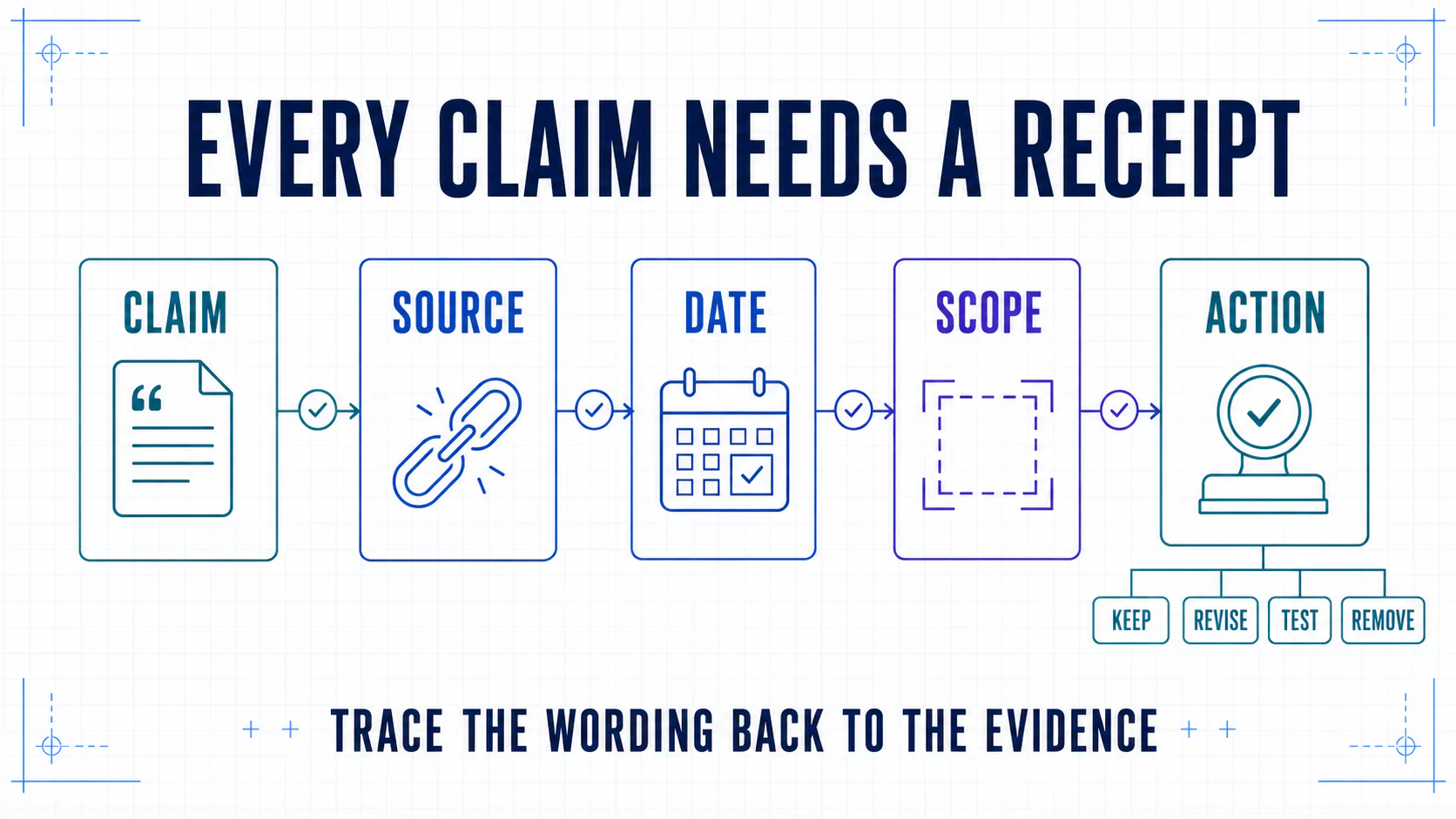
Create a claim ledger for every priority page.
| Claim | Source | Date checked | Scope/conditions | Action |
|---|---|---|---|---|
| A platform uses a named crawler | Platform documentation | YYYY-MM-DD | Platform and crawler purpose | Keep and cite |
| A client result improved | First-party analytics or case record | YYYY-MM-DD | Client, period, sample | Publish with permission |
| A tactic increases citations by a fixed percentage | No verified source | — | Unknown | Remove or test |
- [ ] Every statistic links to an original or authoritative source.
- [ ] The source actually supports the wording used on the page.
- [ ] Dates, products, crawler names, and standards are current.
- [ ] Case results include baseline, period, scope, and material changes.
- [ ] Correlation is not described as causation.
- [ ] Superlatives such as “best,” “leading,” or “top 1%” have evidence or are removed.
- [ ] Guarantees concern deliverables under the provider's control, not third-party search outcomes.
- [ ] Authors are real people or an accurately identified organization.
Entity consistency checks
- [ ] Organization name, legal identity, URL, logo, contact details, markets, and service facts have canonical values.
- [ ] Navigation, landing pages, articles, profiles, and partner listings use those values consistently.
- [ ] Visible author names and credentials agree with metadata and structured data.
- [ ] Conflicts are logged with the affected URL, source of truth, owner, and correction date.
Part 6: Structured data and machine-readable surfaces
Structured data should reflect visible facts. It can help systems understand page entities and qualify pages for supported Search features, but Google says there is no special schema required for generative AI search.
- [ ] Author markup matches the visible author.
- [ ]
ArticleorTechArticledata uses accuratedatePublishedanddateModifiedvalues. - [ ] Breadcrumb markup matches visible navigation.
- [ ] Structured data validates and does not describe hidden content.
- [ ] Only supported, relevant Schema.org types and properties are used.
- [ ] Non-versioned URLs such as
https://schema.org/Organizationare used. - [ ] “Schema 3.0” or other invented AI schema layers are removed.
Schema.org's public release history lists version 30.0, published March 19, 2026, as the current release at the time of this audit. Publishers generally use the ordinary non-versioned vocabulary URLs.
llms.txt review
Treat llms.txt as an optional navigational file for agents that choose to use the proposal—not as a ranking factor.
- [ ] The file describes the business accurately.
- [ ] Links resolve to canonical public pages.
- [ ] Claims match visible website content.
- [ ] Stale services, prices, authors, and results are removed.
- [ ] The file is not presented as a Google visibility factor.
- [ ] Deployment is not counted as a citation result.
Google says Search ignores llms.txt. The specification calls itself a proposal. A valid file may still be useful for documentation or agent workflows that deliberately request it.
Part 7: Citation and competitor analysis
Run the agreed prompt cohort and create a source map.
- [ ] Record owned citations separately from unlinked brand mentions.
- [ ] Record third-party pages that mention the brand.
- [ ] Identify recurring competitor sources.
- [ ] Classify each cited source: official documentation, publisher, directory, review, forum, social, academic, or other.
- [ ] Note whether the cited passage directly supports the generated claim.
- [ ] Record factual inaccuracies and outdated descriptions.
- [ ] Identify questions for which no current source gives a strong answer.
- [ ] Prioritize gaps by buyer importance, not by citation count alone.
Do not copy a competitor's format blindly. Determine what uncertainty its page resolves and whether you can contribute stronger evidence.
Part 8: Measurement, conversion, and experiment design
- [ ] Google generative AI impressions are exported when Search Console provides data, and report limitations are retained.
- [ ] AI referral sources and UTM parameters are preserved in analytics.
- [ ] ChatGPT referrals using
utm_source=chatgpt.comare monitored. - [ ] Landing page, engagement, conversion, and qualified lead data are connected.
- [ ] Brand mention rate and owned citation rate are separate metrics.
- [ ] Sentiment and factual accuracy use a documented classification rubric.
- [ ] The same prompt cohort is rerun on a fixed cadence.
- [ ] Reports state platform, market, sample size, and limitations.
- [ ] Every recommended change has a baseline, release date, observation window, owner, and scale/iterate/stop rule.
Use the AI visibility measurement guide for formulas and a reporting template.
How to prioritize findings
Classify each finding by evidence, impact, and control.
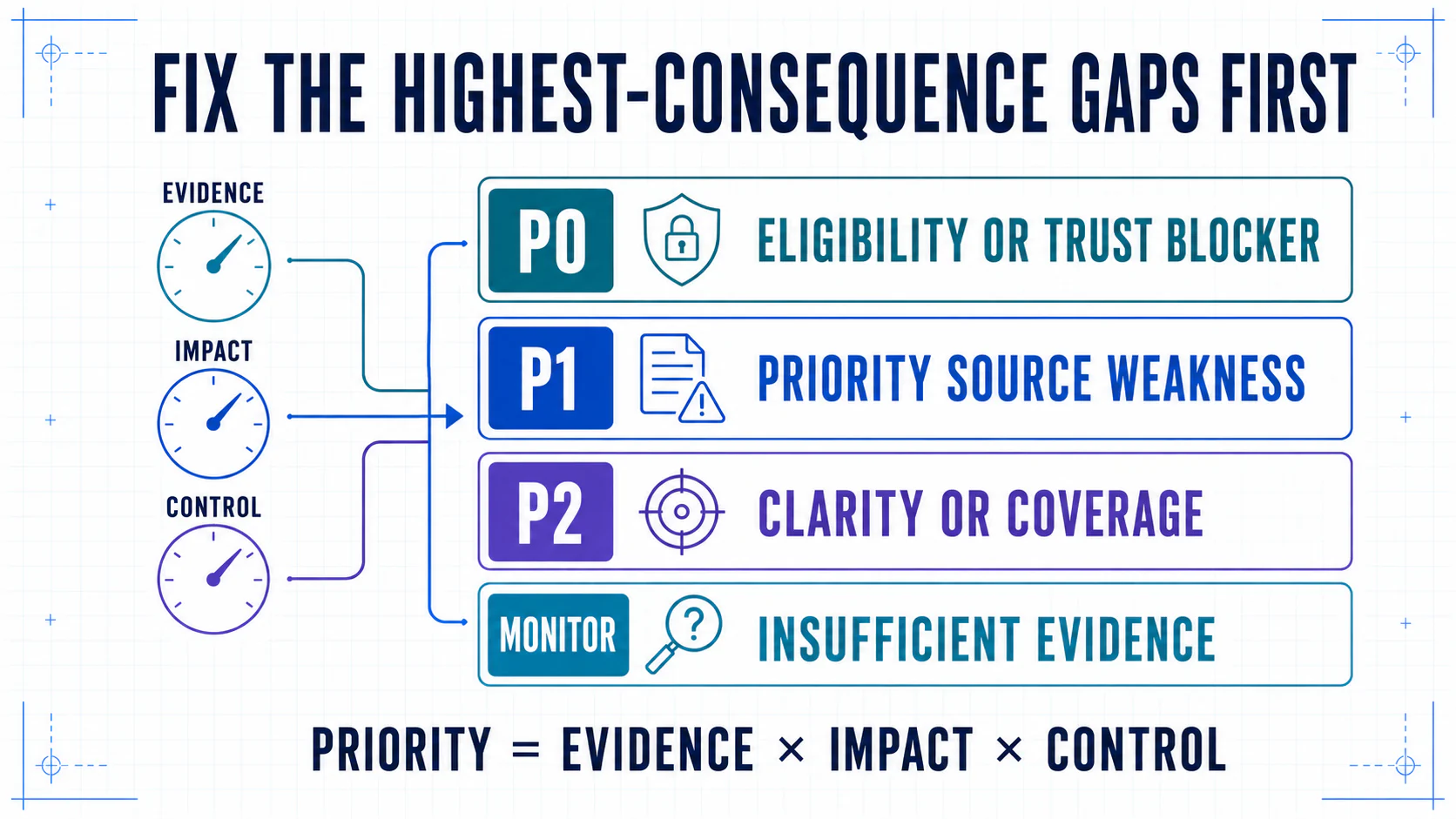
| Priority | Definition | Examples |
|---|---|---|
| P0 | Blocks eligibility or creates material trust risk | noindex, wrong canonical, blocked search crawler, fabricated statistic, false guarantee |
| P1 | Prevents a priority page from becoming a strong source | Commodity content, missing evidence, inconsistent entity facts, weak comparison |
| P2 | Improves clarity or coverage after fundamentals are fixed | Better table, additional FAQ, secondary profile update |
| Monitor | Evidence is insufficient or platform behavior is changing | Experimental file formats, undocumented crawler assumptions |
An audit score can help organize work, but it is not an AI-platform score and should never be presented as a prediction of citations.
Implementation artifact: Download the GEO Audit Fieldbook (Markdown) to capture prompt runs, crawler tests, claim and entity conflicts, citations, findings, owners, retests, and the final 30/60/90-day backlog in one working document.
Recommended audit deliverables
A useful audit should produce:
- A documented scope, prompt cohort, competitors, markets, and date.
- A technical eligibility report with reproducible evidence.
- A page-level claim ledger.
- A source and citation map.
- An entity inconsistency list.
- A prioritized 30/60/90-day backlog with owners, dependencies, and retest dates.
- A measurement specification and baseline export.
- A list of assumptions that still require testing.
The executive summary should state what was directly verified, what was inferred, and what remains unknown. That makes the audit useful even when no citation or traffic change appears during the review window.
Bottom line
A GEO audit is a disciplined evidence review, not a magic score. Fix eligibility first, unsupported claims second, and source quality third. Then measure whether visibility, referrals, and qualified business outcomes change under a repeatable protocol.
For the strategic context behind this checklist, read the complete GEO guide. AppWebSeo can also run the technical, editorial, and measurement review as one scoped diagnostic.
Primary sources
- Google: Optimizing for generative AI features
- Google Search Console: Generative AI performance report
- Google: Search generative AI control
- OpenAI: Overview of OpenAI crawlers
- OpenAI: Publishers and Developers FAQ
- Perplexity: Crawler documentation
- Google: Structured data guidelines
- Schema.org: Releases
- The `llms.txt` proposal