

What is an AI-optimized website?
An AI-optimized website is a human-first site whose important information is accessible, understandable, verifiable, consistent, and measurable across traditional and generative search. It gives every important fact an accountable source, every priority page a clear purpose, and every launch decision reproducible evidence.
It is not a second website written for bots. It does not depend on an “AI schema,” an AI-only sitemap, a universal word count, or a file that guarantees citations. Google's guidance for generative AI features says the established Search fundamentals still apply and that no special AI markup or machine-oriented content treatment is required.
The practical standard is:
A page should work for a person, survive a technical retrieval path, state claims that can be checked, keep its public facts synchronized, and produce evidence after release.
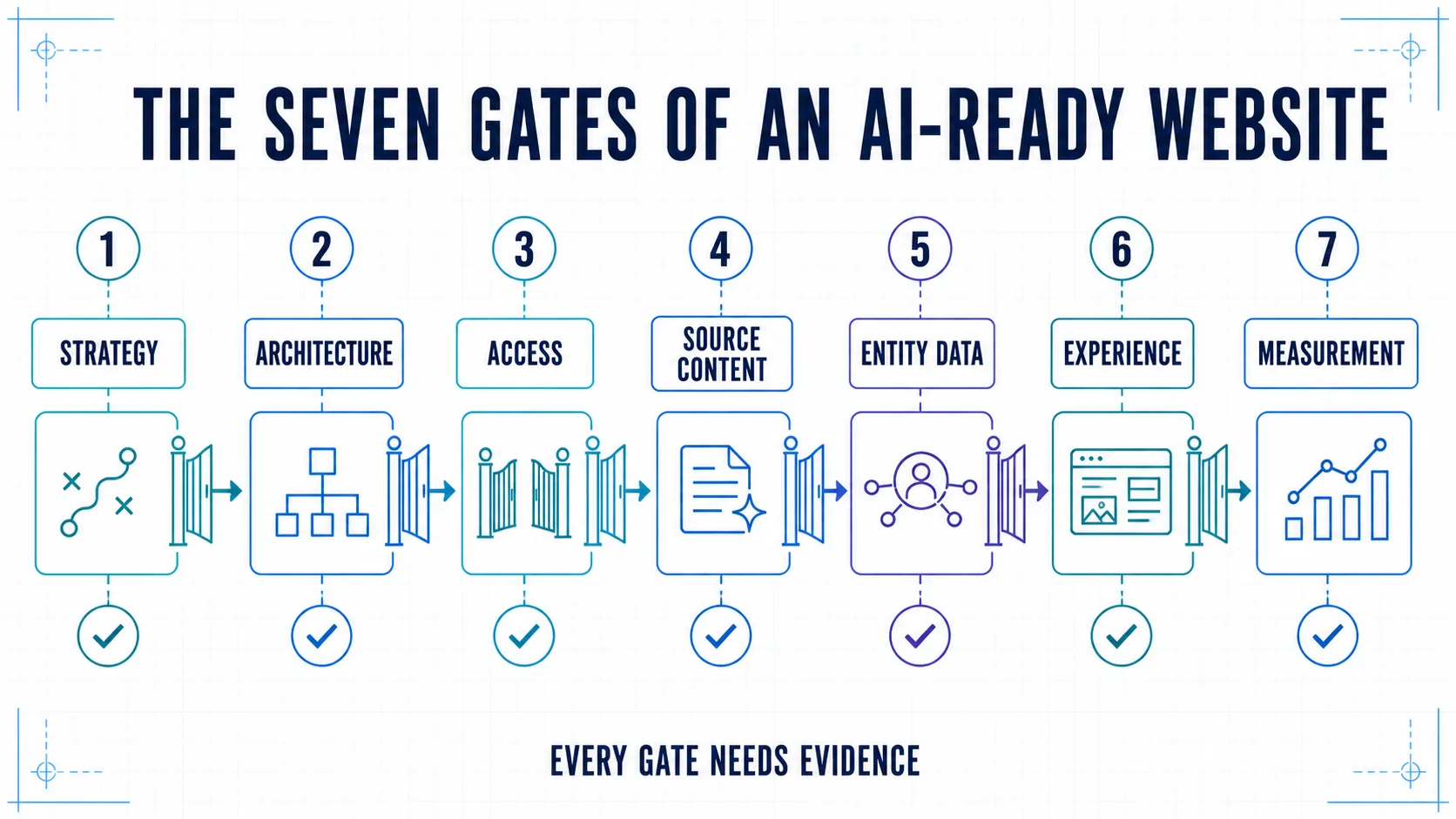
This checklist turns that standard into seven launch gates.
How to use this checklist
Do not treat the checkboxes as a one-time score. For every material item, record four fields:
- Owner: the person accountable for the decision.
- Pass condition: the observable state that counts as done.
- Proof: a URL, response capture, test, log sample, source, or screenshot.
- Retest: the date or release event that triggers another check.
A statement such as “crawler access configured” is not a pass condition. “OAI-SearchBot received a production 200, the main answer was present in rendered HTML, and the request appeared in edge logs on 2026-09-06” is one.
The launch-blocker view
| Gate | Do not launch when… | Minimum proof |
|---|---|---|
| Strategy | no owner or business decision is defined | signed scope and owner matrix |
| Architecture | a priority intent has no canonical destination | route and redirect crawl |
| Access | production returns a block, error, wrong canonical, or empty main content | raw response, rendered page, and log |
| Source content | consequential claims are unsupported or misleading | reviewed claim ledger |
| Entity data | visible facts, JSON-LD, and feeds disagree | cross-surface comparison |
| Experience | the primary task fails on representative mobile conditions | field data or release test |
| Measurement | no baseline, release marker, or conversion validation exists | saved report and event test |
Gate 1: Define the strategy and operating model
“Optimize the site for AI” is not a build brief. Start with the decisions the website must help real customers make.
- [ ] Define the primary audiences, markets, languages, products, and buying stages.
- [ ] List the commercial questions the site must answer: category choice, comparison, implementation, risk, price, compatibility, or vendor validation.
- [ ] Select the priority product, service, and editorial pages for launch.
- [ ] Create prompt families that represent those questions; keep keywords as one input, not the entire model.
- [ ] Identify the authoritative internal record for product facts, prices, availability, policies, people, locations, and proof.
- [ ] Name owners for architecture, content, technical access, entity data, analytics, privacy, security, and translations.
- [ ] Define correction and escalation paths for inaccurate or stale information.
- [ ] Separate success metrics for search visibility, generated-answer mentions, owned citations, referral visits, qualified conversions, and revenue.
- [ ] Reject guarantees of rankings, citations, or recommendations on third-party systems.
Write the decision record before the backlog
Record why the project exists, what it excludes, and which outcomes would justify another release. This prevents “AI optimization” from becoming an unbounded list of speculative tasks.
A useful objective is: “Make our five priority service decisions answerable from maintained first-party evidence in English and German, confirm access on the platforms we choose to support, and measure qualified demand by landing page.” That is much stronger than “get into every AI answer.”
Gate 1 passes when: the team can name the pages, questions, sources of truth, owners, metrics, and non-goals.
Gate 2: Design the architecture and fact model
Information architecture should give every distinct intent one stable destination and make the relationship between pages explicit.
URL and navigation checklist
- [ ] Give each material intent one canonical URL.
- [ ] Create hubs for broad subjects and supporting pages for definitions, comparisons, methods, risks, implementation, and decisions.
- [ ] Use descriptive navigation and contextual internal links.
- [ ] Keep priority pages reachable through a sensible click path.
- [ ] Avoid near-duplicate pages made only for minor keyword or prompt variations.
- [ ] Document lowercase, trailing-slash, parameter, redirect, pagination, and discontinued-content rules.
- [ ] Define what happens when a product, service, location, or article is merged, renamed, or retired.
- [ ] Ensure breadcrumbs and XML sitemaps reflect the intended hierarchy.
Model facts once
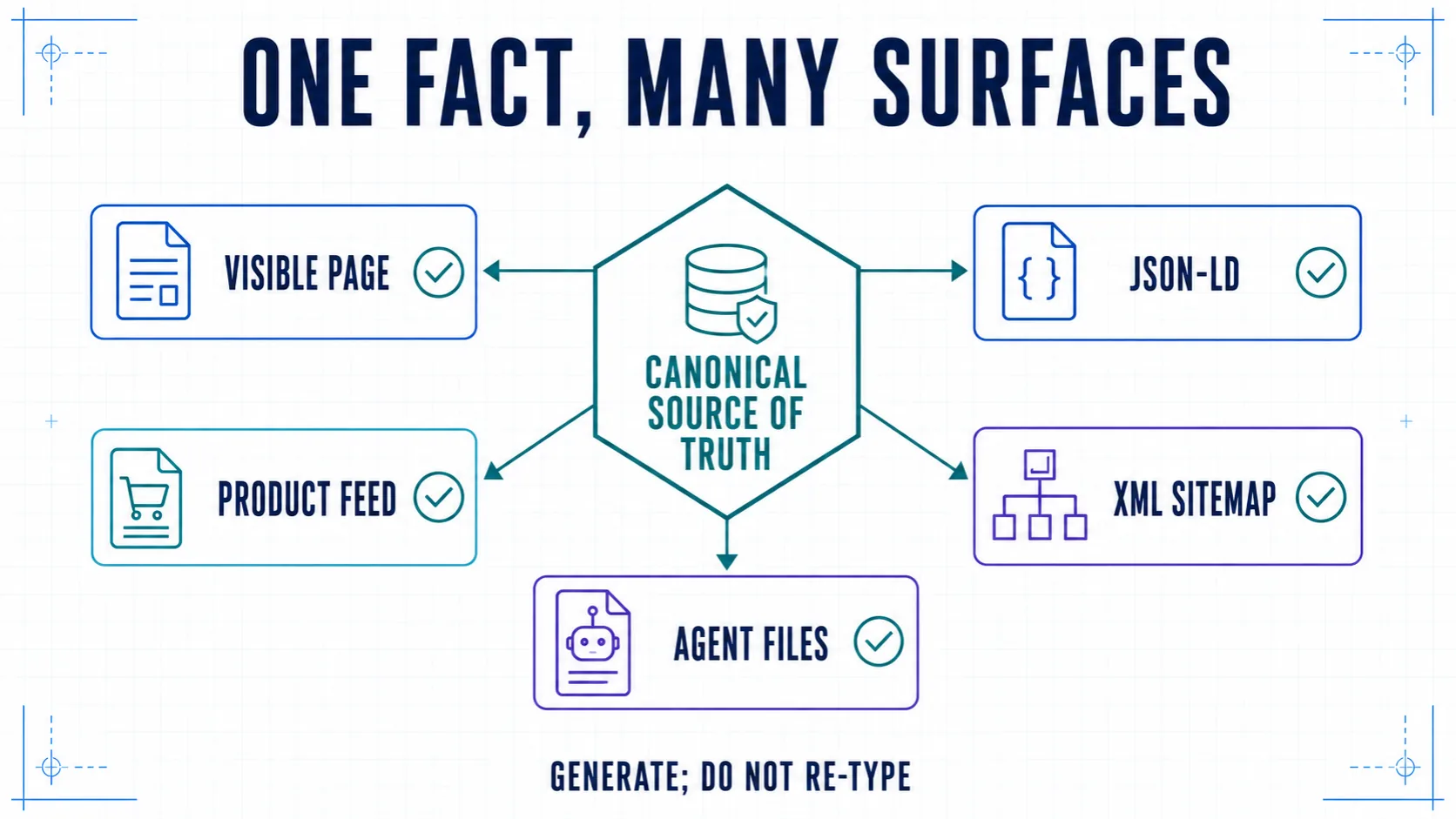
The visible page, JSON-LD, product feed, sitemap, and optional agent-facing file should not be five independently typed records. They should be outputs of maintained data and content.
- [ ] Define canonical fields for organization, author, product, service, location, offer, policy, and article records.
- [ ] Give stable entities persistent identifiers and URLs.
- [ ] Store dates as facts with meaning: published, substantively modified, reviewed, available, or expires.
- [ ] Generate repeated facts from the same underlying record wherever practical.
- [ ] Keep editorial interpretation separate from product facts.
- [ ] Add validation for impossible or conflicting states.
- [ ] Assign an owner and refresh rule to volatile fields.
The least glamorous AI-readiness feature may be the most useful: one price changed in one place. Synchronizing a dull fact across the page, structured data, and feed prevents a far more interesting public contradiction.
Gate 2 passes when: each priority intent has a canonical route and each important fact has one accountable origin.
Gate 3: Prove access, indexing, rendering, and policy
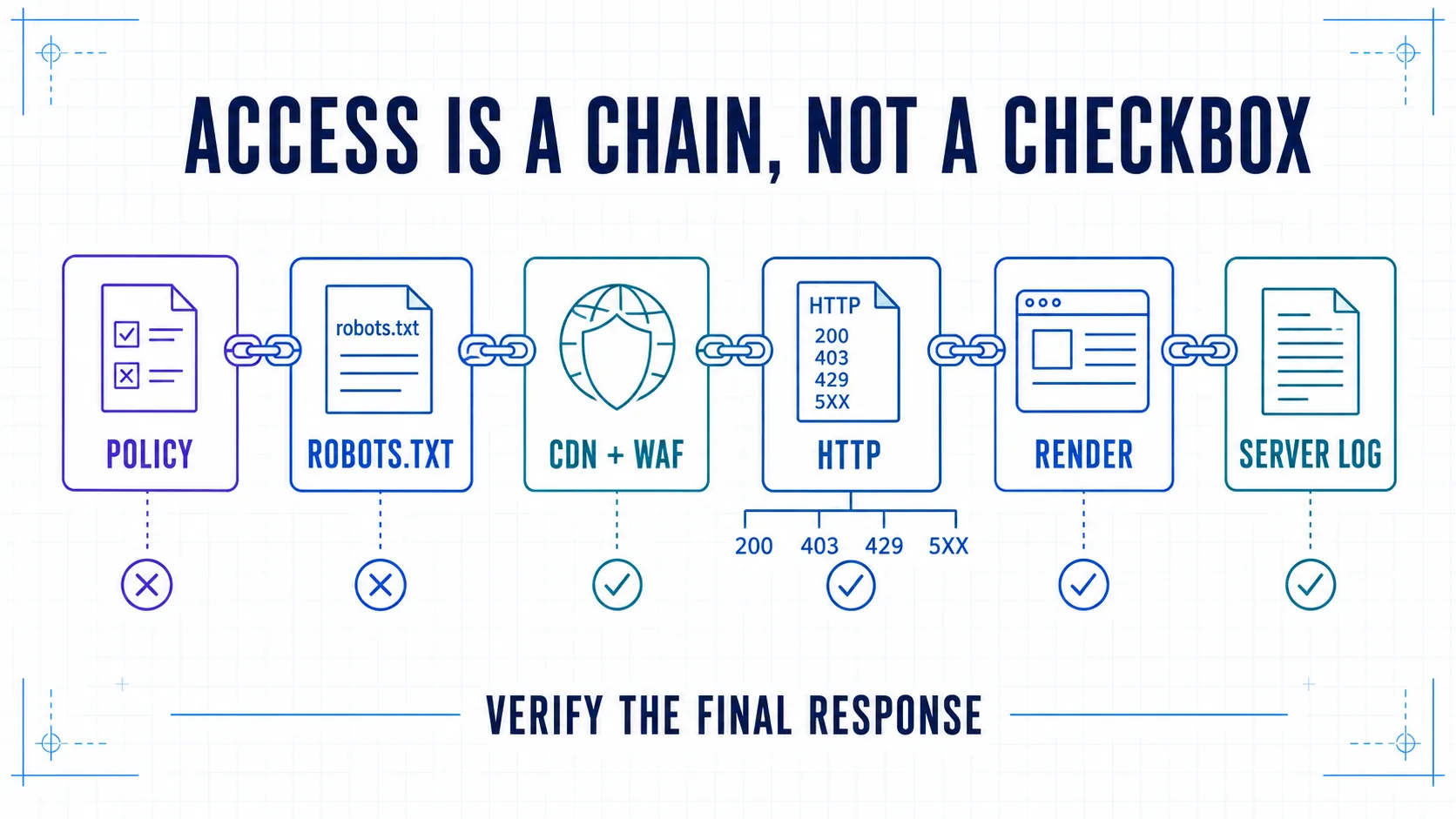
Access is a chain. A correct robots.txt rule does not override a CDN challenge, WAF block, application error, authentication wall, client-rendering failure, or stale canonical.
Crawl and index controls
- [ ] Priority routes return a direct
200in production. - [ ] Redirects are intentional, finite, and resolve to the final canonical URL.
- [ ] Canonicals point to successful, indexable URLs.
- [ ]
robots.txt, meta robots,X-Robots-Tag, authentication, and search-feature controls match the approved policy. - [ ] XML sitemaps contain only absolute canonical indexable URLs and accurate modification dates.
- [ ] Internal links use final URLs rather than redirecting versions.
- [ ] Staging remains protected without leaking its rules into production.
- [ ] Error, removed, and empty states return the correct HTTP status.
- [ ] CDN, WAF, rate limiting, and bot management do not contradict approved access.
- [ ] Server and edge logs can show crawler status, path, timestamp, and response class.
Google says pages must be indexed and eligible to show snippets to appear in its generative Search features. Meeting the requirements does not guarantee crawl, indexing, or selection. Use URL Inspection and Search Console evidence rather than assuming a sitemap submission equals inclusion.
Render the important answer reliably
- [ ] The H1, primary answer, body copy, meaningful links, canonical, author, dates, and relevant JSON-LD appear in server-rendered or reliably prerendered HTML.
- [ ] Critical information does not require a click, filter, search, consent acceptance, or login.
- [ ] Client hydration does not replace correct metadata with stale defaults.
- [ ] Links are ordinary crawlable anchors with real destinations.
- [ ] Lazy loading does not hide the primary text or lead media.
- [ ] Raw and rendered HTML are compared on every priority template.
- [ ] JavaScript errors and failed API requests do not remove the main content.
Google can render JavaScript, but its JavaScript SEO guidance still recommends making content and links discoverable and handling statuses and canonicals correctly. Server or static output reduces the number of failure points for important public information.
Separate bot purposes
- [ ] Decide separately on search discovery, user-triggered retrieval, and model training.
- [ ] Verify crawler names and IP guidance using current first-party documentation.
- [ ] Test the real production response after policy changes.
- [ ] Date the decision and involve legal, privacy, licensing, and security owners where appropriate.
OpenAI's crawler documentation distinguishes OAI-SearchBot for ChatGPT Search, GPTBot for potential training, and ChatGPT-User for user-initiated requests. Perplexity likewise documents separate search and user-triggered fetchers. Names and behavior can change, so do not copy an undated generic bot list.
Treat special files as optional surfaces
- [ ] Use the standard XML sitemap as the canonical discovery file.
- [ ] Treat
llms.txtas an optional proposal for agents that choose to request it. - [ ] Keep any agent-facing file factual, canonical, public, and maintained.
- [ ] Do not claim that
llms.txt, an “AI sitemap,” or AI-specific schema is a Google ranking requirement. - [ ] Do not let an experimental file delay fixes to HTML, canonicals, access, or source quality.
The `llms.txt` specification describes itself as a proposal. Google says no new machine-readable AI file or special markup is needed for its generative features.
Gate 3 passes when: policy, edge delivery, HTTP state, rendered content, canonical selection, and logs tell the same story.
Gate 4: Build source-led content, not prompt-shaped filler
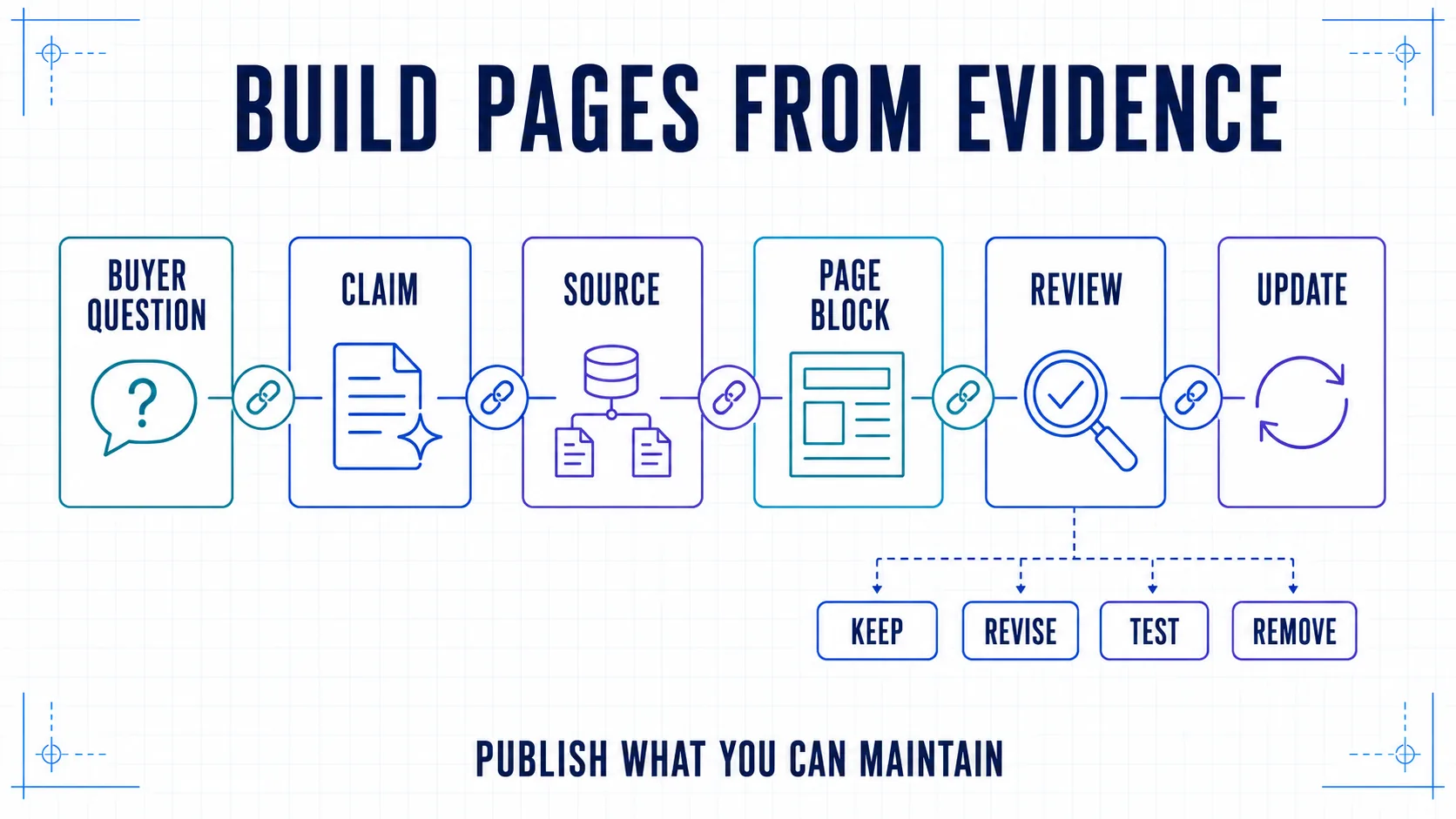
A source-worthy page resolves a real uncertainty and lets a reader verify the important parts. It does not need to predict every wording of a future prompt.
Page design checklist
- [ ] Answer the primary question near the beginning.
- [ ] Use descriptive headings based on reader tasks.
- [ ] Write complete passages that retain meaning when quoted with their qualifiers.
- [ ] Use numbered steps for sequences and tables for genuine comparisons.
- [ ] Define important terms in plain language.
- [ ] Explain trade-offs, constraints, prerequisites, and who the recommendation does not fit.
- [ ] Cover the next logical questions without stealing another page's intent.
- [ ] Add an appropriate next step instead of repeating sales CTAs.
- [ ] Use useful images with descriptive alt text and adjacent explanation.
- [ ] Avoid filler word counts, mechanical “chunking,” and mass-produced near duplicates.
Claim and source checklist
- [ ] Map consequential claims to primary or authoritative sources.
- [ ] Put citations beside the wording they support.
- [ ] Confirm that the source supports the scope, date, population, and causal language used.
- [ ] Label observed, modeled, estimated, and opinion-based statements.
- [ ] Publish methods and limitations for original benchmarks, surveys, and tests.
- [ ] Remove or qualify claims that cannot be maintained.
- [ ] Record source review dates and monitor material changes or broken links.
- [ ] Provide a correction channel and name the update owner.
- [ ] Change
updatedDateonly after substantive review.
Google's guidance on generative AI content centers on accuracy, quality, and relevance. Automation can assist research, transformation, QA, or drafting, but scaled low-value output is still low-value output. Where readers reasonably need context about automation, explain the process.
Add original information
Priority clusters should include at least one asset another publisher cannot create by paraphrasing the same sources:
- a documented implementation or teardown;
- a benchmark with a reproducible method;
- a calculator, fieldbook, template, or decision framework;
- a first-party survey or anonymized operating dataset;
- a case with baseline, changes, period, and limitations;
- expert answers that expose real constraints and judgment.
Use the source-led citation guide to build the claim ledger and review policy.
Gate 4 passes when: a skeptical editor can trace material claims to evidence, understand the limitations, and see what this page contributes beyond synthesis.
Gate 5: Align entities, structured data, and commercial surfaces
Structured data helps describe visible entities and can support eligible search appearances; it is not a citation switch. Google's structured data guidelines require markup to represent visible, current page content and do not guarantee a rich result.
Entity consistency
- [ ] Maintain a canonical organization record with name, URL, logo, contacts, markets, and identifiers.
- [ ] Create stable author, product, service, offer, and location records.
- [ ] Use consistent entity names and URLs across navigation, articles, profiles, listings, and partner pages.
- [ ] Connect authors to real biographies, relevant experience, and review responsibility.
- [ ] Distinguish legal identity, trading name, brand, and product names where necessary.
- [ ] Resolve conflicts through the source-of-truth owner instead of editing one surface.
Structured data
- [ ] Choose only relevant types supported by Schema.org and the intended search feature.
- [ ] Generate JSON-LD from the same records as visible content.
- [ ] Reuse stable
@idvalues where entities recur. - [ ] Ensure authors, dates, breadcrumbs, products, offers, ratings, availability, and policies match what users can see.
- [ ] Do not invent reviews, aggregate ratings, prices, awards, availability, or credentials.
- [ ] Remove duplicate or conflicting template and plugin output.
- [ ] Validate syntax, feature eligibility, and the rendered production output.
- [ ] Revalidate after template, CMS, pricing, localization, or routing changes.
Ecommerce, local, and feed parity
- [ ] Product price, currency, availability, identifier, variant, and shipping facts agree across page, structured data, checkout, and feeds.
- [ ] Local name, address, phone, hours, service area, and booking rules agree across the site and maintained profiles.
- [ ] Policies have stable public URLs and explicit effective dates.
- [ ] Fast-changing values have freshness ownership and automated conflict checks where feasible.
Gate 5 passes when: a comparison of visible copy, JSON-LD, feeds, and entity records finds no material contradiction.
Gate 6: Engineer a usable, resilient experience
Performance is not an AI citation guarantee. It supports crawling efficiency, reader trust, task completion, and search page experience.
Performance and stability
- [ ] Measure field LCP, INP, and CLS at the 75th percentile for representative page groups.
- [ ] Use Google's “good” thresholds as release targets: LCP at or below 2.5 seconds, INP at or below 200 milliseconds, and CLS at or below 0.1.
- [ ] Improve server response and remove avoidable API waterfalls.
- [ ] Discover and prioritize the real LCP resource.
- [ ] Reduce long main-thread tasks and unnecessary hydration.
- [ ] Reserve dimensions for images, embeds, banners, ads, and consent UI.
- [ ] Set route-level budgets for JavaScript, images, fonts, and third-party code.
- [ ] Test mobile hardware and networks representative of the audience.
See the Core Web Vitals implementation guide for a field-to-fix workflow. Google's Core Web Vitals documentation is the primary source for current definitions and thresholds.
Accessibility, security, and task completion
- [ ] Semantic landmarks and heading order express the document structure.
- [ ] Keyboard users can navigate and complete primary tasks.
- [ ] Images have appropriate alt text; decorative assets are ignored.
- [ ] Forms have labels, useful errors, and confirmation states.
- [ ] Contrast, focus visibility, zoom, and reduced-motion preferences are respected.
- [ ] Consent and promotional overlays do not cover the main answer.
- [ ] HTTPS, security headers, dependency review, and abuse controls are part of release QA.
- [ ] Rate limiting protects infrastructure without silently blocking approved crawlers or customers.
- [ ] Important information remains usable when optional scripts fail.
International delivery
- [ ] Each locale has a stable URL and self-referencing canonical.
- [ ] Equivalent pages use valid reciprocal
hreflang. - [ ] Language switching uses crawlable links.
- [ ] IP or browser-language detection does not force an uncrawlable redirect.
- [ ] Main content, terminology, currencies, units, examples, sources, and proof are genuinely localized.
- [ ] Facts and limitations remain consistent between languages.
- [ ] Locale routing, sitemap, content availability, and analytics use one registry.
- [ ] Native-language prompt cohorts are measured separately.
Gate 6 passes when: the priority task works on representative devices, languages, and failure conditions without losing the main information.
Gate 7: Instrument the launch and learning loop
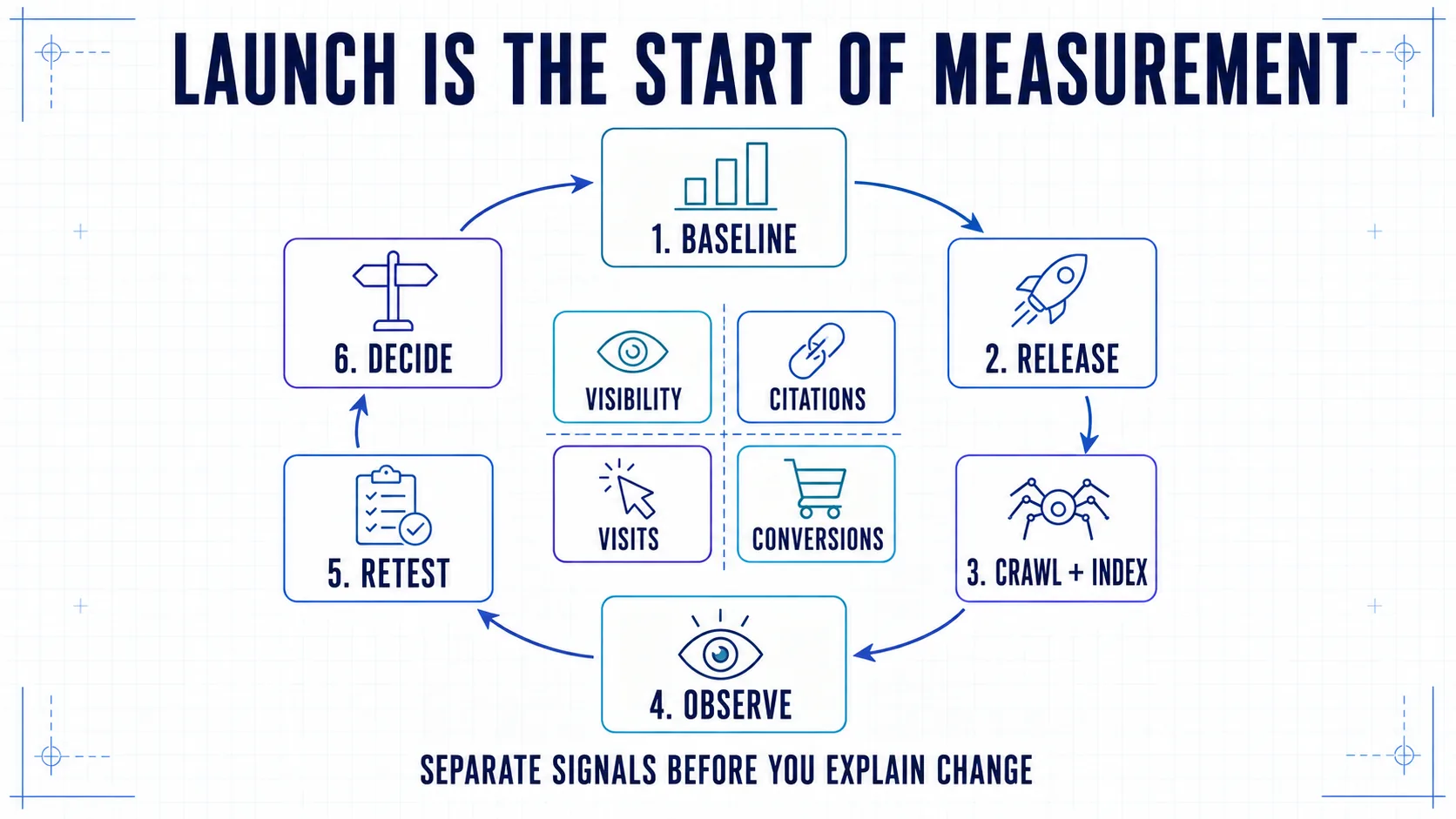
Build the baseline before release. Otherwise, a post-launch change becomes a story rather than a measurement.
Baseline and analytics
- [ ] Save organic search landing-page, query, device, country, engagement, and conversion baselines.
- [ ] Export Google's generative AI performance report when data is available.
- [ ] Keep Google AI Overview and AI Mode impressions separate from cross-platform citations.
- [ ] Classify known AI referral sources and preserve referrers and UTM parameters through redirects.
- [ ] Validate primary conversion events in production.
- [ ] Connect qualified leads, pipeline, or revenue where consent and systems allow.
- [ ] Freeze a prompt cohort with wording, market, language, platform or mode, session state, repetition, and capture date.
- [ ] Record mentions, owned citations, cited third parties, prominence, accuracy, sentiment, visits, and conversions separately.
- [ ] Keep a release log with changed URLs, hypotheses, owners, and rollout dates.
Google's Generative AI performance report currently reports impressions from AI Overviews and AI Mode by page, country, date, and device. It is useful first-party evidence for Google Search, but it does not explain why a page was selected and does not measure ChatGPT or Perplexity.
Pre-launch QA
- [ ] Crawl production-like output across every priority template and locale.
- [ ] Compare raw HTML, rendered HTML, and the user-visible page.
- [ ] Validate statuses, redirects, canonicals, robots directives, sitemaps, titles, headings, authors, dates, and structured data.
- [ ] Test approved crawler paths through the real CDN and WAF.
- [ ] Check internal links, citations, images, and downloadable assets.
- [ ] Verify analytics events, consent behavior, and referral preservation.
- [ ] Run performance, accessibility, mobile, security, and form tests.
- [ ] Confirm monitoring, rollback, and incident ownership.
- [ ] Have accountable humans review consequential claims and published translations.
Post-launch cadence
- Confirm successful delivery and rendering from tests and logs.
- Review indexing and canonical selection.
- Mark the first complete observation window.
- Compare search visibility, generated-answer observations, visits, and conversions separately.
- Investigate factual errors and source gaps before chasing volume.
- Run one defined content or technical experiment at a time where possible.
- Wait for crawl, indexing, and a defensible observation window.
- Rerun the same measurement cohort.
- Decide to scale, revise, retain, or stop.
Gate 7 passes when: the team can reproduce the baseline, identify the exact release, validate the business event, and explain what it will compare next.
Implementation artifact: Download the AI-Optimized Website Build Spec (Markdown) to assign every gate, record evidence, maintain the claim and entity registers, and run launch plus 30/60/90-day reviews in one working document.
Final sign-off: what must be true on launch day
The website is ready to launch when:
- each priority buyer question has one canonical, reachable destination;
- important content is present in reliable HTML and no approved path is contradicted by edge security;
- claims, authors, dates, products, services, and policies have accountable sources;
- visible facts, structured data, and feeds agree;
- primary tasks work on representative mobile, language, accessibility, and consent conditions;
- every material finding has evidence, an owner, and a retest;
- the baseline, release marker, monitoring, conversion test, and rollback plan exist.
Passing this checklist cannot guarantee a ranking, mention, recommendation, citation, click, or revenue result on a third-party platform. It creates something more controllable: a reliable public source that people can use, search systems can access, editors can defend, and the business can improve with evidence.
For an existing website, use the GEO audit checklist to diagnose current eligibility and visibility. AppWebSeo's generative engine optimization service combines the architecture, engineering, content, entity, and measurement work into an accountable implementation program.
Primary sources
- Google: Optimizing for generative AI features
- Google: Using generative AI content on your website
- Google: JavaScript SEO basics
- Google: General structured data guidelines
- Google: Core Web Vitals and Search
- Google Search Console: Generative AI performance report
- OpenAI: Overview of OpenAI crawlers
- Perplexity: Crawler documentation
- The `llms.txt` proposal