

What is the best headless ecommerce platform in 2026?
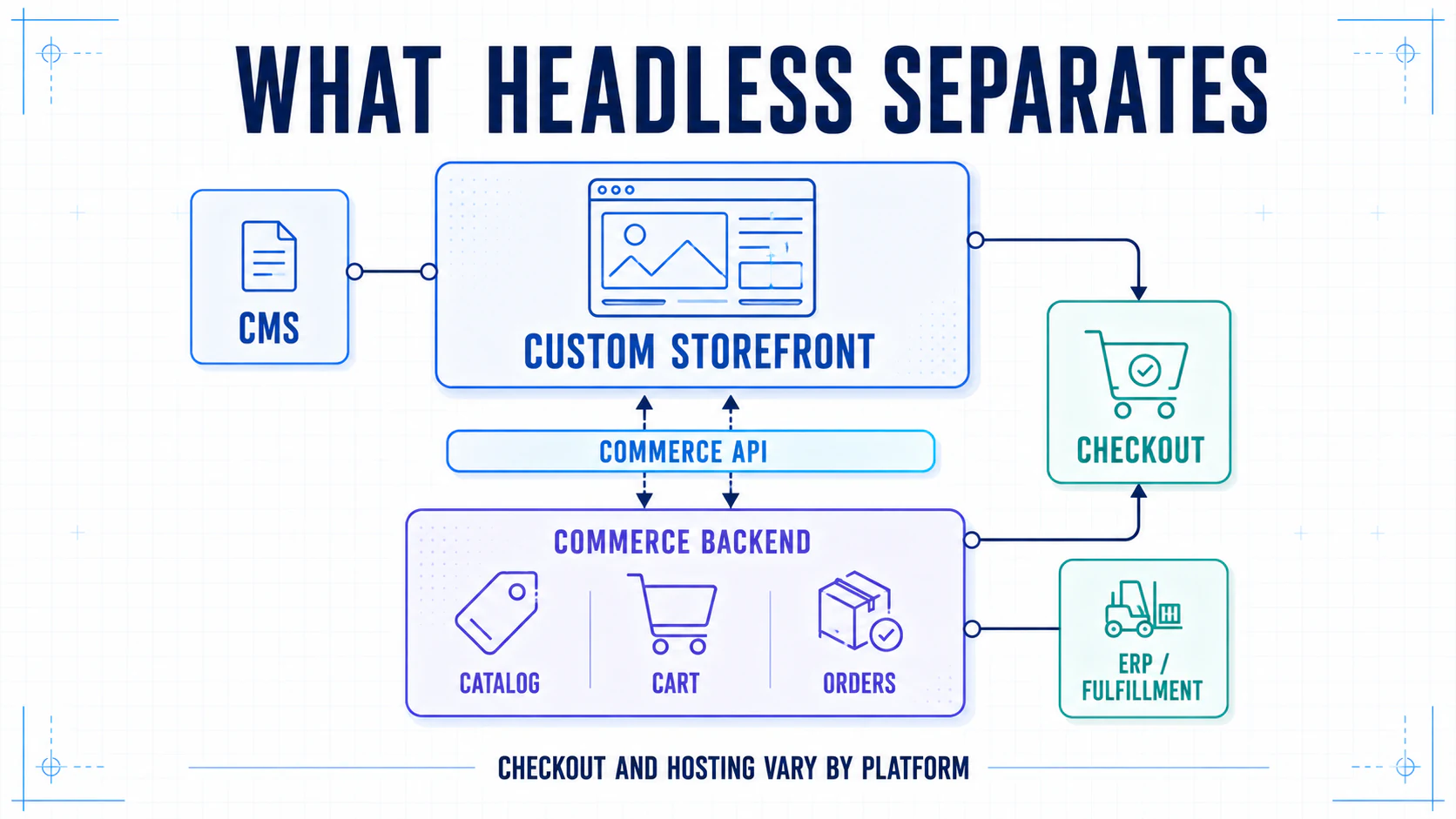
There is no single best headless ecommerce platform. The right choice is the platform that covers the business's difficult commerce rules while leaving the frontend team enough control to improve the customer journey without rebuilding commodity capabilities.
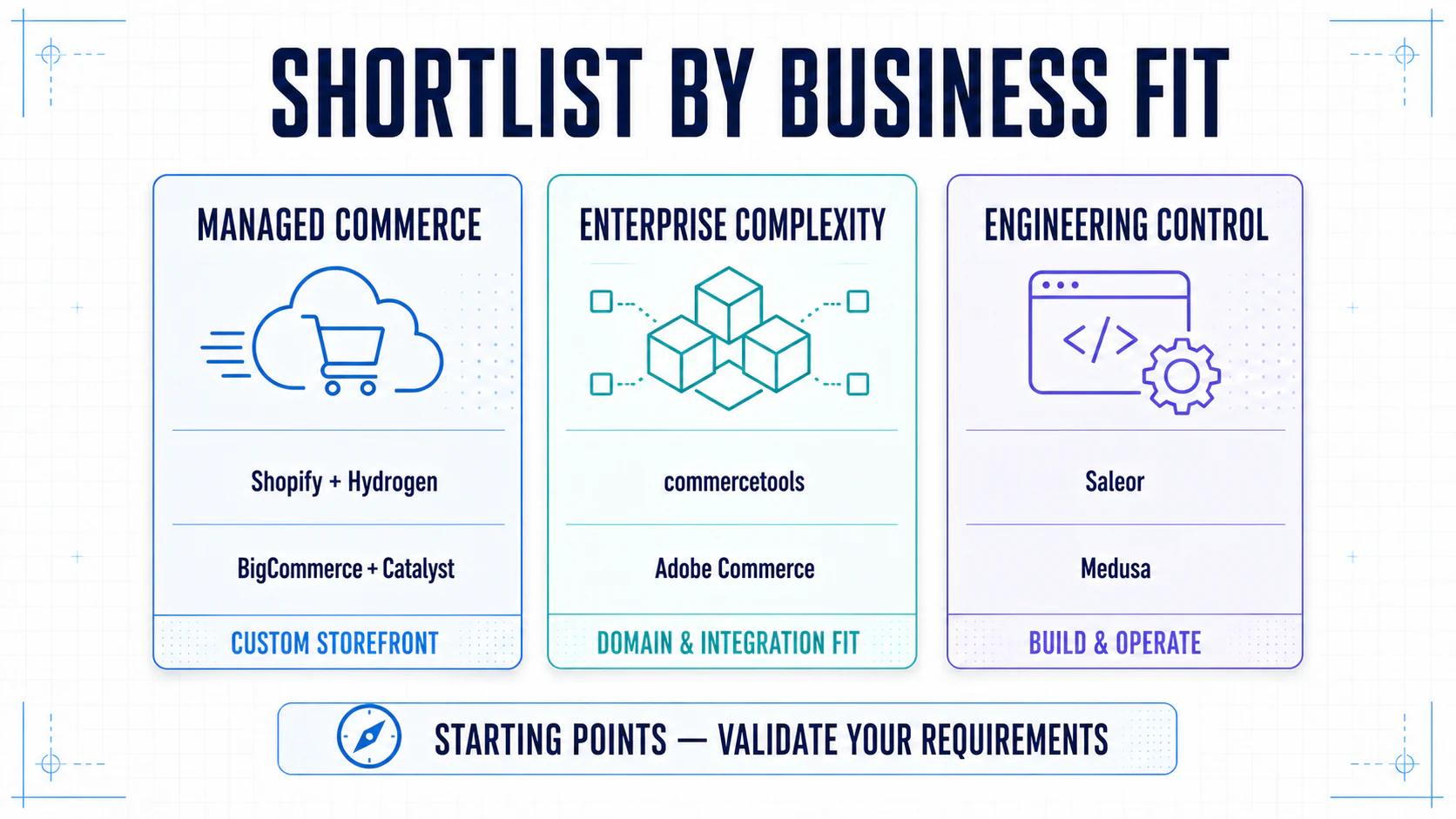
For growth brands whose requirements fit Shopify's commerce model, Hydrogen provides a supported route from a managed backend to a custom storefront. BigCommerce Catalyst is a strong fit for teams that want a SaaS backend with an official Next.js reference storefront. commercetools and Adobe Commerce suit complex enterprise programs with larger integration and governance needs. Saleor and Medusa suit engineering-led teams that value API-native or modular open-source control.
“Headless” alone does not raise conversion. Conversion depends on product-market fit, merchandising, checkout, content, price, trust, performance, experimentation, and operational reliability. Architecture can remove constraints—or create new ones.
Shortlist at a glance
| Platform | Strongest fit | Frontend starting point | Main trade-off |
|---|---|---|---|
| Shopify + Hydrogen | Growth brands wanting managed commerce and custom UX | Supported Hydrogen stack; 2026 framework-agnostic preview also available | Deep non-standard commerce logic can require apps or external services |
| BigCommerce + Catalyst | Mid-market and enterprise teams wanting SaaS plus Next.js | Catalyst with Next.js, React components, GraphQL, and visual editing | Not every platform or marketplace feature has headless parity |
| commercetools | Large composable programs with complex domains and multiple channels | Choose or build a frontend; optional commercetools Frontend | High solution-design and integration responsibility |
| Adobe Commerce | Adobe-centered enterprise, B2B, and complex catalog operations | Custom or Adobe storefront options over GraphQL services | Operational and architectural complexity |
| Saleor | GraphQL-first teams needing extensibility and multichannel control | API-first backend with Next.js storefront examples | Requires a capable product engineering team |
| Medusa | JavaScript/TypeScript teams wanting modular open-source commerce | Separate custom storefront or Next.js starter | Team owns more assembly, infrastructure, and lifecycle decisions |
This shortlist is not exhaustive. It focuses on platforms with documented headless architectures and distinct buyer profiles. Evaluate every candidate against your actual catalog, promotions, tax, checkout, market, and integration scenarios.
Review method: Platform architecture and support claims were checked against the linked first-party documentation on September 5, 2026. The fit recommendations are editorial judgments. This guide does not report a comparative production benchmark or measured conversion uplift.
1. Shopify with Hydrogen
Best for
Brands that want Shopify's managed catalog, order, market, payment, and checkout ecosystem while replacing the standard theme layer with a custom storefront.
Shopify describes Hydrogen and Oxygen as its recommended headless stack. The current supported Hydrogen path uses React Router and provides Shopify-specific components, Storefront API clients, server rendering, routing, caching patterns, and deployment to Oxygen. Shopify's Hydrogen fundamentals document how these parts work together.
In June 2026, Shopify released a developer preview that separates Hydrogen's commerce primitives from a single framework. The official preview documentation distinguishes the supported React Router path from the preview SDK, which can work with several server-rendered JavaScript frameworks and runtimes. A production decision should explicitly choose stable support or preview flexibility rather than mixing the two accidentally.
Strengths
- mature hosted commerce operations and checkout;
- first-party Storefront API and headless tooling;
- Shop Pay and Shopify Markets integration paths;
- managed Oxygen edge hosting for the supported stack;
- strong merchant familiarity and partner ecosystem;
- a practical path for brands already operating on Shopify.
Watch-outs
- app behavior built for Online Store themes may not work automatically in headless;
- custom analytics must preserve Shopify and consent requirements;
- API, caching, customer-account, and market behavior need explicit tests;
- a custom storefront creates code ownership and release responsibility;
- highly specialized B2B, pricing, or workflow rules may require additional architecture.
Choose Shopify when its commerce model fits and custom presentation is the primary reason to go headless. Do not choose it merely because Hydrogen is fashionable.
2. BigCommerce with Catalyst
Best for
Teams that want a managed BigCommerce backend and an official React/Next.js storefront foundation with a relatively direct route to customization.
BigCommerce describes Catalyst as its composable headless storefront framework built with Next.js, React storefront components, and the GraphQL Storefront API. The documented starter includes product discovery, product and category pages, cart, customer accounts, and a secure redirected checkout, plus Makeswift visual editing.
Strengths
- production-oriented reference storefront rather than a blank API integration;
- GraphQL storefront data and React component foundation;
- BigCommerce-managed commerce administration;
- visual-editing route for content teams;
- documented support for complex and frequently changing catalogs;
- hosted checkout can reduce the frontend's payment-card scope.
Watch-outs
BigCommerce's own storefront getting-started documentation notes that the GraphQL Storefront API does not support every platform feature, not every marketplace app supports Catalyst, and the merchant owns production hosting of the storefront. Verify each required feature rather than assuming parity with a Stencil store.
Choose Catalyst when its documented funnel and extension model cover the requirements. If a critical promotion, account, app, or checkout behavior is unsupported, price the workaround before committing.
3. commercetools
Best for
Large organizations building composable commerce across multiple brands, regions, teams, or channels, especially when domain services and integration ownership are already part of the operating model.
commercetools provides API-based commerce capabilities and lets teams assemble the experience and surrounding services. Its Frontend offering is optional rather than the commerce database itself. The commercetools Frontend documentation explicitly states that Frontend does not store product or customer commerce data; it integrates with headless commerce systems for those functions.
Strengths
- granular composable architecture;
- flexibility across brands, channels, and custom experiences;
- API-first integration model;
- separation between commerce domains and frontend experience;
- good fit for organizations with platform engineering capability.
Watch-outs
- the organization must design and govern the total solution, not just license a platform;
- search, CMS, checkout, identity, observability, and integration decisions can span vendors;
- more optionality creates more architecture and testing work;
- a weak ownership model can turn composability into distributed failure and high total cost.
Choose commercetools because complex business domains justify composability, not because a simpler platform feels insufficiently “enterprise.”
4. Adobe Commerce
Best for
Enterprises with sophisticated catalog, B2B, merchandising, and Adobe ecosystem requirements, or organizations already invested in Adobe Commerce operations and skills.
Adobe exposes core commerce and storefront services through GraphQL. Its Storefront Services documentation separates read-optimized catalog, live search, and product-recommendation schemas from core cart, checkout, customer, and order mutations. That separation can support fast storefront reads, but the frontend must route each operation to the correct service and account for asynchronous indexing where applicable.
Strengths
- extensive commerce capability for complex enterprise operations;
- B2B and catalog depth;
- GraphQL options for headless storefronts;
- Adobe ecosystem integrations;
- separate storefront services for catalog, search, and recommendations.
Watch-outs
- several GraphQL schemas and services can increase integration complexity;
- hosting edition, extensions, headers, and service compatibility matter;
- implementation and maintenance usually require specialized Adobe skills;
- custom frontend performance depends on data orchestration and caching, not the platform label.
Choose Adobe Commerce when its operational depth and ecosystem are real requirements. Model the exact request flows for catalog, cart, customer, checkout, search, and pricing before selecting the frontend stack.
5. Saleor
Best for
Engineering-led businesses that want a GraphQL-native headless commerce backend, strong API control, and an extensible multichannel model.
Saleor presents itself as API-first: storefront and admin capabilities are accessed and extended through APIs, with GraphQL at the center. Its official documentation provides the API reference, core concepts, extension model, app development, self-hosting, and cloud guidance.
Strengths
- GraphQL-native interaction model;
- clear decoupling of storefront and backend;
- open-source core and cloud option;
- extensibility through apps, webhooks, and APIs;
- suitable for custom product and channel experiences.
Watch-outs
- the buyer needs engineering capacity for storefront, integrations, testing, and operations;
- extension and deployment choices require architecture ownership;
- reference storefront code still needs product-specific UX, analytics, SEO, and quality work;
- validate tax, payments, promotions, localization, and back-office requirements against the current version.
Choose Saleor when GraphQL-first control is a requirement the team can operate, not simply a developer preference.
6. Medusa
Best for
JavaScript and TypeScript teams that want modular, open-source commerce building blocks and are comfortable owning the assembled product.
Medusa separates storefront applications from its Node.js server and admin. Its storefront development guide supports a custom frontend or a Next.js starter. Commerce functions are split into modules for domains such as cart, product, pricing, promotion, inventory, order, payment, tax, region, and sales channel, as listed in the Commerce Modules documentation.
Strengths
- modular commerce domains and workflow customization;
- TypeScript/Node.js-friendly development model;
- independent storefront technology;
- open-source control with a managed cloud option;
- flexible fit for specialized workflows and integrations.
Watch-outs
- flexibility transfers more product and operational decisions to your team;
- starter storefronts are a foundation, not a finished conversion system;
- self-hosting requires security, upgrades, backup, observability, and incident ownership;
- confirm module maturity and required integrations for the specific use case.
Choose Medusa when the team wants to build and own a commerce product, not when it needs a turnkey merchant platform with minimal engineering.
Separate frontend control from backend operations
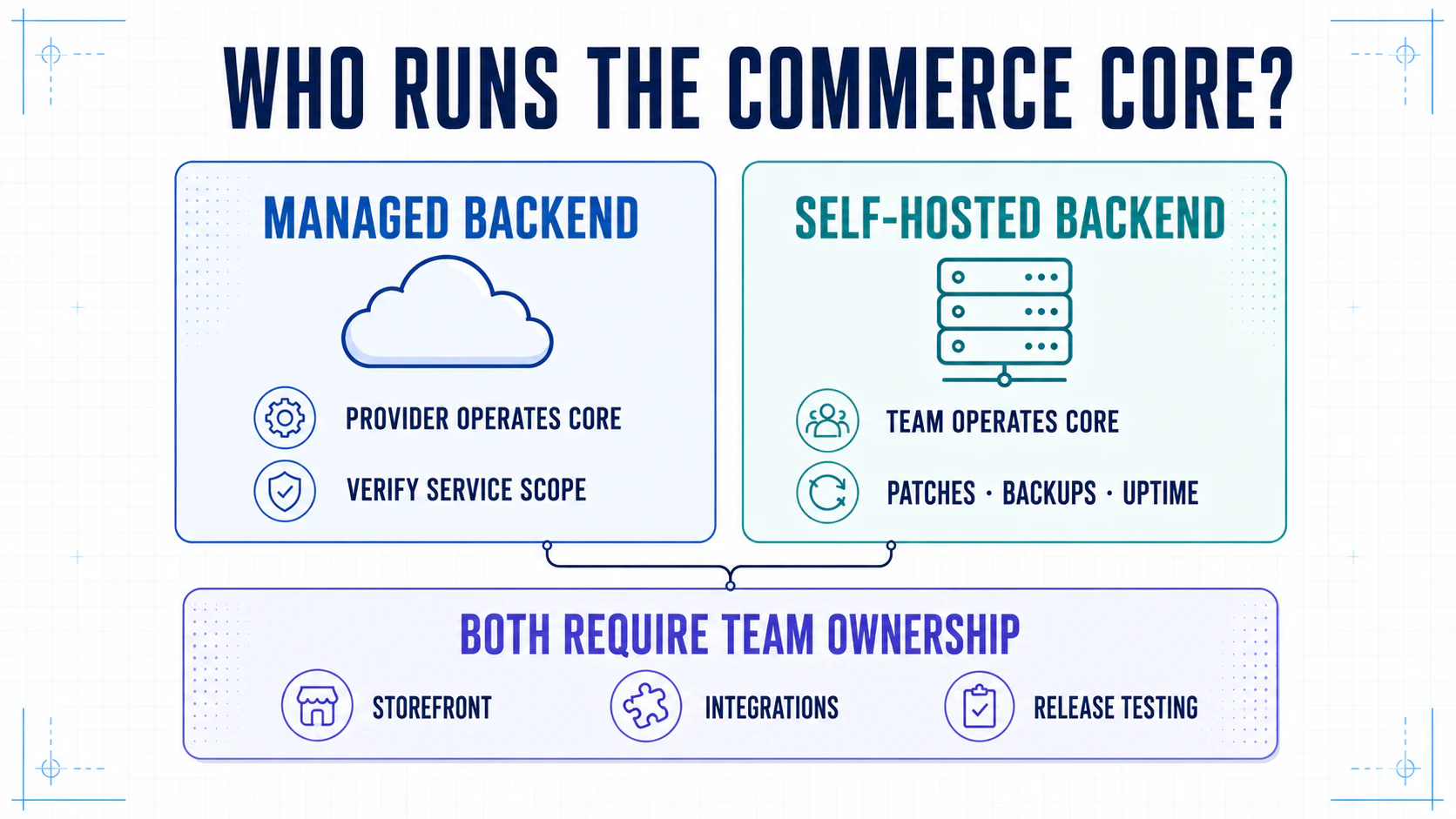
A custom storefront does not require self-hosting the commerce backend. Saleor and Medusa offer cloud options alongside their open-source software, while managed commerce services still leave the team responsible for storefront code and integrations. Confirm who patches the core, restores backups, handles incidents, and supports each integration under the proposed contract.
How to choose for conversion, not for a feature checklist
1. Map the revenue-critical journeys
Test the actual scenarios:
- anonymous and logged-in purchase;
- mobile product discovery;
- promotions and gift cards;
- subscriptions or bundles;
- returns and customer service;
- multi-currency and multi-market checkout;
- B2B account, quote, approval, and price-list flows;
- search, merchandising, and zero-result recovery.
A platform can have hundreds of features and still fail the one journey that differentiates the business.
2. Prototype the hardest rule
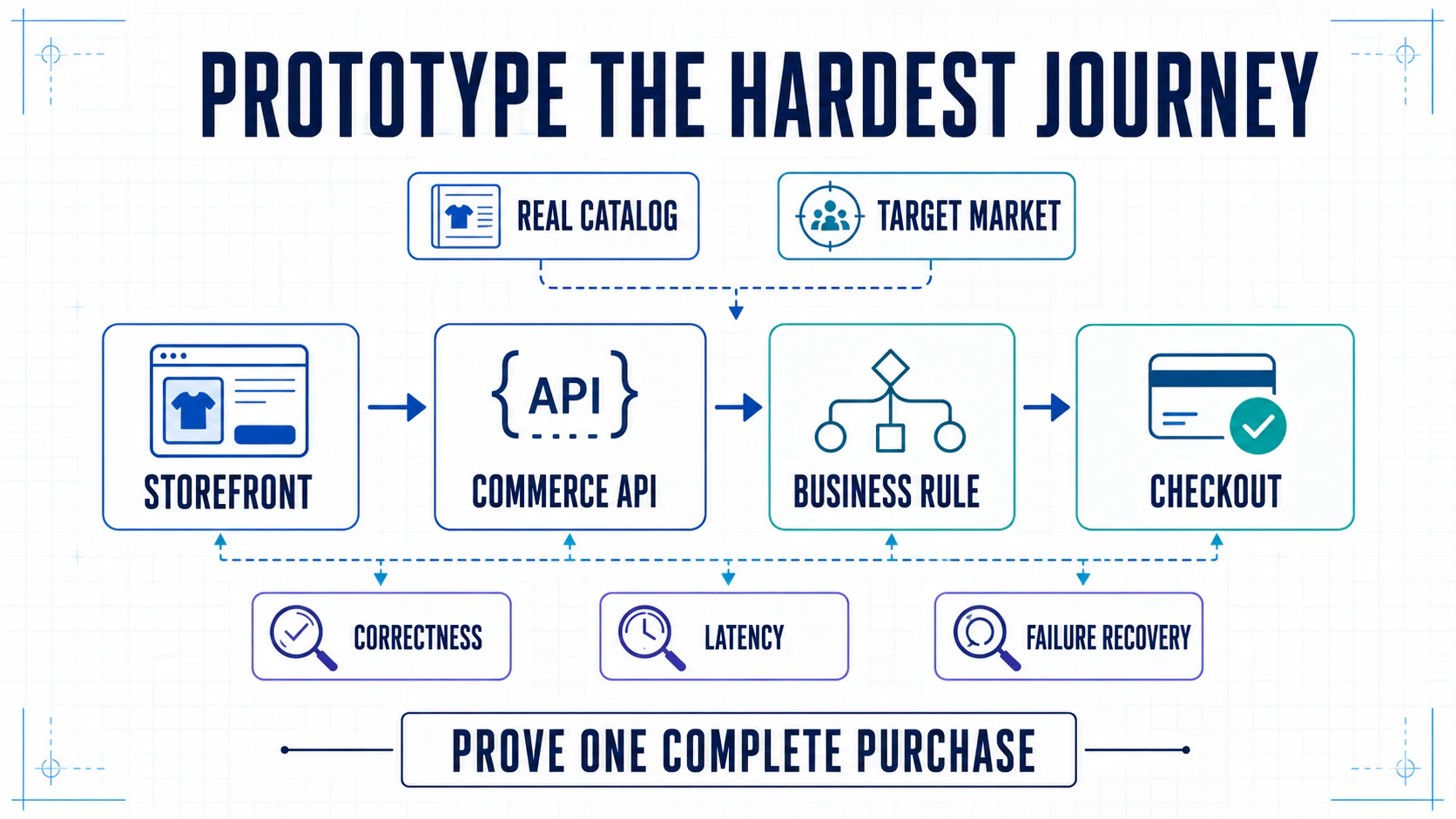
Build a thin vertical slice through storefront, commerce API, integration, and checkout. Use real catalog complexity and a representative market. This reveals API gaps, latency, caching, preview, and operational constraints before the migration is irreversible.
3. Define performance by percentile and journey
Measure field Core Web Vitals, server response, API latency, cache hit rate, error rate, and checkout reliability by market and device. Do not compare vendor demo Lighthouse scores as if they predict your production storefront.
4. Include the editorial workflow
A visually fast storefront can still be commercially slow if marketers need developers for every landing page. Test preview, scheduling, localization, product-content composition, permissions, and rollback.
5. Calculate total operating cost
Include:
- licenses and usage pricing;
- frontend hosting and edge services;
- CMS, search, personalization, and integration vendors;
- implementation and migration;
- engineering and QA capacity;
- monitoring, security, and incident response;
- version upgrades and API changes;
- content operations and localization.
The lowest license price can produce the highest total cost when the team must assemble missing capabilities.
A weighted selection scorecard
Score each candidate using evidence from documentation, a prototype, and reference calls—not sales slides alone.
| Criterion | Example weight |
|---|---|
| Revenue-critical commerce fit | 25% |
| Checkout and payment fit | 15% |
| Market and localization fit | 10% |
| API and integration fit | 15% |
| Storefront performance control | 10% |
| Editorial workflow | 10% |
| Security and operations | 5% |
| Three-year total cost | 10% |
Weights should reflect the business. A B2B manufacturer and a direct-to-consumer fashion brand should not produce the same scorecard.
First identify mandatory requirements, such as an essential payment method, a market's tax behavior, or a required account approval flow. A candidate with an unresolved failure stays outside the scored comparison. Otherwise, a high average can hide the one missing capability that prevents launch.
For candidates that pass those requirements, rate each criterion from 1 to 5 and multiply each rating by its weight. With weights totaling 100%, the sum is a score out of 5. Keep evidence beside the ratings and use the same scale for every candidate. These example weights are a planning aid, not a validated prediction of commercial performance.
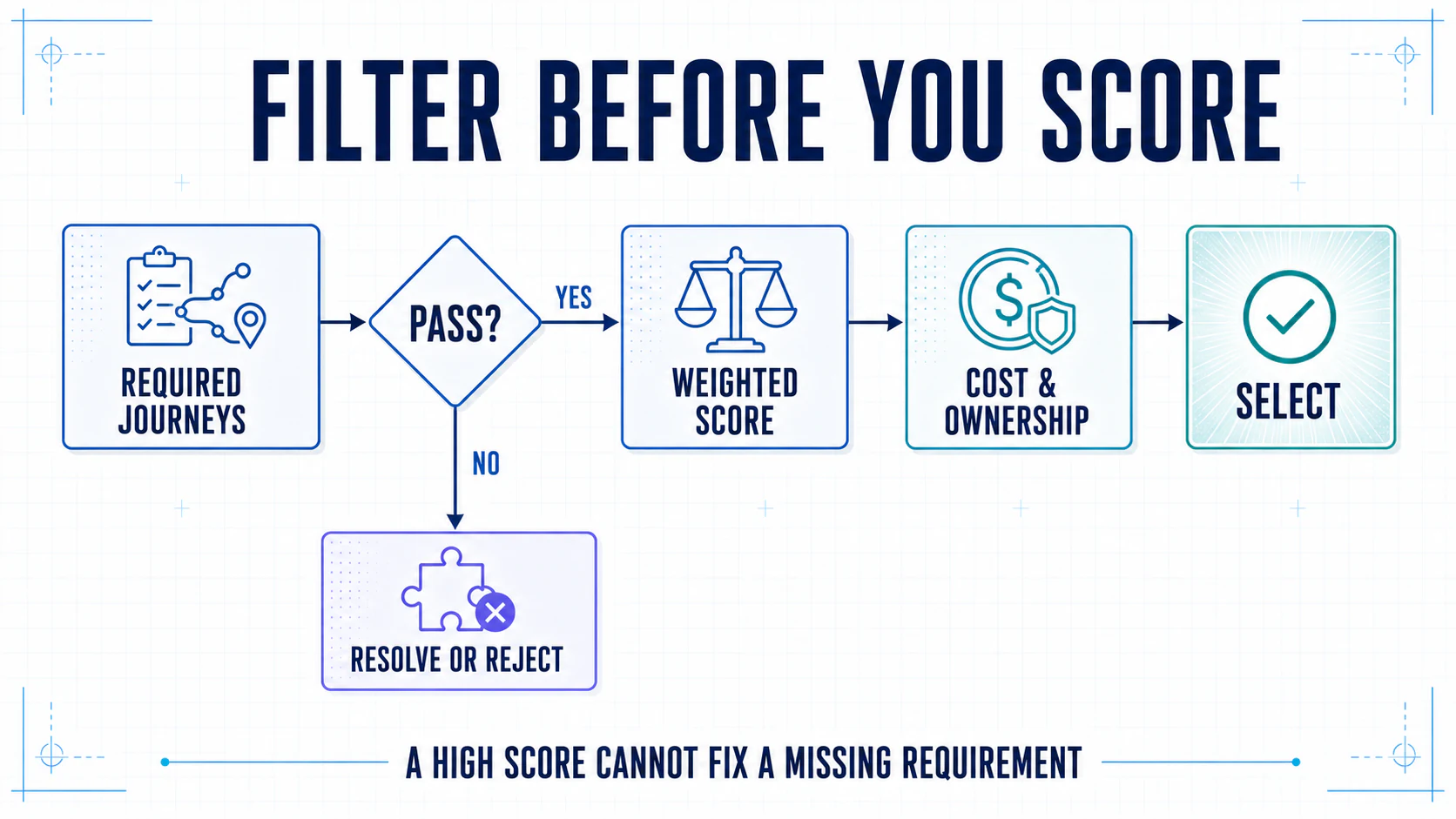
Decision workbook: Download the headless platform selection workbook (XLSX). Adjust the eight weights, test four mandatory requirements per candidate, and enter evidence-based scores for all six platforms. The workbook calculates a comparison only when the inputs and requirements are complete; an evidence log records the supporting tests, links, and owners.
When not to go headless
Stay with a platform's standard storefront when:
- the desired experience is close to a supported theme;
- the team cannot own a custom frontend lifecycle;
- headless would break critical app integrations;
- the business has not identified a valuable constraint to remove;
- content and experimentation needs can be met in the existing stack;
- migration risk exceeds the expected commercial benefit.
The headless Shopify versus monolith comparison offers a narrower framework for Shopify decisions.
Final recommendation
Shortlist platforms by business model, then prove the hardest journey with production-like data. Choose the smallest architecture that meets the known requirements and preserves the differentiation you actually need.
For growth brands, begin with Shopify/Hydrogen and BigCommerce/Catalyst. For complex enterprise composability, evaluate commercetools and Adobe Commerce. For engineering-owned, API-native products, evaluate Saleor and Medusa. Then let the prototype, operating model, and three-year cost—not the “headless” label—decide.
AppWebSeo's headless commerce engineering combines platform selection, storefront architecture, performance budgets, analytics, and conversion testing in one delivery plan.