

When does a fixed-price engineering scope work?
A fixed-price engineering scope works when the buyer and supplier can describe the same bounded outcome, identify the material delivery risks, and agree how completion will be proven. The price can then cover known work, an explicit allowance for identified risk, and the supplier's responsibility for delivering within that boundary.
It does not work merely because a budget has been approved. If the problem, interfaces, data, content, quality bar, or decision process is still unknown, a fixed number only relocates the uncertainty. It usually reappears as contingency, exclusions, change requests, delay, margin pressure, or reduced quality.
The practical rule is:
Fix the price of work that is understood. Buy evidence about work that is not.
That distinction matters more than the label on the contract. A well-designed fixed phase can support agile delivery; a vaguely specified time-and-materials engagement can still waste money. The commercial model should follow the evidence, risk, and operating conditions of the project.
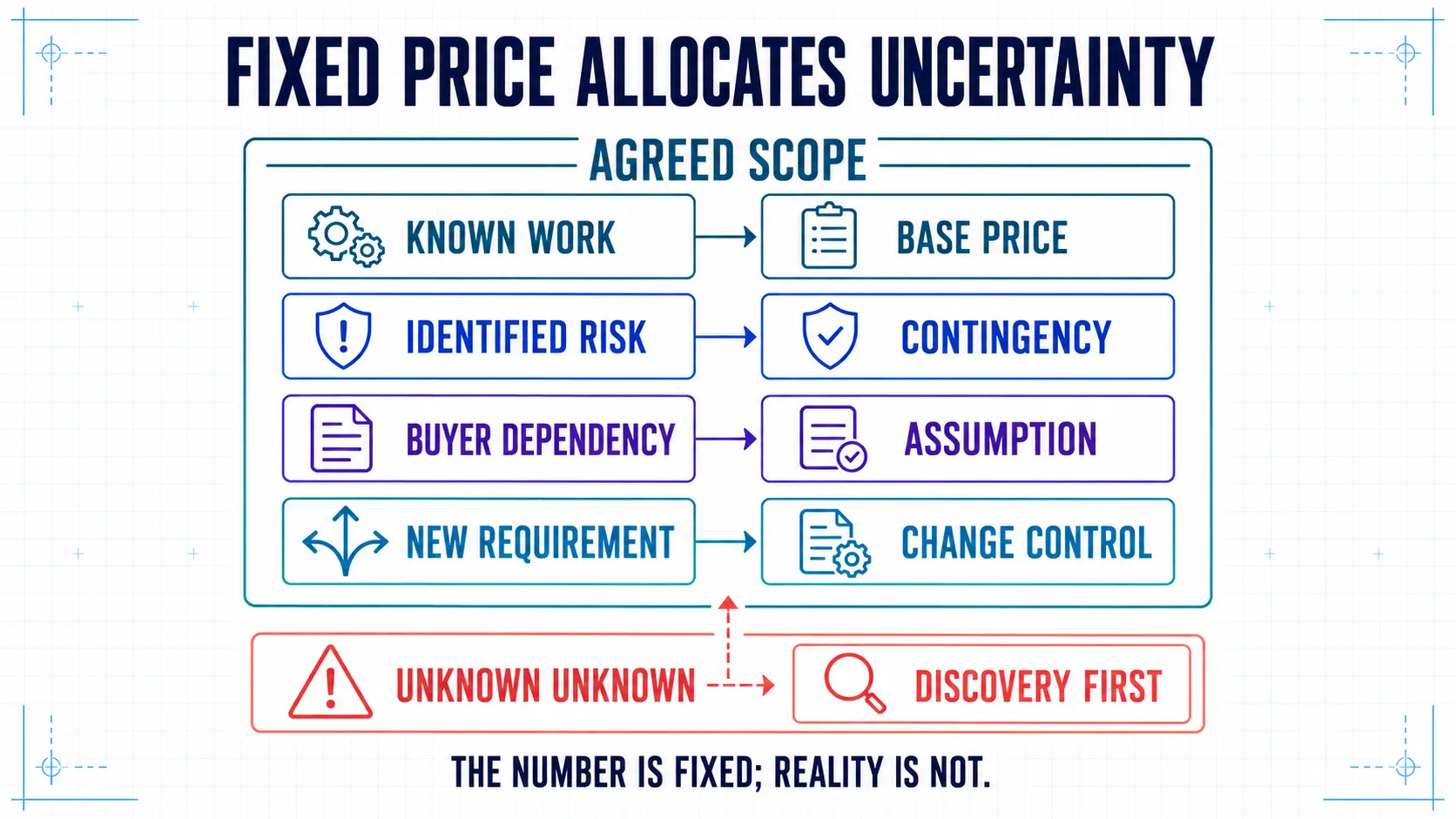
What “fixed price” actually fixes
In a firm fixed-price arrangement, the supplier agrees to deliver a defined scope for an agreed amount. The supplier's internal cost does not automatically change the buyer's price. That creates an incentive to estimate carefully, control execution cost, and choose efficient implementation methods.
It also transfers risk. The current US Federal Acquisition Regulation description of firm-fixed-price contracts makes that mechanism unusually explicit: the contractor assumes responsibility for its costs and resulting profit or loss. Its application guidance ties suitability to reasonably definite specifications and a price that can be established fairly at the outset. Those rules govern US federal procurement, not every commercial software agreement, but the economic logic travels well.
The fixed price should establish a commercial baseline for:
- the business outcome and intended users;
- the included journeys, states, components, integrations, data and content;
- quality and non-functional requirements;
- supported browsers, devices, languages and regions;
- buyer and supplier responsibilities;
- milestones, evidence and acceptance rules;
- assumptions, exclusions and named dependencies;
- change control, delay treatment and decision authority;
- handover, warranty and post-launch support.
It cannot freeze reality. A payment provider can deprecate an API. Production data can differ from the sample. A buyer can request a new workflow. A regulator can impose a new requirement. The agreement needs a rule for each event, not a promise that none will happen.
Fixed scope is not the same as a frozen backlog
A fixed scope can preserve implementation flexibility. The parties can agree on the outcome, boundary, quality threshold, capacity and timebox while allowing backlog priorities to move within that envelope. A lower-priority item can be exchanged for a similarly sized higher-priority item if the substitution does not alter architecture, dependencies, risk or acceptance.
This is different from adding work. “Use a different label” may be a clarification. “Replace email login with enterprise SSO” is likely a change. Good governance distinguishes them before the project starts.
The six-gate priceability test
Before requesting or accepting a fixed price, test the work against six gates. A confident “yes” at every gate makes the project a candidate; it does not guarantee that fixed price is the best model.
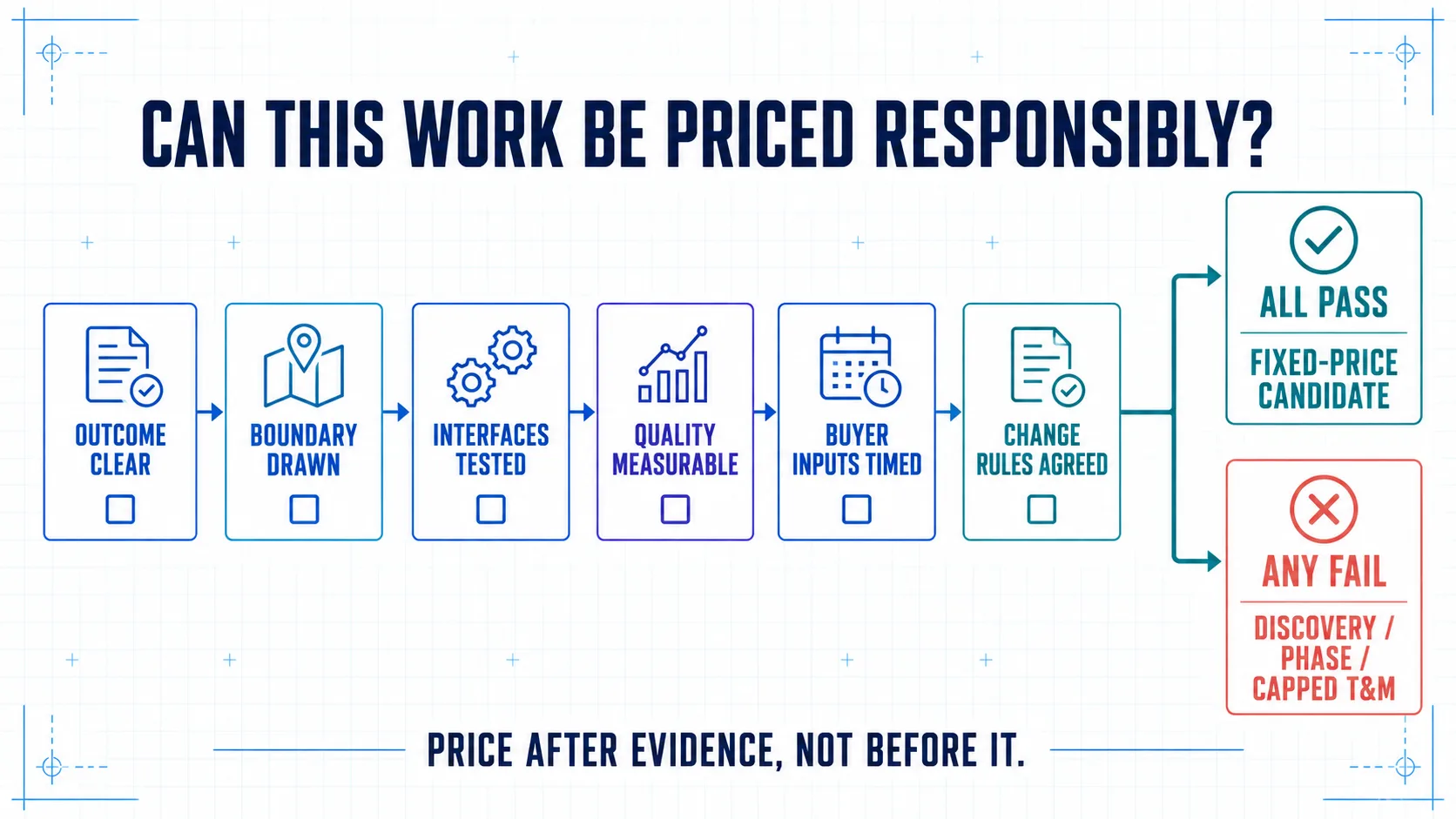
Gate 1: Is the outcome clear?
“Build a new website” is an output category, not a sufficient outcome. A priceable objective identifies the audience, problem, business result and release condition. For example:
Replace the current service site without losing canonical route coverage, enable editors to publish three languages, and measure qualified enquiries through the agreed analytics events.
Not every business KPI belongs in supplier acceptance—the supplier cannot guarantee market demand—but every engineering deliverable should connect to the intended result.
Gate 2: Is the boundary drawn?
Name what enters and leaves the system: routes, roles, journey states, content types, APIs, data sets, environments, accounts and third parties. Include the awkward states: empty, error, delayed, unauthenticated, unavailable and partially migrated.
If two bidders can read the brief and reasonably price different systems, the boundary is not ready.
Gate 3: Have critical interfaces been tested?
Documentation is not always evidence. For high-impact dependencies, inspect the real API, authentication flow, data sample, export, rate limit, sandbox or legacy code. Use a technical spike when one answer could change the architecture or estimate materially.
Typical fixed-price hazards include undocumented plugins, inconsistent product records, proprietary CMS behavior, unavailable test environments and third-party approval queues.
Gate 4: Is quality measurable?
“Fast,” “accessible,” “secure,” “SEO-friendly” and “production-ready” are aspirations until the scope supplies a test, environment and threshold. Define the relevant performance budget, accessibility standard and conformance level, security checks, analytics events, crawl tests, browser matrix, recovery procedure and defect tolerance.
Do not make quality the invisible buffer that absorbs schedule pressure.
Gate 5: Are buyer inputs timed?
Fixed delivery depends on the buyer as well as the supplier. Name the owner and latest response time for access, content, translations, credentials, legal review, design decisions, data mapping, user acceptance and launch approval.
The scope should say what happens when an input is late: the schedule moves, reserved capacity is charged, an assumption becomes operative, or the parties approve a revised plan. Silence is not a delay policy.
Gate 6: Are change rules agreed?
The parties need a shared definition of clarification, defect and change; an approval authority; an impact format; and a route for trading scope. Change control should be light enough to use and strong enough to prevent invisible commitments.
If any gate fails, do not force confidence into the estimate. Commission a bounded discovery, prototype, integration spike, fixed phase or capped time-and-materials engagement that produces the missing evidence.
Why fixed-price scopes can work so well
Budget and approval become concrete
A known commercial baseline is easier to compare with expected value, approve and forecast. Finance does not have to infer a likely total from weekly utilization. Procurement can compare proposals against the same boundary and evidence requirements.
This is useful for bounded deliverables such as:
- a defined technical SEO remediation package;
- a known design-system component set;
- structured data across an inventoried set of templates;
- a documented CRM, ERP, payments or analytics integration;
- a marketing-site rebuild after content and technical discovery;
- an MVP whose core user workflow and feasibility have been validated.
The word baseline is important. Budget certainty means the original commitment and the consequences of an approved change are visible. It does not mean unlimited new work is free.
Incentives can align around the outcome
When acceptance is objective, the supplier benefits from a simpler solution that passes the agreed evidence. The buyer pays for a result, not inefficiency. This leaves room for engineering judgment without weakening the outcome.
Poor scopes invert that incentive. If a detailed feature list is fixed while quality remains implicit, the easiest route to margin can become less testing, weaker documentation, narrow edge-case handling or delayed technical debt. Protect the non-functional requirements and operational work inside the baseline.
Prioritization happens before expensive implementation
A fixed boundary makes trade-offs visible. “Must have,” “should have” and “later” become real decisions because they compete for the same commercial envelope. That pressure is healthy when it protects the core journey and removes low-value variation.
Risk ownership becomes discussable
The scope can distinguish:
- supplier-controlled risk, such as implementation productivity or defects against an agreed requirement;
- buyer-controlled risk, such as late content, access or decisions;
- third-party risk, such as platform approval or vendor API availability;
- shared risk, such as a migration outcome that depends on supplied data and transformation code;
- unresolved risk, which should trigger discovery or provisional treatment.
Risks should sit with the party best able to influence them. The UK government's current Risk Allocation and Pricing Approaches guidance makes the same point and warns that ambiguous scope creates room for disputes while responsible markets price unknowns as risk.
Progress can be judged against proof
A review environment, working journey, test report, crawl result or deployment rehearsal reveals more than a status percentage. Evidence-based milestones allow both parties to see risk early and correct course while choices are still reversible.
Why fixed-price scopes fail
Most fixed-price failures are not caused by the arithmetic. They begin when the commercial promise is more precise than the underlying knowledge.
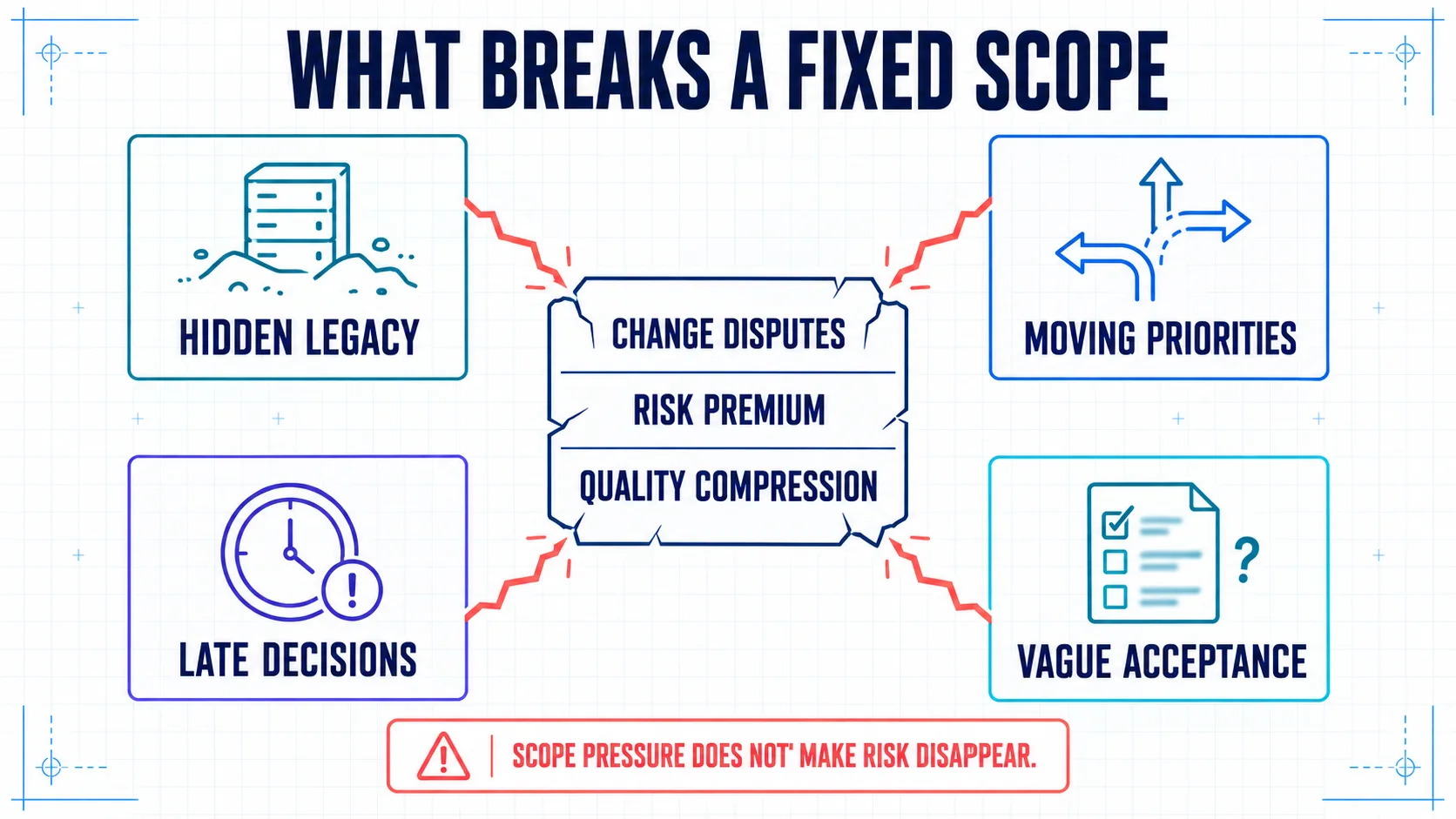
Hidden technical conditions
An undocumented CMS, bespoke plugin, inconsistent data set, proprietary integration or missing test environment can invalidate an estimate. A supplier may exclude the unknown, price worst-case contingency or accept a risk it cannot actually control. None is as useful as investigating the condition first.
Product discovery is incomplete
If users, workflow, demand or success conditions remain hypotheses, learning should change the plan. A contract that treats change as failure punishes the very feedback the project needs.
Experimental AI systems are a strong example. A team can fix the deliverables for an evaluation phase—representative test set, baseline, prototype, error analysis and go/no-go recommendation—without promising that an untested model or retrieval approach will meet production quality.
Priorities are expected to move continuously
A live product team may need to respond to incidents, customers, regulation or market learning every week. Repricing a whole contract for each decision adds friction. Stable capacity, capped time and materials, or fixed time-and-capacity with a variable backlog may fit better.
Buyer decisions arrive late
An agency cannot finalize a regulated flow without legal review or complete a migration without approved data mapping. If buyer response windows are absent, both sides can be contractually correct and operationally stuck.
Acceptance is subjective
“Modern,” “intuitive,” “high quality” and “works as expected” invite interpretation. Subjective review has a place in design, but the scope must identify who decides, at which prototype or review gate, and what happens after approval.
The supplier wins by underpricing ambiguity
A low headline price may reflect a thin interpretation, aggressive assumptions, dependence on later changes or an unsustainable margin. Compare normalized inclusions, evidence and risk—not totals alone. The UK Digital, Data and Technology Playbook warns that unreasonable commercial mechanisms and unsustainable cost reductions can bias delivery toward low quality and increase failure risk.
Defect, clarification, scope swap, or change?
This taxonomy prevents many commercial arguments:
| Classification | Practical definition | Typical treatment |
|---|---|---|
| Defect | Delivered behavior does not satisfy an agreed requirement or acceptance threshold | Supplier corrects it within the fixed price and agreed warranty |
| Clarification | Added detail resolves wording without changing behavior, effort, architecture, dependency or risk materially | Record it; no price change |
| Scope swap | One planned item is replaced with another of genuinely comparable effort, risk and dependency impact | Approve inside the existing envelope |
| Change | New or altered requirement affects effort, schedule, quality, architecture, dependencies or risk | Written impact and authorized baseline change |
| Discovery | New evidence reveals a condition that the agreement explicitly left unresolved | Apply the pre-agreed provisional, re-scope or stop/go rule |
“Comparable” cannot be judged by story count or screen count alone. One login screen connected to enterprise identity can carry more risk than several content templates. The team should assess engineering effect, not visual surface area.
A useful change request contains:
- the requested behavior and business reason;
- the current baseline it changes;
- effect on price, time, quality, risk and dependencies;
- options, including defer, simplify or swap;
- revised acceptance evidence;
- the authorized decision and date.
Small clarifications should not become administrative theatre. Material changes should not be absorbed invisibly.
Acceptance criteria must create evidence
Acceptance is the bridge between “we worked on it” and “the contracted outcome exists.” A strong scope defines both the test and the evidence that survives the meeting.
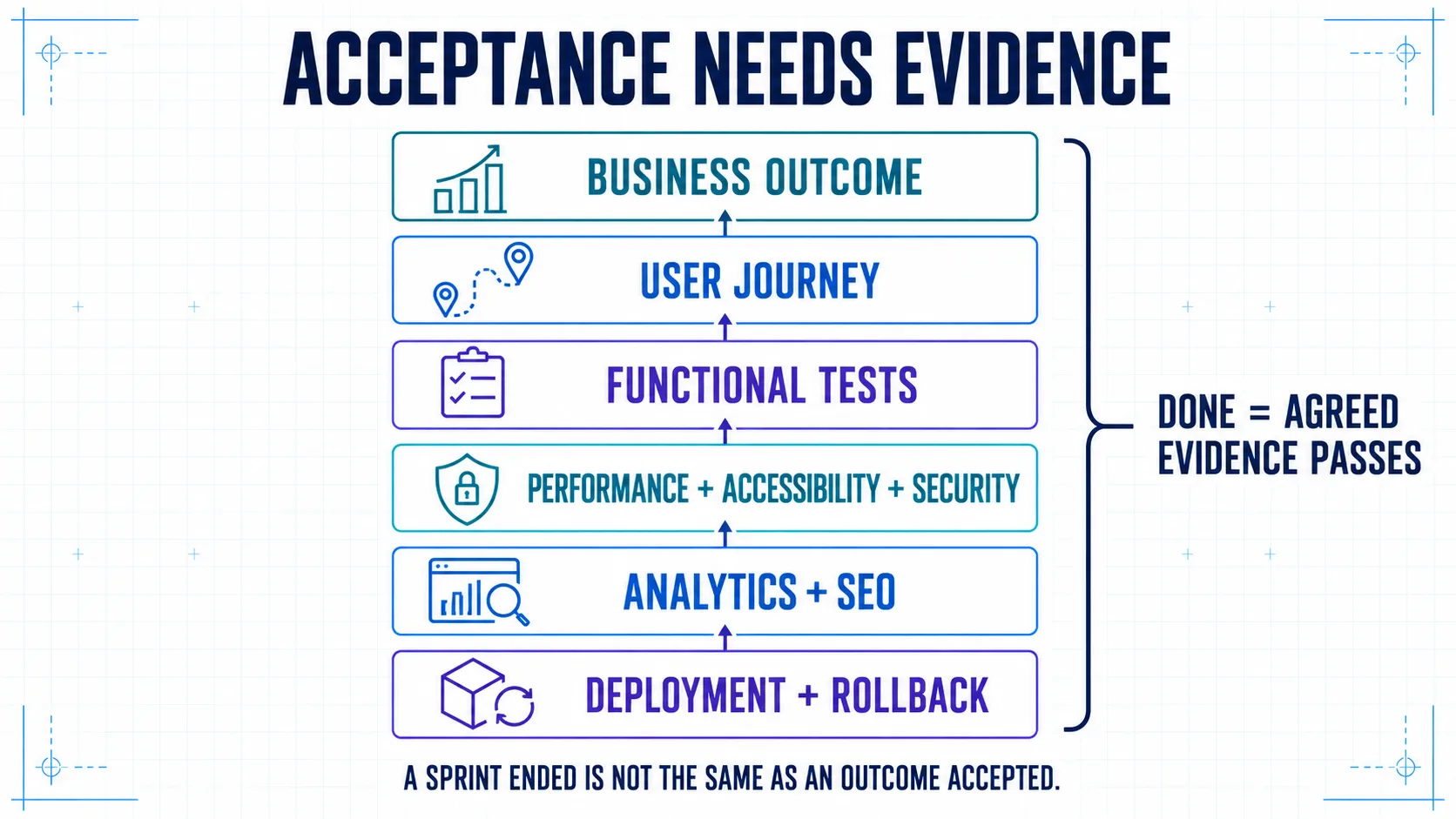
Use only the layers relevant to the project, but make each one concrete:
| Layer | Example acceptance evidence |
|---|---|
| Business outcome | Named capability exists and the agreed leading indicator can be measured |
| User journey | Critical path and named exception states pass in a production-like environment |
| Functional behavior | Automated and manual tests map to requirements with no open blocking defects |
| Performance, accessibility and security | Agreed tools, environments and thresholds produce passing evidence |
| Analytics and SEO | Events, consent behavior, canonicals, metadata, structured data and crawl checks match the specification |
| Deployment and rollback | Release runbook, monitoring, ownership, backup or rollback exercise and access handover are complete |
Tie payment to accepted deliverables or released value, not merely the performance of ceremonies. The UK agile-contracting guidance specifically advises including non-functional requirements and avoiding milestones based only on completing a certain number of sprints.
Also define the review mechanics:
- who may accept or reject;
- how many review days are available;
- what evidence accompanies delivery;
- how rejection maps to a written criterion;
- whether partial acceptance is possible;
- when silence counts—or explicitly does not count—as acceptance;
- which defects block acceptance and which enter warranty or backlog.
This is commercial design, not legal advice. Contract language, consumer rules, procurement duties, tax and liability need qualified review for the relevant jurisdiction.
Choose the model that fits the uncertainty
| Commercial model | Best fit | What is fixed | Main governance need | Main failure mode |
|---|---|---|---|---|
| Fixed project price | Mature, bounded outcome with tested dependencies | Price, boundary, time window and acceptance | Evidence reviews and change control | False certainty around hidden work |
| Fixed-price phase or sprint | A bounded next decision or delivery increment | Phase objective, price, capacity/timebox and gate | Fast backlog decisions and phase acceptance | Re-scoping friction between phases |
| Capped time and materials | Important work is variable but total exposure needs a ceiling | Rates, cap, reporting and stop rule | Active prioritization and burn transparency | The cap is mistaken for a delivery guarantee |
| Time and materials | Discovery, incident work or changing backlog | Rates and often team composition | Frequent value review and stop authority | Paying for activity without outcome control |
| Dedicated team or retainer | Ongoing product ownership and a durable backlog | Capacity, roles and operating cadence | Product leadership and outcome metrics | Capacity is treated like a promised feature list |
No model eliminates the need to govern value. Fixed price needs acceptance and change discipline; time and materials needs prioritization, transparent burn and stop decisions.
The strongest pattern: staged commitment
A responsible buyer does not need to choose between “fix the whole project now” and “approve unlimited hours.” Commitment can increase as uncertainty falls.
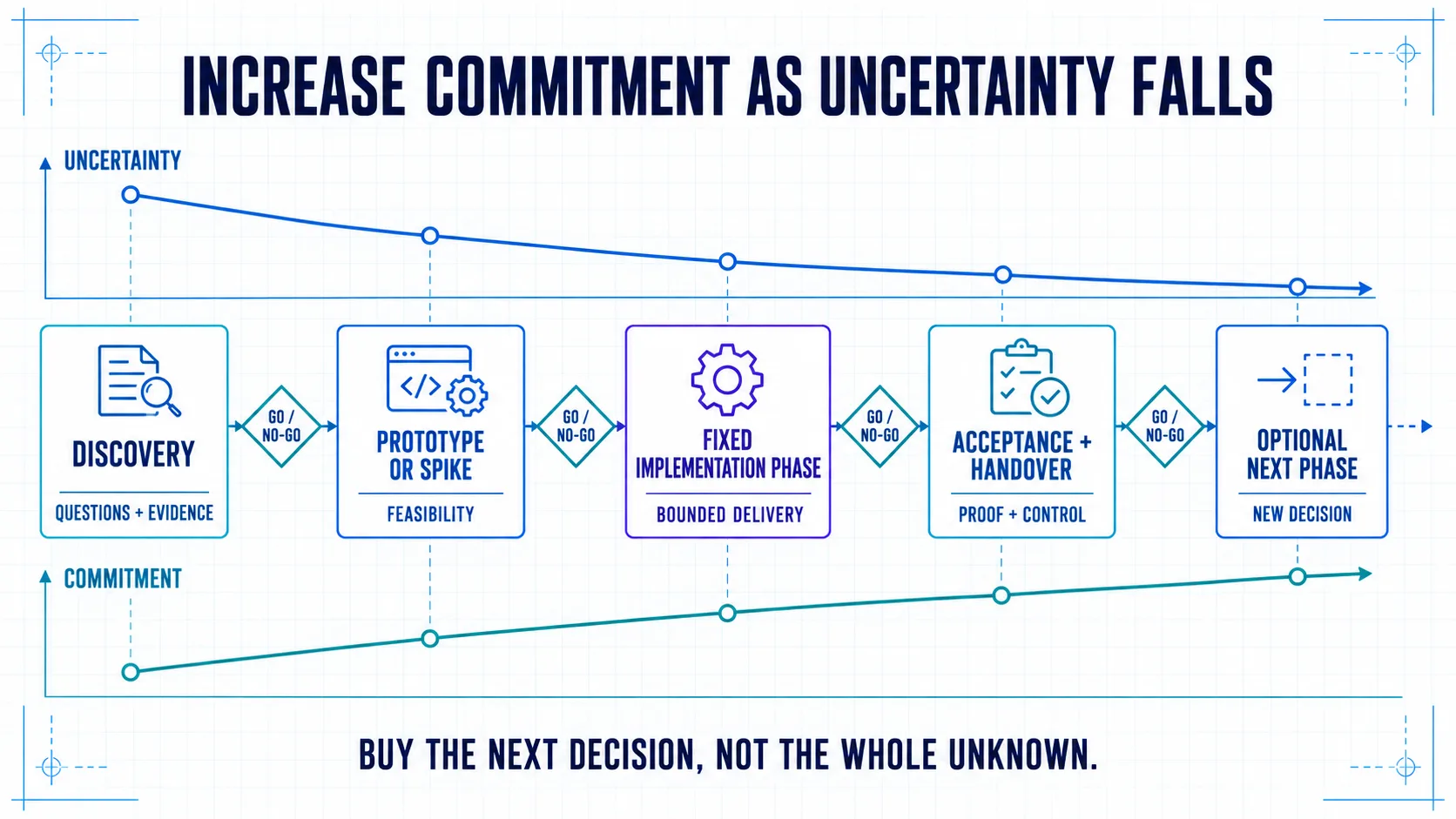
A practical sequence is:
- Fixed discovery: inventory the system, map journeys and data, test critical dependencies, define options and create an evidence-backed estimate.
- Prototype or technical spike: answer the feasibility question that could materially change architecture, scope or risk.
- Fixed implementation phase: commit to the now-bounded outcome, quality thresholds, interfaces, responsibilities and acceptance evidence.
- Acceptance and handover: prove the release, transfer control, close blocking defects and record residual risk.
- Optional next phase: make a new decision using current evidence rather than an old forecast.
Each gate should permit continue, revise or stop. A smaller initial engagement is not automatically “extra cost”: when it changes the confidence of a much larger commitment, it buys decision quality and optionality.
A useful contracting fact: fixed-price agile is not a contradiction. The UK government's Contracting for Agile guidance explicitly describes fixed-price sprints and phased contracts as ways to manage uncertainty. The fixed element can be the bounded phase, price and timebox while feedback still changes priorities inside the agreed outcome.
How to write a responsible fixed-price engineering scope
1. Write the decision and outcome
State why the work exists, which user or operator it serves, the business capability it should create, and what is not being promised. Separate controllable delivery acceptance from downstream commercial targets.
2. Build the scope boundary
Inventory routes, states, roles, content types, data, integrations, environments, regions and ownership. Attach wireframes, data samples, API references and architecture diagrams where words leave room for competing interpretations.
3. Resolve estimate-changing unknowns
Rank open questions by impact and reversibility. Inspect, prototype or spike the few that can change feasibility, architecture or price. Do not spend discovery effort equally on trivial and existential questions.
4. Define the delivery model
Specify team interfaces, review cadence, environments, release approach, tools, access and decision rights. If backlog order can change, document the envelope and swap rule.
5. Specify non-functional requirements
Include performance, accessibility, security, privacy, analytics, SEO, observability, resilience, backup, browser/device support and maintainability as applicable. Give each requirement a method and threshold.
6. Create the acceptance matrix
Map every deliverable to its criterion, test environment, required evidence, reviewer and review window. Define severity levels and the difference between acceptance-blocking defects and warranty work.
7. Time buyer responsibilities
Assign an owner and due date or response window to content, data, access, third-party fees, approvals and specialist review. Include consequences for delay that protect both the schedule and reserved capacity.
8. Record assumptions, exclusions and dependencies
An assumption states what the estimate relies on. An exclusion identifies the boundary. A dependency identifies an external condition and owner. Do not use exclusions to hide work a reasonable buyer would consider essential to the stated outcome.
9. Build the risk and change system
For each material risk, record probability qualitatively, impact, evidence, owner, mitigation and commercial treatment. Add the classification taxonomy, request format, approval authority and scope-swap rules.
10. Align milestones, payments and control transfer
Connect payments to demonstrable, accepted value. Specify repositories, infrastructure, accounts, credentials, licenses, documentation, data exports, deployment rights and warranty. Avoid a final milestone that leaves the buyer without operational control.
Proposal and brief red flags
Pause before signing if the scope includes several of these:
- a total price with no assumptions or exclusions;
- “all features” or “production-ready” without an inventory or quality criteria;
- payment only by date or sprint count;
- no named buyer responsibilities or decision windows;
- a warranty with no definition of defect;
- all third-party behavior treated as supplier-controlled;
- estimates based only on screens, pages or story count;
- “unlimited revisions” instead of review gates;
- material integrations priced without access to documentation or a sandbox;
- acceptance based on subjective satisfaction alone;
- no rule for newly discovered legacy or data conditions;
- no repository, account, infrastructure or documentation handover;
- a very low bid whose interpretation is not normalized against other proposals.
Ten questions to answer before signing
- Which discovery evidence supports the estimate?
- What exactly is the system and journey boundary?
- Which unknowns could still change feasibility, price or schedule?
- Are functional and non-functional requirements independently testable?
- Who provides content, access, data, decisions and approvals—and by when?
- What distinguishes a defect, clarification, scope swap, change and discovery?
- What evidence is required for milestone and final acceptance?
- How are third-party failures and buyer-caused delays handled?
- Which code, accounts, infrastructure, documentation, rights and warranties transfer?
- Does the model match current uncertainty, or are we purchasing certainty before earning it?
Working artifact: Download the Fixed-Price Engineering Scope Decision Brief (Markdown). It includes the six priceability gates, uncertainty register, scope boundary, acceptance matrix, buyer responsibility table, change taxonomy, risk allocation, milestone plan and final go/no-go record.
The decision: buy certainty only after it is earned
Fixed-price engineering works when it makes a sufficiently understood commitment testable. Its real strengths are budget clarity, disciplined prioritization, explicit risk ownership and evidence-based acceptance. Its danger is false precision.
If the critical interfaces have been tested, the boundary is stable, quality is measurable and both parties can meet their obligations, a fixed price can be efficient and fair. If the important questions remain open, fix the price of the next learning phase instead.
For architecture-heavy work, the headless React versus monolithic CMS guide helps expose ownership and integration questions before scope is fixed. AppWebSeo's MVP launch engagements and headless architecture work use staged evidence gates so commercial commitment can grow with technical confidence.
Sources and methodology
This guide was checked against current official contracting guidance and the dominant search-intent patterns for fixed-price software delivery on September 8, 2026. Commercial ranking pages were used to identify recurring buyer questions; factual principles were grounded in primary or authoritative sources:
- FAR 16.202-1: Firm-fixed-price contract description
- FAR 16.202-2: Application of firm-fixed-price contracts
- UK Digital, Data and Technology Playbook
- UK Contracting for Agile Guidance Note
- UK Risk Allocation and Pricing Approaches Guidance Note
- Carnegie Mellon SEI: Contracting for Agile Software Development
The regulatory sources are used for contracting principles, not as universal legal rules. Have the final agreement reviewed for the applicable jurisdiction and procurement context.