

What is headless web architecture?
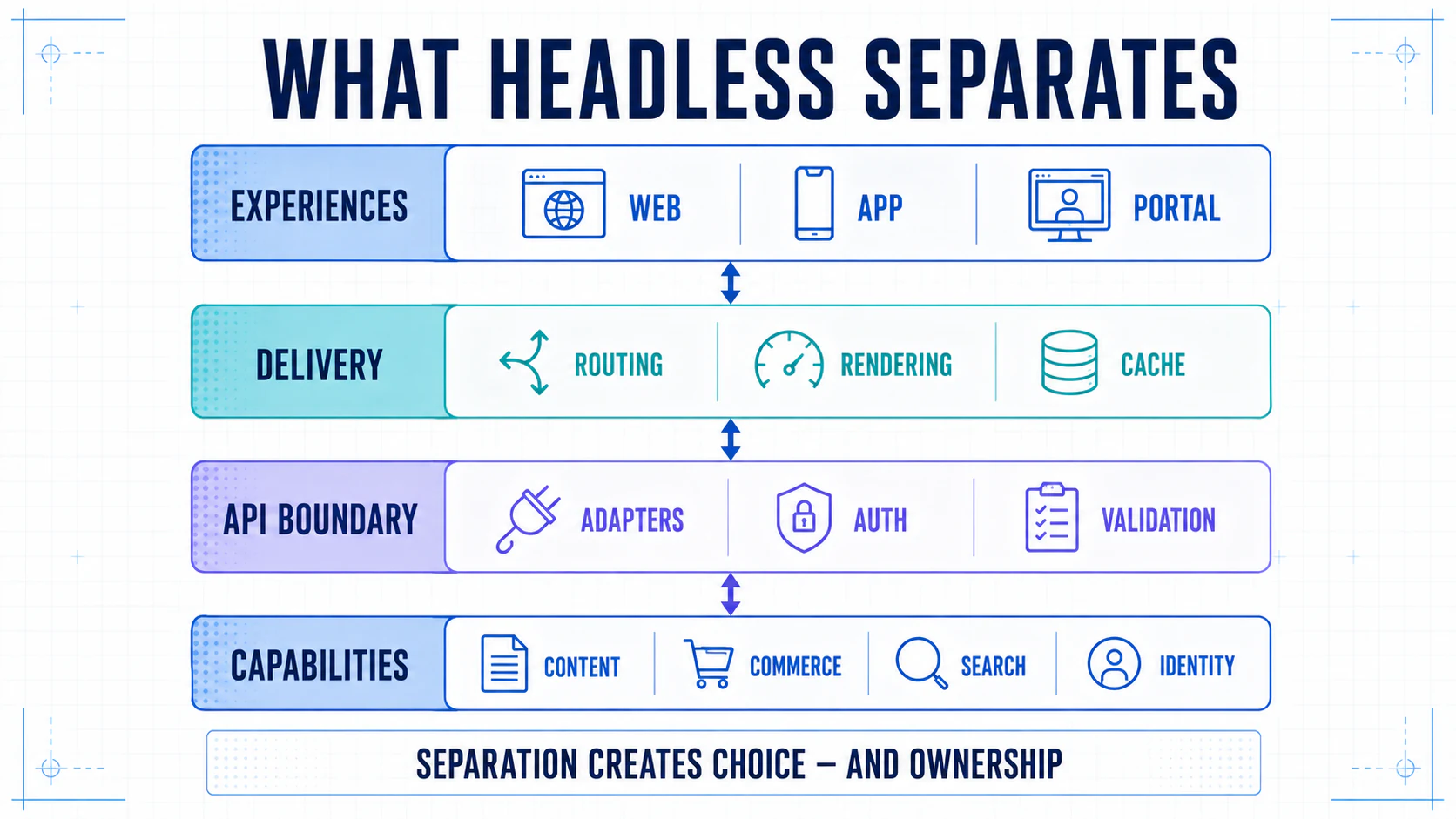
Headless web architecture separates the presentation layer—the website or application users see—from content, commerce, search, identity, and other backend capabilities. The frontend requests structured data through APIs and decides how to render it for each channel.
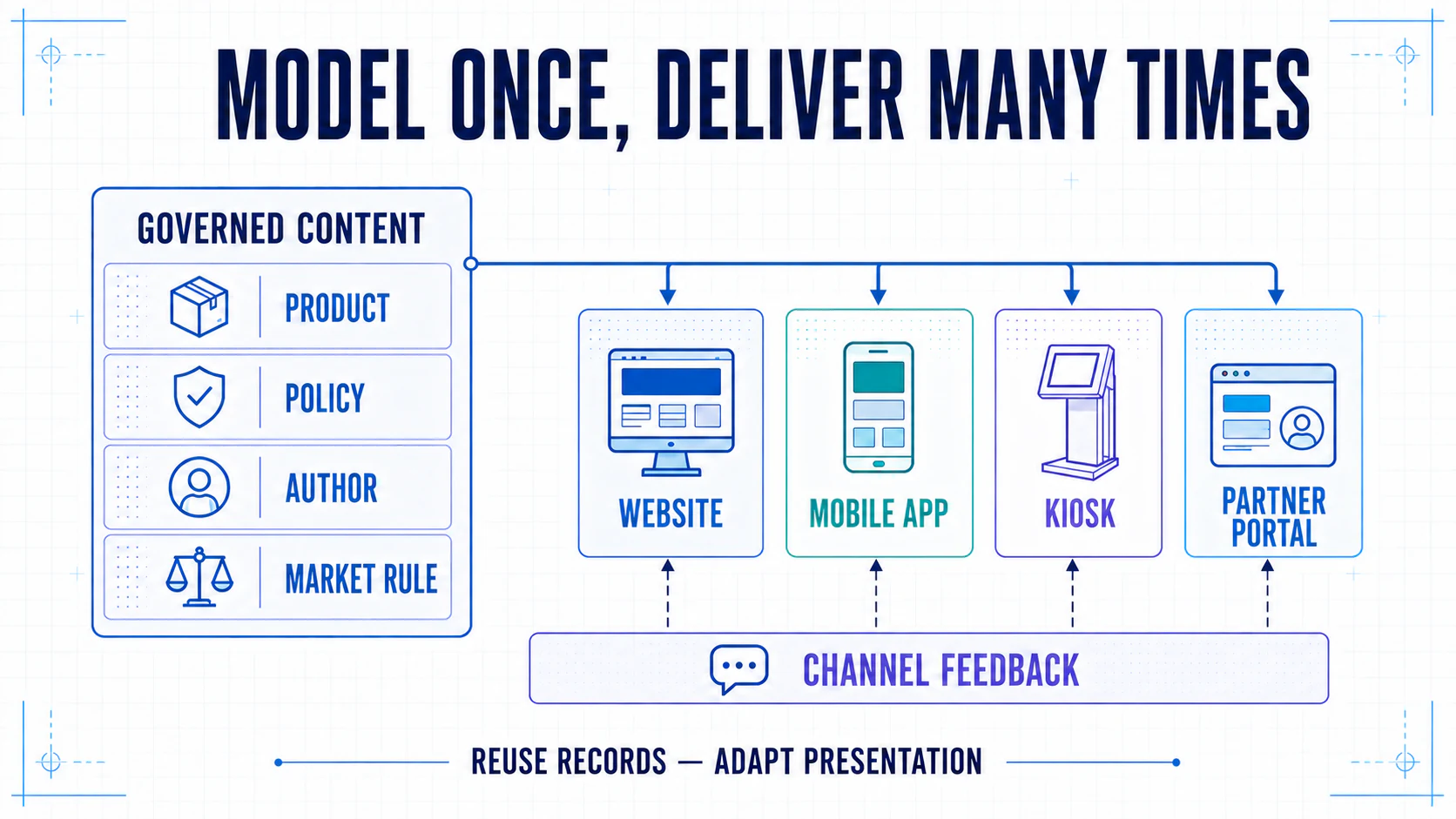
In a traditional CMS, authoring, templates, plugins, and delivery usually live in one system. In a headless model, an editor can manage a product, article, location, or campaign once, while a React website, mobile app, kiosk, email workflow, and partner portal consume the same governed record.
The separation is valuable when the organization needs that independence. It is not an automatic upgrade for every website.
Review method: The implementation claims in this guide were checked against the linked first-party technical documentation on September 5, 2026. The benefits are conditional design outcomes, not benchmark results or guaranteed improvements.
The main benefits of headless architecture
1. One content model can serve many channels
Structured content is stored as reusable fields and relationships rather than as one finished web page. A product name, policy, author profile, offer, or market-specific disclaimer can feed several interfaces without manual copying.
This reduces duplicate editing and makes cross-channel changes easier to govern. The benefit depends on good content modeling; a headless CMS filled with page-shaped blobs simply recreates the old coupling behind an API.
2. Frontend teams gain delivery control
The frontend is no longer constrained by a CMS theme engine. Teams can choose an appropriate rendering framework, component system, deployment platform, accessibility approach, and release process.
React's official server API, for example, can render a tree to an HTML stream and hydrate that server-generated HTML for interaction. That capability supports fast initial delivery and rich interfaces, but the implementation still needs correct caching, status codes, error handling, and performance budgets.
3. Backend and frontend can evolve independently
A documented API contract allows presentation releases without changing the editorial system and content-model changes without replacing every frontend. Teams can modernize one surface at a time, introduce a new channel, or replace a vendor behind an adapter.
Independence is never absolute. Schema changes, API limits, authentication, preview behavior, and webhooks are still shared contracts that need versioning and ownership.
4. Performance can be engineered by route
Public content can be statically generated, server-rendered, streamed, or cached at the edge according to how frequently it changes. Interactive account areas can use a different strategy. The updated web.dev rendering guide recommends evaluating rendering choices by their performance trade-offs rather than treating one pattern as universal. Images, scripts, and API calls can have explicit budgets.
Headless does not guarantee speed. Client-only rendering, excessive hydration, uncached APIs, and long request waterfalls can make a headless site slower than a well-built monolith. The benefit is control over the architecture, not a performance result by label.
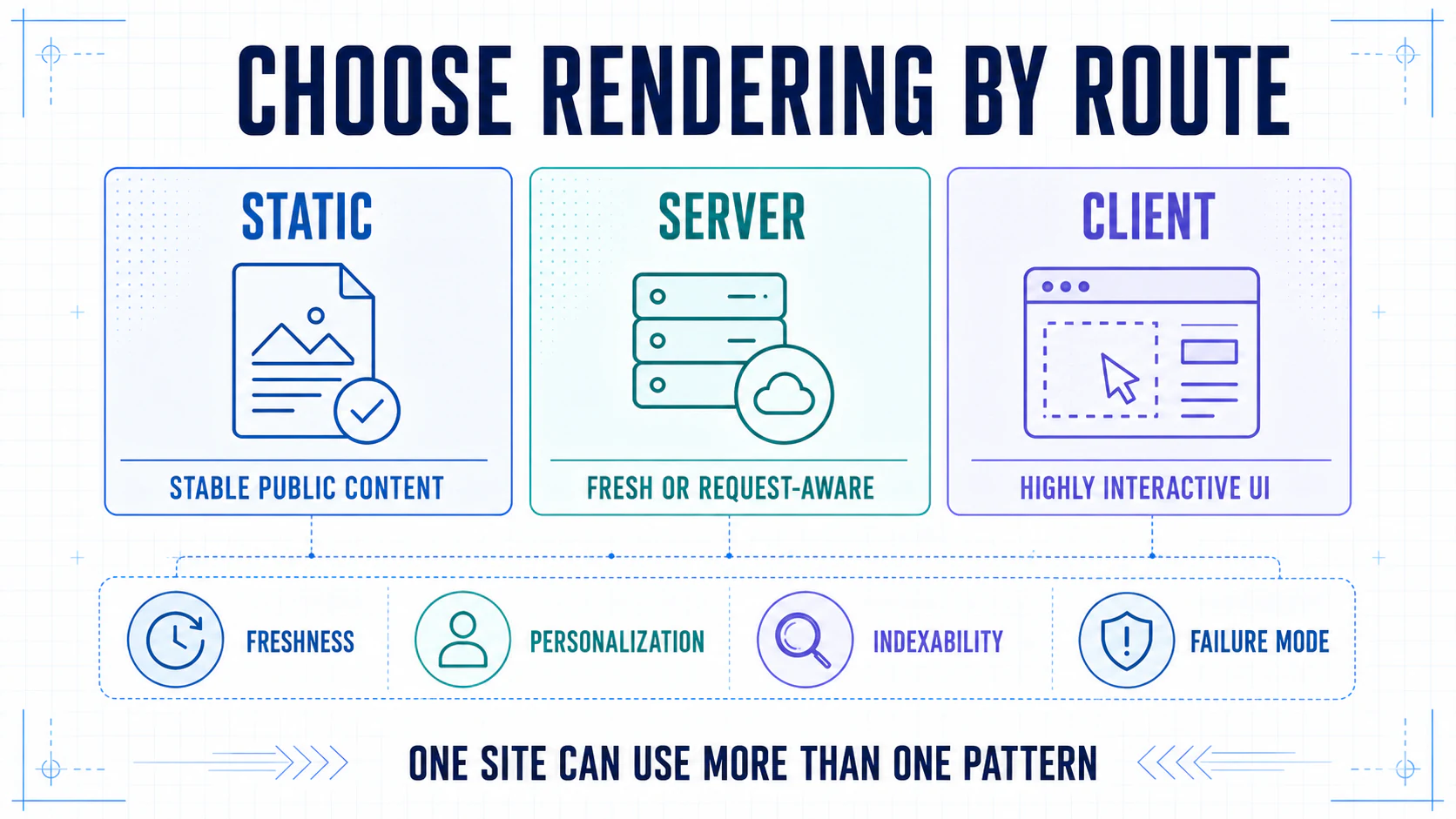
Search visibility is part of delivery design. Google can render JavaScript, but its JavaScript SEO guidance still recommends server-side or pre-rendering because it helps users and crawlers—and not every bot runs JavaScript.
5. The public attack surface can be narrower
The editorial interface does not have to be exposed on the public web host. A static or server-rendered frontend can consume only the APIs it needs, while administrative access stays behind separate identity and network controls.
This can reduce some plugin- and theme-related exposure, but it introduces API tokens, webhooks, preview endpoints, build systems, and more vendors to secure. The OWASP API Security Top 10 includes authorization, authentication, resource consumption, inventory, and unsafe upstream consumption risks that belong in the design. Security responsibility changes shape; it does not disappear.
6. Multi-market delivery becomes more systematic
A structured locale model can connect equivalent pages, shared entity facts, market-specific offers, currencies, legal text, and translation status. One locale registry can drive routing, hreflang, sitemaps, navigation, and analytics.
Headless architecture is especially useful when several regions share a product catalog but require different availability, proof, or compliance content. It does not replace native localization or market ownership.
7. Teams can compose specialized services
Search, commerce, experimentation, personalization, DAM, CRM, and translation can be selected independently when the business case justifies them. A composable approach avoids forcing every capability into one CMS plugin ecosystem.
The trade-off is integration ownership. Each additional service brings a contract, failure mode, bill, security review, and observability requirement.
8. Content becomes easier to validate programmatically
Structured fields can enforce required authors, dates, locales, identifiers, source links, SEO metadata, and relationships before publication. Validation can run in the CMS, CI pipeline, or both.
This supports consistent pages and machine-readable entity data. It does not make inaccurate facts true; editorial review remains necessary.
Headless architecture trade-offs
| Area | Potential benefit | New responsibility |
|---|---|---|
| Content | Reusable structured records | Content modeling and migration |
| Frontend | Full rendering and UX control | Framework and component maintenance |
| Performance | Route-specific rendering and caching | Cache invalidation and API waterfalls |
| Security | Separate public and editorial surfaces | Tokens, APIs, webhooks, supply chain |
| Localization | Shared locale and entity model | Translation workflow and market QA |
| Delivery | Independent releases | Preview, orchestration, rollback |
| Vendors | Best-fit services | Integration cost and lock-in management |
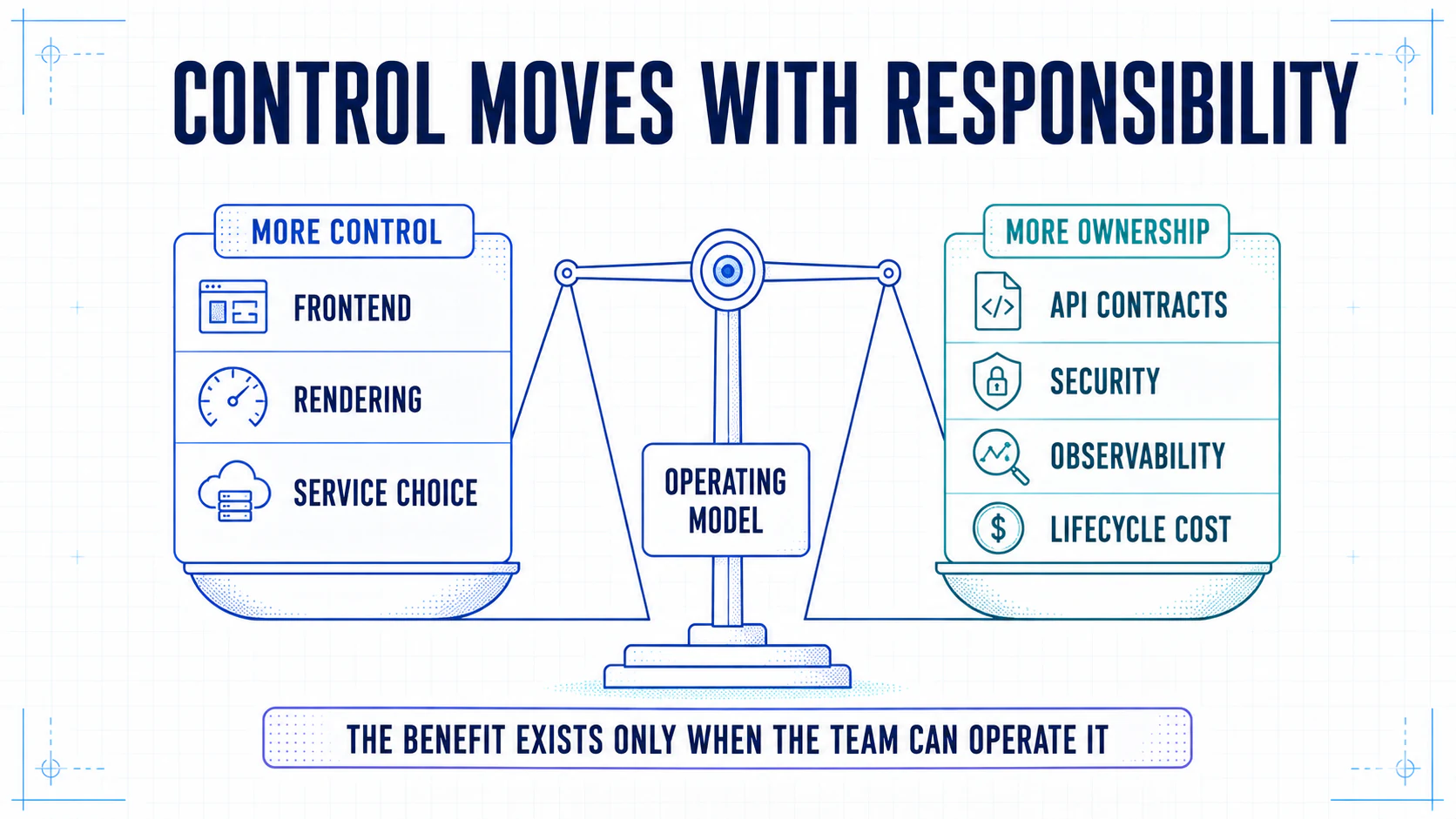
The architecture shifts complexity from a packaged product into explicit engineering decisions. That is beneficial only when the team can own those decisions.
When headless is a strong fit
Choose headless when several of these are true:
- the same content or catalog serves multiple channels;
- multiple markets need controlled local variations;
- the frontend requires capabilities a template system cannot support cleanly;
- engineering and editorial teams need independent release cycles;
- performance, accessibility, or experimentation needs route-level control;
- integrations are core business infrastructure, not occasional plugins;
- the organization can own APIs, observability, security, and lifecycle cost.
When a monolithic CMS is the better decision
A traditional or integrated platform may be better when the site is a small brochure or blog, one channel is sufficient, editors need a mature page builder immediately, the team has no dedicated frontend capacity, or speed to first launch matters more than architectural flexibility.
Choosing the simplest architecture that meets the next several years of credible requirements is not under-engineering. It is good system design.
A practical implementation sequence
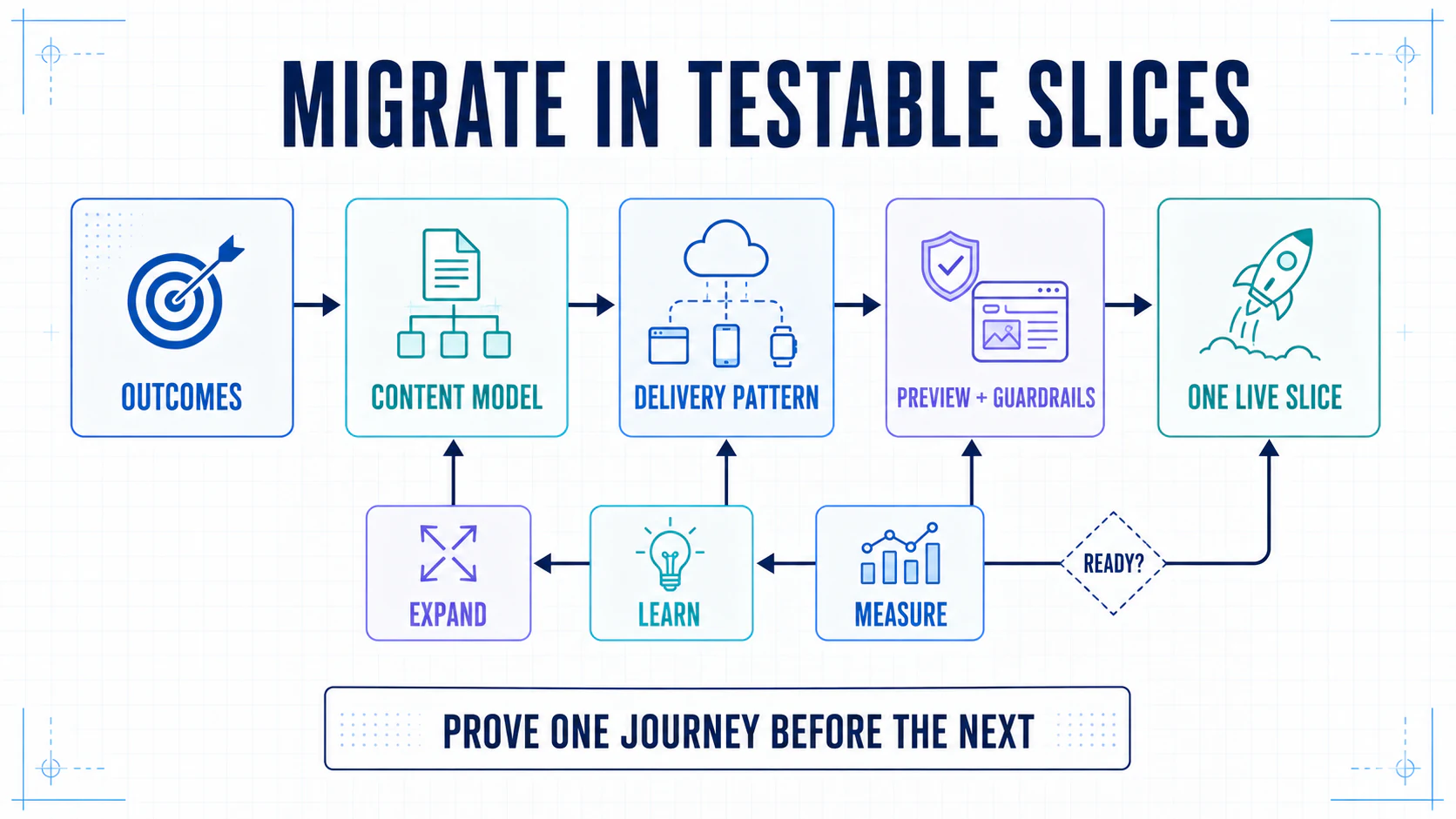
- Define outcomes. Name the channels, markets, workflows, performance targets, and constraints that justify separation.
- Model content and entities. Design reusable records, relationships, identifiers, locales, and validation rules before building pages.
- Choose delivery patterns. Decide which routes are static, server-rendered, streamed, personalized, or authenticated.
- Create an integration boundary. Keep CMS and service APIs behind typed adapters so the UI is not coupled to vendor payloads.
- Build preview and publishing. Editors need draft preview, status, validation, scheduled publication, and rollback.
- Set budgets. Define limits for API latency, JavaScript, images, third parties, build time, and cache freshness.
- Instrument the system. Monitor origin, CDN, rendering, API errors, content releases, Core Web Vitals, and conversions.
- Migrate in slices. Move one content type or journey, validate it, then expand rather than attempting an opaque big-bang rewrite.
Decision artifact: Download the Headless Architecture Decision Canvas (Markdown). It combines readiness gates, a route-delivery matrix, a service-boundary register, an editorial operating test, a one-slice prototype brief, lifecycle cost, and an architecture decision record.
How to measure whether the architecture worked
Measure outcomes against the original reason for change:
- time to publish or update across markets;
- duplicate-content and data-error rate;
- frontend release frequency and rollback time;
- API availability and p75/p95 latency;
- Core Web Vitals by template and market;
- percentage of content reused across channels;
- translation turnaround and locale parity;
- total operating cost, including internal engineering time;
- conversion and task completion on affected journeys.
Do not call a migration successful because it uses React or a headless CMS. The architecture succeeds when it improves governed delivery at an acceptable lifecycle cost.
The decision
Headless web architecture is most valuable as an organizational boundary: content and business capabilities become reusable services, while each frontend can evolve around its users. The price is explicit ownership of integration, rendering, preview, security, and operations.
Compare the two operating models in Headless React vs monolithic CMS, review platform choices in the headless ecommerce guide, or use our headless React architecture service to scope the migration and delivery system.