

Vienna digitalisation funding: the decision in five minutes
The Vienna Business Agency’s Digitalisation Funding helps small and medium-sized enterprises invest in digital solutions that develop connected workflows or value-creation processes. It may suit a business currently handling several steps manually and looking to connect customer enquiries, CRM, quotations, ERP and order fulfilment.
The important boundary: A new website or webshop as a standalone measure is not eligible according to the agency. An integration could form part of a wider project, but the funding body decides whether a specific project and its costs qualify. This guide and its examples are not an award.
We checked the programme page, programme documents and assessment criteria, and the framework guidelines on 27 October 2026. The documents valid at submission and the agency’s decision govern. The current application period ends on 31 December 2026; no successor programme is assumed here.
| Question | Current call |
|---|---|
| Who? | Existing SMEs in all sectors; a Vienna establishment for at least one year at application and predominantly Vienna-based value creation |
| What? | A connected project with a clear digitalisation plan and an effect on workflows or value creation |
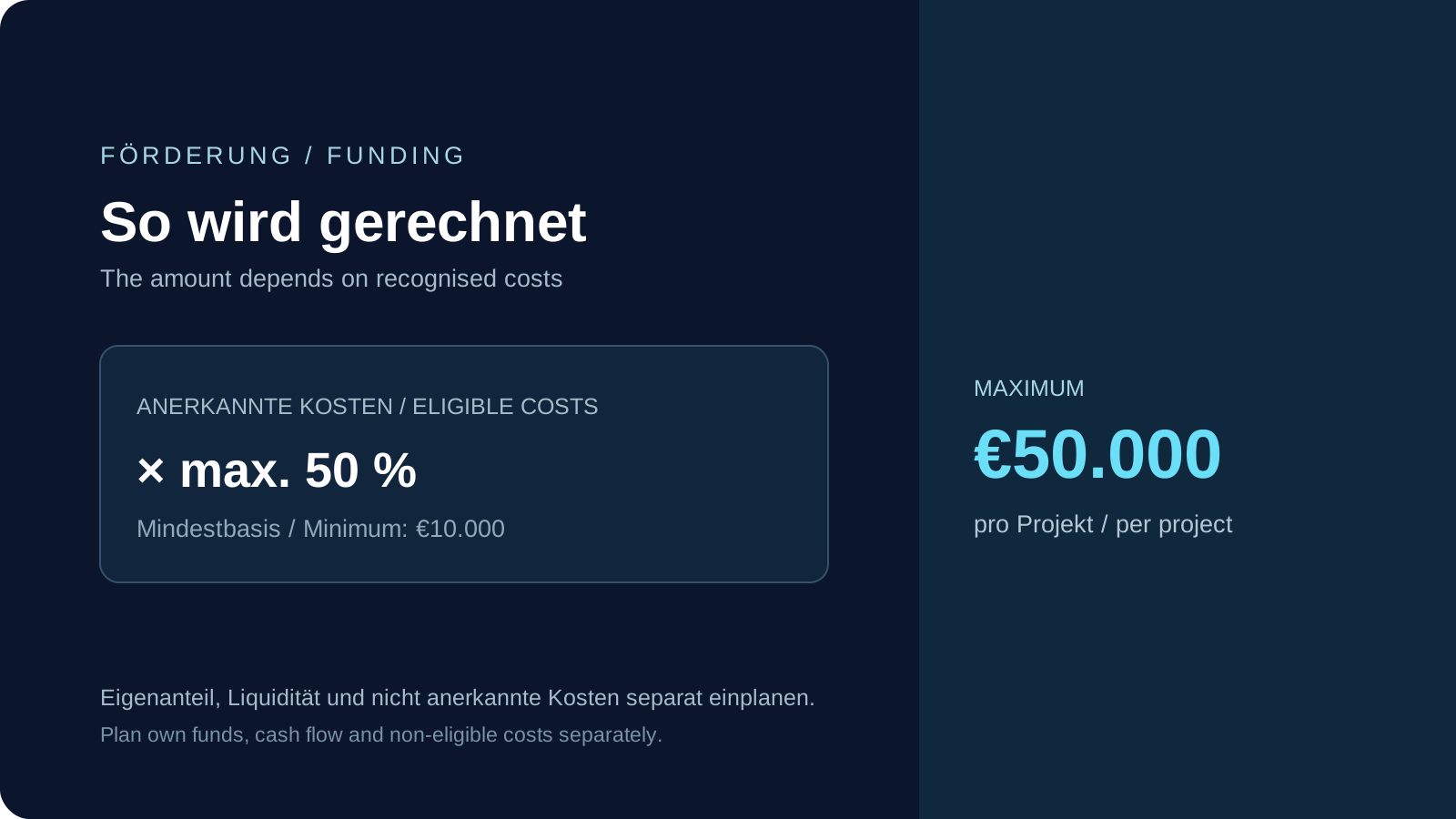
| How much? | Up to 50% of recognised project costs, capped at €50,000 per project |
| Minimum | At least €10,000 of recognised project costs as the assessment basis |
| Duration | Generally no more than two years; extensions only under specified conditions |
| Application | Online throughout the period; the remaining deadline and end of the current period is 31 December 2026 |
| Decision | Formal review, independent jury competition and decision by the agency’s executive committee |
| State aid basis | De minimis; check previous aid and cumulation |
Benefits and constraints
The grant can reduce the business’s own contribution to a recognised project. It can combine project-specific external development, implementation, necessary technology and external training. Businesses in every sector may apply. A possible advance after approval can help cash flow; it is not available before a positive funding decision. The grant is generally non-repayable, but can be recovered in whole or part if conditions are not met or an overpayment occurs.
The operational value lies in a well-defined project: fewer duplicate entries, clearer ownership, better handovers or more traceable customer communication. These are possible objectives, not promised results. Baselines and a realistic plan make the outcomes measurable.
There is no entitlement to funding. The agency evaluates applications competitively within available funds. Prepare a no-grant scenario and do not start the investment before submitting the complete application.
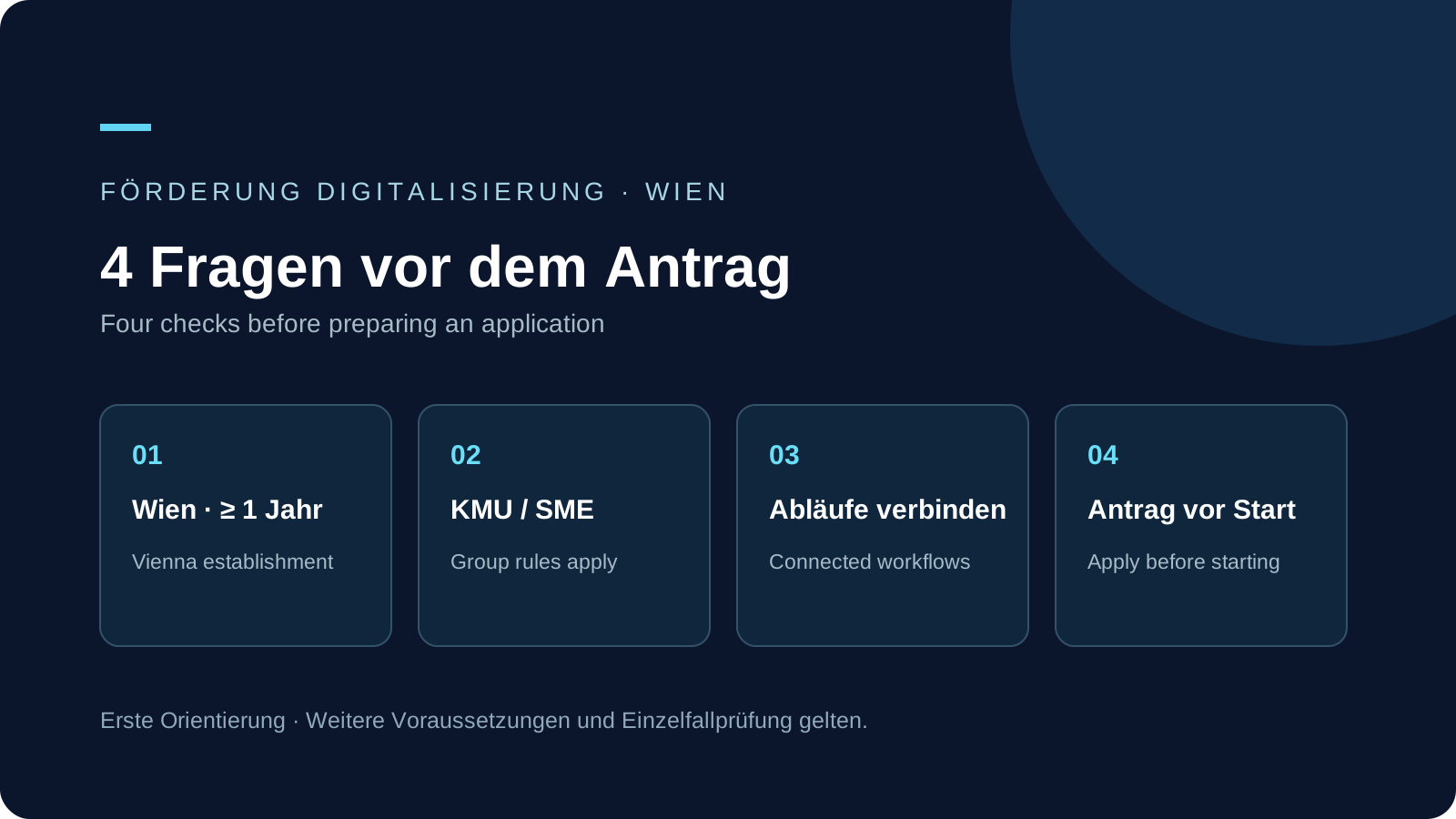
Who can apply?
Vienna establishment and SME status
Applicants are existing small and medium-sized enterprises in all sectors that have had a Vienna establishment for at least one year at application and carry out most value-creating activity there. An intention to set up in Vienna later is insufficient for this programme. The agency assesses the actual circumstances.
The simplified SME table in the programme document describes small enterprises as having fewer than 50 staff and turnover or a balance-sheet total of at most €10 million; medium enterprises have fewer than 250 staff and turnover of at most €50 million or a balance-sheet total of at most €43 million. EU SME rules on annual work units, ownership, partners and linked enterprises can change the calculation. Discuss the details with your accountant and the agency.
The framework guidelines contain further exclusions, including certain insolvent or over-indebted applicants and civil-law partnerships without their own legal personality. Eligibility, completeness and available funding are checked separately.
De minimis and previous grants
This funding is awarded as de minimis aid. Under general EU Regulation 2023/2831, the ceiling is normally €300,000 per single undertaking and member state over any three-year period; company relationships, award dates and special rules can matter. Collect previous aid decisions and consult the agency or your adviser if uncertain. Other support for the same costs can also trigger cumulation rules; do not assume the same cost can be financed twice. Sources: framework guidelines in the funding cockpit and EU Regulation 2023/2831.
What can and cannot be funded?
The programme requires a coherent digitalisation plan. It may connect purchasing, service delivery, personnel, customer administration, payments, dispatch, returns or upstream and downstream processes. The examples below are preparation guidance; recognition depends on the actual project and the agency’s review.
| Project or cost | How to approach it |
|---|---|
| Connecting CRM, ERP and quotations | Can form part of a suitable connected project; evidence its objectives, interfaces and effect |
| Linking customer support to tickets and order data | May fit if internal workflows and customer benefit are clearly improved |
| Project-specific external development and implementation | An eligible cost category in principle when directly attributable and recognised |
| Consulting during implementation and external course fees for the new solution | Potentially eligible; the programme document specifies course fees for training |
| Necessary project hardware, software and licences | Potentially eligible under programme conditions; substantiate need and cost period |
| Website relaunch or webshop alone | Not eligible as an isolated measure according to the programme page |
| Own personnel, ongoing operations, standard office software or PCs as standalone measures | Not eligible; pure replacement investments and tax advice are excluded too |
| Invoice with eligible costs below €200 net | Not eligible according to the programme document |
Not every digital purchase is automatically a project investment. Itemise reasonable costs, separate ongoing operating expenses, and ask the agency before applying how licences, VAT and mixed work packages will be treated. Costs are generally considered net if input VAT is recoverable; the framework covers demonstrably non-recoverable VAT separately.
Example: from an isolated purchase to a process project
A fictional Vienna service business receives enquiries by email, prepares quotations manually and then re-enters orders into its ERP. A possible plan records the current workflow, a shared data model, a CRM/ERP interface, roles, testing and external training. Metrics could include turnaround time and the number of manual transfers before and after. The business must measure them; we do not claim a standard saving. The agency assesses whether the actual project qualifies.
How much funding is possible?
The assessment basis is the sum of recognised project costs. The maximum calculation is the lower of 50% of recognised costs and €50,000, subject to approval, the actual rate, de minimis headroom and final accounting. Below €10,000 in recognised costs, the minimum basis is not met.
| Recognised costs | Maximum calculation | Minimum own contribution |
|---|---|---|
| €8,000 | Minimum basis not met | Project is below this threshold |
| €10,000 | €5,000 | €5,000 |
| €30,000 | €15,000 | €15,000 |
| €100,000 | €50,000 | €50,000 |
| €120,000 | €50,000 due to the cap | €70,000 |
This model assumes a 50% rate and excludes additional ineligible costs, tax and cash-flow effects. Total budget and recognised costs are not the same. If total costs are €30,000 but only €24,000 are recognised, the maximum at 50% is €12,000. Even before an advance, the business needs a plan for paying project costs.
Advance and final settlement
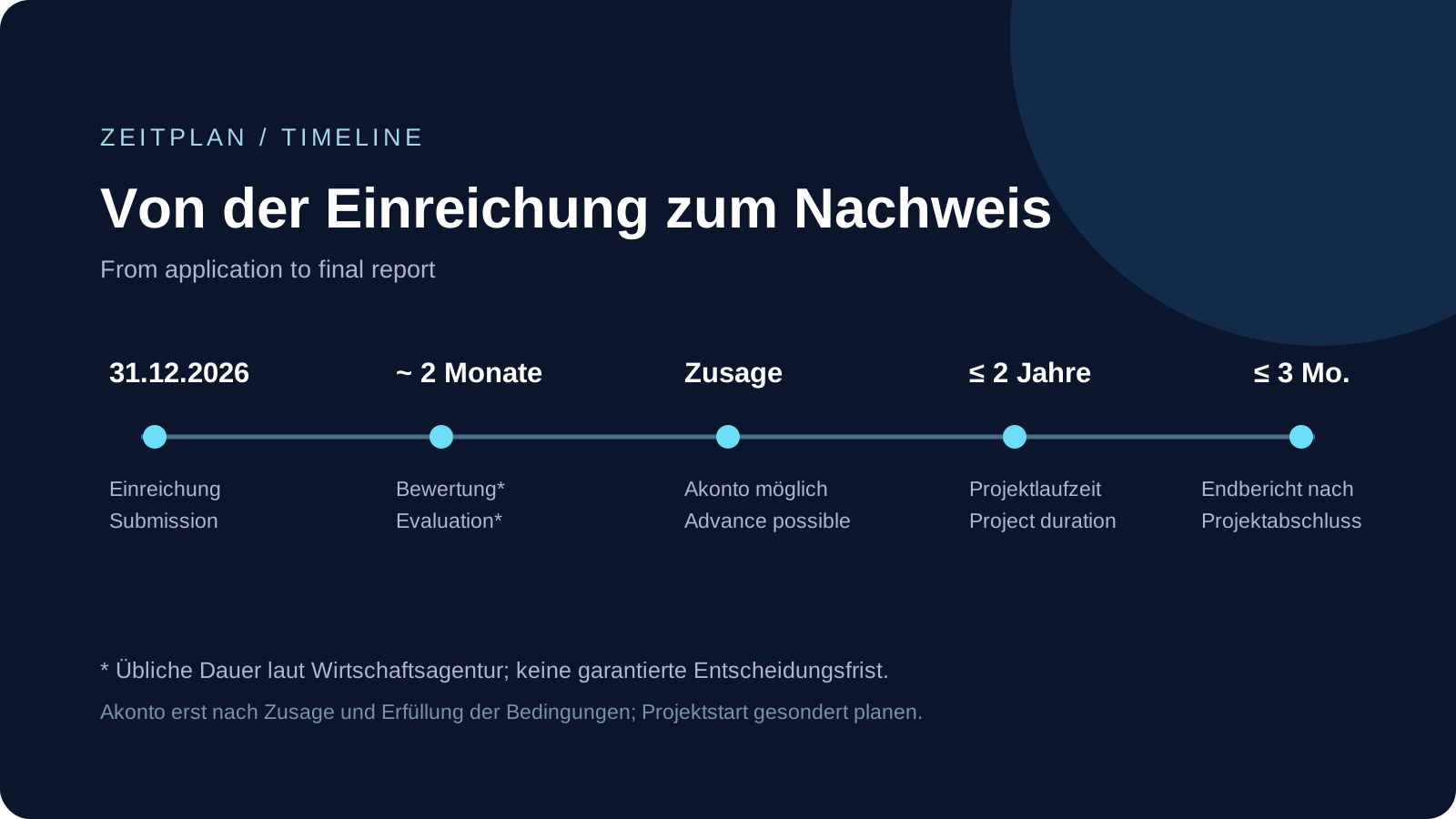
An advance of up to 50% of the approved grant is possible, not 50% of the project budget. The framework requires written approval, fulfilment of any conditions and evidence that the project has begun. If the approved grant were €15,000, the advance could be at most €7,500; timing and the actual amount require confirmation.
After completion the agency checks the final report and recognised actual expenses. It recalculates funding within the approval cap and deducts any advance. A negative balance must be repaid when requested. Keep invoices, proof of payment, deliverables, approved changes and decisions organised.
How to apply
- Define the project: Record the workflow, participants, current problem, intended state, work packages, dates and measurable outcomes.
- Check eligibility: Confirm Vienna establishment history, SME calculation including connected businesses, de minimis aid and financing for the whole project.
- Consult the agency: The Vienna Business Agency offers guidance on programme fit and open conditions. Contact details appear on the programme page.
- Prepare costs and documents: Gather latest annual accounts or income-and-expenditure statement, de minimis declaration, budget and quotations for cost items above €10,000 net. The online process generates the application confirmation.
- Submit online: Register in the funding cockpit, complete and submit the application, and record the date and completeness.
- Manage decision risk: The project must not start before application. Starting after submission but before approval is at the business’s financial risk. Submission confirmation is not a grant approval.
- Deliver and settle after approval: Follow any conditions and the approved cost period, keep evidence, and submit the final report and account promptly, no later than three months after project completion.
The maximum project duration is two years. The programme document permits extensions only in defined cases, such as certain objectively delayed purchases or documented care responsibilities of a small business’s project manager. Consult the agency before changing the project.
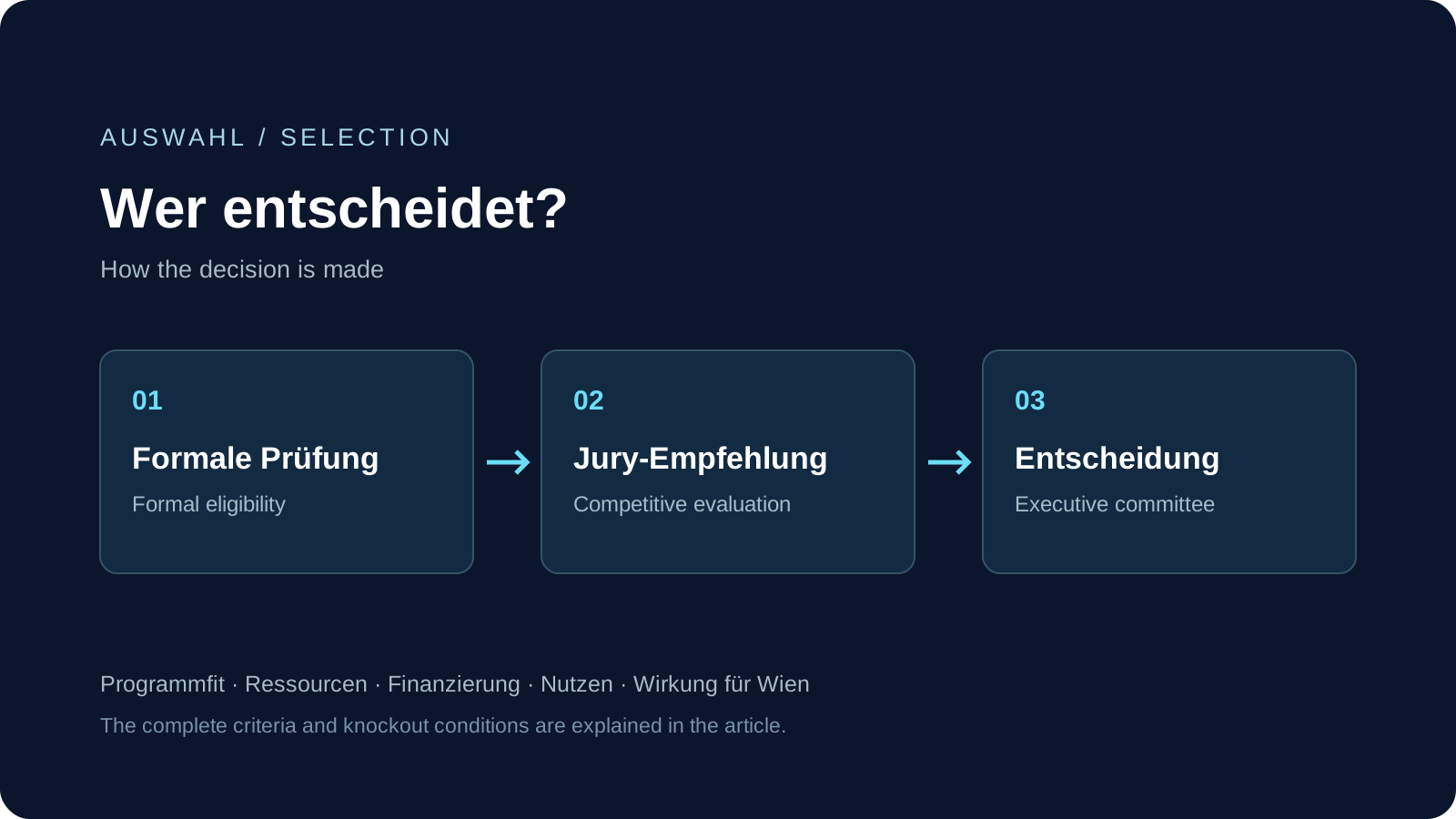
How does the agency decide?
First, the agency reviews formal conditions. Ineligible applications may be rejected; the framework permits a single opportunity to correct certain formal deficiencies under specified conditions. An independent jury then compares projects from the same quarter. Its recommendation goes to the agency’s executive committee, which approves or rejects the application. The applicant receives the result in writing. The agency says applicants usually hear within around two months; this is not a guaranteed decision deadline.
The official application questions and criteria set out ten indicators. The table translates them into preparation questions; it is not a separate scoring system.
| Criterion | What the application should explain | Official knockout threshold |
|---|---|---|
| Programme-specific requirements | Alignment with programme aims and whether funding changes project scope or speed | Zero points or less |
| Resources | Team, suppliers, infrastructure and ownership available to deliver | No |
| Finance | Credible financing for the whole project, including own funds | No |
| Feasibility and risk | Technical, organisational and legal risks and how they are addressed | No |
| Customer benefit | Real needs; process improvements may yield indirect benefit | Zero points or less |
| Economic effects | Expected effect on competitiveness and business structure | Zero points or less |
| Climate/environment, diversity, employment | Expected effects or justified neutrality | Normally −2; explicitly defined mandatory or desired focus themes can have stricter thresholds |
| Vienna location effects | Positive effect on Vienna and, where relevant, wider social value | Zero points or less |
The document uses a −2 to +3 scale for most scored indicators and 0 to +3 for programme-specific requirements. Positive scores do not guarantee selection. Do not invent environmental, employment or revenue benefits: describe the evidence, assumptions, uncertainty and any possible negative effects honestly.
How AppWebSeo can support the project
We help businesses turn a digital business problem into an actionable project scope. Depending on the agreed engagement, we can:
- Map processes and systems: Document the current workflow, participants, data flows, interfaces, risks and objectives.
- Plan the digitalisation project: Describe work packages, dependencies, technical architecture, a realistic effort estimate and acceptance criteria.
- Support application preparation: Prepare technical material, a scope of services and cost items for your application, and structure open questions with you. You apply to the agency in your own name.
- Implement agreed solutions: Build and test CRM/ERP integrations, internal workflows, customer portals or automation, and provide project documentation and evidence for your reporting.
Whether we accept a particular assignment and its price are agreed after reviewing the requirements. AppWebSeo is not the Vienna Business Agency and does not make funding decisions. We cannot guarantee selection, a particular rate or recognition of individual costs. Tax and legal questions and the binding funding assessment belong with the appropriate professionals and authority.
Discuss your digitalisation project
Tell us where you are starting. We will follow up about the project and how we can support its preparation and implementation.
This enquiry is sent to AppWebSeo, not the Vienna Business Agency. It is not a funding application or eligibility decision.
Free project planning template
Download the Vienna digitalisation funding project template without completing a form. It contains a fictional example and fields for the current process, objectives, scope, costs, financing, jury criteria, documents and evidence. It is a working aid, not the official application form.
Frequently asked questions
Can a website relaunch be funded?
The agency explicitly lists website creation or renewal and webshops as standalone measures that are not eligible. Ask the agency before applying whether any specific component of a broader process project can be recognised.
Can the project begin before the grant is approved?
The programme requires that the project does not begin before application. Starting after a complete submission but before the decision is at the applicant’s risk; eligible costs must arise after application and project start within the allowed cost period. Submission is not approval. Ask the agency about unclear preparatory work or existing orders before making further commitments.
What happens if fewer costs are recognised?
The grant is recalculated against recognised actual costs and the approved maximum. It may be lower, and an excessive advance may have to be repaid. Discuss a shortfall below the minimum basis and material project changes promptly with the funding body.
Can AppWebSeo guarantee an application succeeds?
No. We can support technical preparation and implementation within an agreed scope. The agency checks the application, the jury assesses it competitively and the competent body decides. The applicant is responsible for the submission and accuracy of company information.
Will the programme continue in 2027?
The programme period checked here ends on 31 December 2026. Check the agency’s current funding overview for new calls; continuation on the same terms has not been established.
Sources and maintenance
- Vienna Business Agency: Digitalisation Funding, facts and FAQ
- Funding cockpit: programme document, framework guidelines and assessment criteria
- Digitalisation programme document, 2024–2026
- Application questions and assessment criteria
- EU Regulation 2023/2831 on de minimis aid
Research and verification date: 27 October 2026. Programme rules and deadlines may change; check the current documents and consult the funding body before applying.